FOR THOSE LIKE GALILEO

Peniche Original

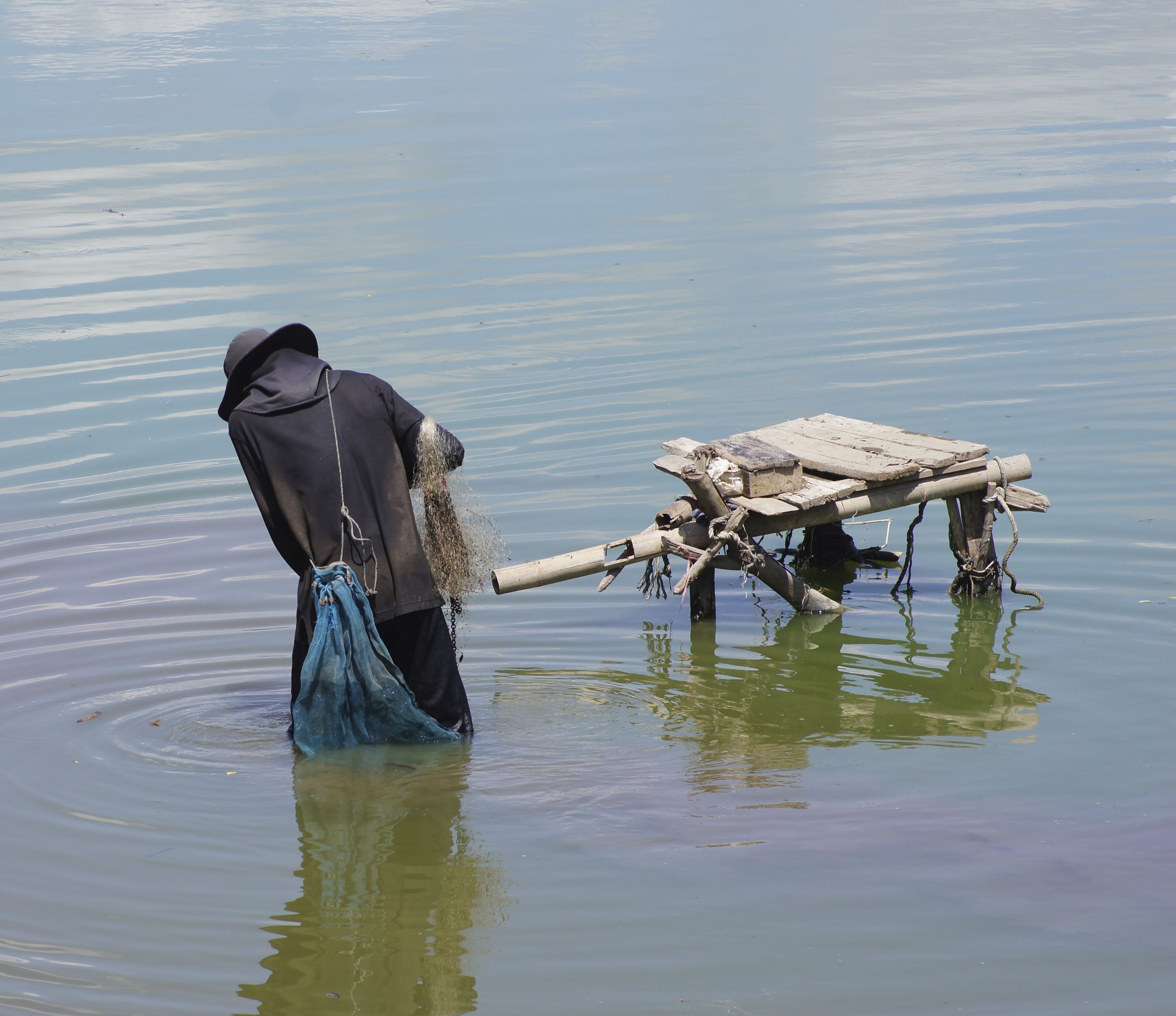
 A Péniche on the Canal de Bourgogne.
(Click to see the Other World better.)

……….
….from FOR THOSE LIKE GALILEO WHO NO LONGER READ
……………………………………………..Le Canal de Bourgogne

……………….So where are they now the poems
……………….For those who do no longer read
……………….But lose their way in words,
……………….Their overheated selves
……………….Closed down like God’s own
……………….Disowned fools in
……………….Damp, forgotten locks
……………….And other fasts and solitudes—
……………….Fisher kings, tall stilt-legged birds,
……………….The mist-wrapped walker with
……………….The busy dog and old felt hat—
……………….Mute, pre-dawn souls bewildered by
……………….The wash and roar of meanings when it’s all
……………….Gunnel-rubbing function transport
……………….Pumping huge breast-plates of
……………….Greased iron up and down
……………….A ruined cut?

……………………………from GALILEO’S SECRET: Two Decades of
……………………………….Poems under House Arrest.
…………………………………………..(unpublished fragment)

…………………………..………

To pass through the Tunnel click on the Stamp.

A personal Note:
The venerable industrial canal has provided much of the transport for heavy cargo in Europe right up to the present, yet few of us are familiar with the gates, cranks and levers, or understand the complex hydraulics of the dams and reservoirs that feed them. The 242kms Canal de Bourgogne, a truly sacred relic with its 189 shaded locks, ascends 400 meters vertically in the Burgundy region of central France and then descends to meet the Yonne and the Seine rivers and on down through Paris to Le Havre and the sea. An engineering masterpiece, the canal linked the Mediterranean with the English Channel and at the same time put the finishing touches on one of the most beautiful old-world landscapes in Europe. Much less known is the fact that it came to shelter a unique community of people who lived on boats, and whose identity was formed not by place or jurisdiction, but by how they worked apart and at the same time respected each other.

The Canal de Bourgogne is one of the places I have loved most in my long life away from home. I still rejoice in the thought of it but know it’s unlikely I shall ever visit it again as it’s no longer a place to work one’s way through, just to play around in, to pretend. For that reason I’m not really very interested in it anymore  — it was ‘working my way through it’ that so engaged me right from my first passage 50 years ago to the moment when it was closed to heavy traffic in the 1990s. “Se frayer un passage” (“to ‘force’ or ‘work’ one’s way through something, like a blacksmith ‘works’ wrought-iron) is what the French “bateliers” (‘barge people’) have always called working their huge 125ft steel barges through the complex system of wrought-iron gates, sluice valves, levers and ladders for days on end to wherever they happened to be going  — and it could be grand places too, Marseille,  Lyon, Paris — or anywhere in Holland, Belgium, Germany, indeed all the way from the Rhone to the Rhine and back again to humble St Jean de Losne on the Saône or Conflans-sur-Seine. And they did all that not only with 350 tons of sand, stone, coal or grain on board, but with the whole family — home was aboard and everybody was there all the time!

Alone and always pushing the limits, the bateliers are fiercely proud of who they are and what they do to this day, indeed as proud as the ‘Roma,’ Tinkers,’ or ‘Travelers’ in Ireland and the U.K. or the ‘Gitanes’ in France are proud, all unique people who work their way stealthily through long, hard, isolated lives on the back roads of modern life. Deracinated and forever on the move, they dedicate their lives to wrestling with the loss of so much that was once so kind and familiar, and to watching the world self-destruct on the high roads. And that’s heroic, isn’t it, even if it means you look down on everybody else? (I add that last while bowing, quietly, as a poet, out of sight myself.)
)…………………………………………C.W. (photo March 2nd, 2025)

.

……….A Batelier family photographed at home on a Sunday.

A sensitive reader who has been through a Galileo-like “house arrest,” and I think many of us have, will understand the extreme dislocation, the burden, the longing  and the loneliness he must have experienced. Even more importantly, such a person may have experienced the mysterious resolution at the end of the poem, of being as alone as that yet well and whole at last.

………………
CONTINUED IN  THE FOLLOWING DISCUSSION.

IN PURSUIT OF THE STILL UNWEIGHED: Off the Record at Eighty.

…………………
I am on the side of angels and of dirt.”
…Sir Stanley Spencer (1891-1959)

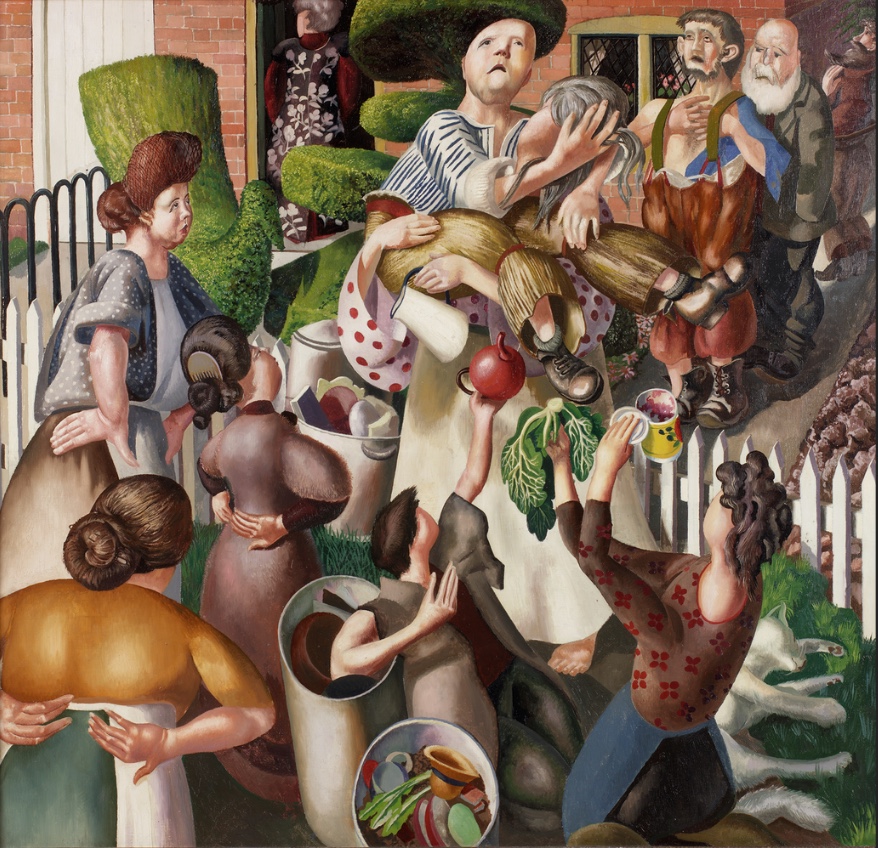
  The Lovers (The Dustman)  (1934)
Sir Stanley Spencer

A “dustman” in England is what Americans call a “garbageman,” and Stanley Spencer loved to see the “dustbins” set out every Tuesday morning in the streets of  his beloved Cookham. In  the painting he is himself a dustman with his trousers tied up tightly just below the knee — to prevent the vermin from climbing up inside them! Like a grown-up difficult child he is in the arms of his wife who is holding some left-over milk for him while he twists her thick grey hair in his fingers — which  he so loved to do! The other women are offering him bits of sacred garbage too: a broken teapot, some cabbage leaves, an empty jam tin…

The painting was submitted by the artist to the Royal Academy for the 1935 Summer Exhibition and was rejected. As a result, Stanley Spencer, already a revered painter at 45, resigned from the Academy.

[N.B. I have to show you the whole unpublished poem because the entire thread is about how  failure can also be a kind of forgiveness… (Oct. 17th, 2026 )


…………GRAVITY’S RAINBOW:
…………SUNDAY IN THE PARK WITH SIR STANLEY

………………..O rejoice in the women,
………………..And the white perfect ducks
………………..With their fashionable heads in the mud,
………………..How they tether themselves down
………………..With pegs in the ground
………………..So they won’t float up in the air,
………………..The feathery dry air that is brighter than gold
………………..But stays unredeemed on the shelf.

………………..For the ducks like the women
………………..Turn weight upside down
………………..By the water on Sunday to stay down,
………………..Not to be better, or up nearer the sun
………………..With the buskers, fine philharmonic
………………..Conductors, preachers, teachers,
………………..Invalids in chariots, toddlers and clowns —
………………..Ah those sweet little flippers that tickle the air,
………………..As pliant as play-dough or beeswax,
………………..Useless as paperweight slippers,
………………..Ballast for butterflies, barbells for kittens —
………………..Perfect as the lead in the magician’s tight furnace
………………..Or the sticky brown muck in God’s oven.

………………..“O the big wide basket of my body,”
………………..The duck woman cries,
………………..“O the piles of starched linen, the fillips,
………………..The white cotton aprons and tea-towels
………………..Folded so nicely in my trembling arms,
………………..Down on my knees by the pool!

………………..“Take this fine little turn-up,
………………..For example,” she says,
………………..“Do you see how it’s paddled and done?
………………..“The masterful curl at the end of the tail,
………………..How the bottom turns upward as if at a ball,
………………..The crinoline, the petticoats,
………………..The old-fashioned drawers that kick highest of all —
………………..And O how they flutter with each do-si-do,
………………..And how the heart goes — can’t you feel it?
………………..And aren’t it worth the applause?”

……………….. “Come on in then, come on in!”
………………..The duck-caller cries,
………………..And when she comes in on his arm
………………..To waddle like a lover on the velvety floor,
………………..Or soon to be mother,
………………..Which is very good too,
………………..How he dips by the water for a nod or a snooze
………………..Any day in the park, old poet by the pool —
………………..Takes his nap on a folding green chair and the paper,
………………..A moist royal nap amongst women,
………………..Head-over-heels in God’s pool.

…………………………Christopher Woodman
……………………………. from GALILEO’S SECRET: Two Decades of
……………………………..poems under House Arrest. [unpublished]”

NOTE: “Gravity’s Rainbow” from the very end of GALILEO’S SECRET, has in itself a considerable bibliography just waiting to be discovered by some ardent young academic a few years after Christopher Woodman’s death. “And the guy never got published,” the lucky student  may recount breathlessly to his friends over his latte at Starbucks, “so  nobody’s ever done him!”

“I can’t wait!” says Christopher.”

…………………THE DISCUSSION CONTINUES IN THE COMMENTS

HOW BAD IS THE DEVIL?

Mantegna 466

At the very end of his life, Andrea Mantegna inscribed the answer to the question on the tree in this delicate cameo-painting of Delilah snipping away at Samson’s hair — as if the fountain next to the tree weren’t clarification enough.

If it’s hard to read the words on the tree, you can click on the tree itself to read them more easily — and if that’s still not enough you can click yet again on the bigger picture. Then it’s a piece of cake — that is, the riddle’s a piece of cake, not the beautiful, dignified, introspective young woman trimming the hair of her grizzled, old, pumped-up and psyched-out lover, the act that reduces all men to the divine fools they are destined to be. Because the Divine Fool is the true message of the Samson story, it seems to me, that is if you read the details of the story very carefully — or, alternatively, if you carefully and exhaustively read your own life, or even read me if you know where to look — which is why I am writing what follows, to find out.

I’m going to leave some space on that now, for reflection.

[ADDED A WEEK LATER]

My reflections on Mantegna’s dictum, foemina diabolo tribus assibus est mala peior, are developed day by day in the Comments below, and if you are interested in such things I hope you will be able to read them with as much hope for an answer as I posted them. On the other hand, if you’re impatient you can skip ahead to a specific discussion of HOW BAD IS THE DEVIL IN THE END.  But fasten your seat belts as you scroll down, because jumping ahead is going to make for a very fast ride!

And those of you who start at the beginning, be warned as well: the discussion that follows thrives on hair-pins and other sticky corners, and very often paints itself into untenable places as well — I do hope you’ll be charitable and forgive me for all the dead-ends. I’m an Old Father William, and all I can tell you is that this is how it goes. Indeed, that’s part of the riddle of knowing where you are in the space you inhabit, and it doesn’t much matter whether it’s on earth, in space, buried in your own person or in some other idea or dimension, or perhaps even suited up in a New Age space-vehicle transitting infinity to arrive where you actually are, like in Carl Sagan’s Contact.

Wrapped up in your own cocoon like Eve, in other words, even if you’re a man and not yet ready to be that beautiful, powerful, and fey. Or a snake with your own tail in your mouth like Satan in the Garden of Eden — indeed, you may even be impatient enough to want to go straight to the discussion for men and women who are no longer inhabitants of the Garden of Eden but would like to know what really happened back then.

……….1.) CLICK HERE TO START AT THE BEGINNING OF THE END.

Or if, like most of my friends, you’re more interested in my own demise as a soi-disant angel and poet yet again you can begin at that end:

……….2.) CLICK HERE FOR THE END OF WHAT WAS ACHIEVED IN
………………..THIS THREAD
.

And finally, if you don’t want to begin at any end but just keep on fooling around like Old Father William:

……….3.) CLICK ON THE END OF HIS NOSE TO SEE HOW
………………..EVERYTHING GOES
.

Christopher Woodman,
Chiang Mai, March 3rd, 2016
….

THIS THREAD IS CONTINUED IN THE COMMENTS THAT FOLLOW.


SAVAGE BEAUTY (do I dare? do I dare?)

Huay Tung (Brian) Naam Tok Dtaat Mook — a hidden waterfall on the Huay Tung. Over 300 feet high, Dtaat Mook is rarely visited by ordinary people, encircled as it is by the dark rituals that protect the jungle. My intrepid friend, Brian Hayden, photographed three odd fires beside the track as we made our way up the mountain, all three of which contained the charred remains of broken bamboo poles tightly wrapped in saffron robes and bound with plastic string. Click about and see what you can see —  if you dare, if you dare.

………………………

Huay Tung Hex (small)

………………………
………THE COMMENTS THAT FOLLOW DEVELOP THE THREAD

CLICK THRICE, THEN LET ME KNOW

…“I want poems that don’t tell secrets but are full of them.”
………………………………………………………………………….Stanley Kunitz

SONY DSC
………photos by Brigitte Garnier

..So what do people do?
..Is what they do who they are?
..Click twice on each, then let me know.
………………………….Christopher

..
………THE COMMENTS THAT FOLLOW DEVELOP THE THREAD

ONE FOR SORROW, TWO FOR JOY

Piero de la Farncesca 475 Piero della Francesca, Nativity (1475)(click on it to see the birds better)

……………………………………………..~

……………………..POST HOC, PROPTER ERGO HOC

………………………..“Two magpies,” she wrote him
………………………………….on shore again in February.

………………………..He propped them up above
………………………………….the herb jars in the galley

………………………..All that winter while she
………………………………….traveled overland in Africa—

………………………..Others hung there too, almost
………………………………….a dozen as the days lengthened

………………………..And the bright green shoots
………………………………….shone like spring in porthole pots.

………………………..He lay more naked in his letters then
………………………………….but the light-sick moths powdered

……………………….His thighs, made his eyes
………………………………….dapple and water as if he missed her.

………………………..Then she wrote again about
………………………………….small birds that migrate pole to pole

………………………..And told him he really ought
………………………………….to have more Arctic dreams.

………………………..It was then he began to notice
…………………………………the way the sheets twisted oh so

………………………..Tight like water-wings about him.
………………………………….He wrote her twice to Porto Ferraio

………………………..But the letters came back
………………………………….to an empty berth and bits

………………………..Of white silk on the bulwarks
………………………………….as if he’d undressed or cracked

………………………..In the terrible rush of the hatch—
………………………………….the brightness of a sheltered reach

………………………..Perhaps, the ease with which
………………………………….mayflies rise on the silvery stream.

…………………………………………………..~

This is a very small poem in a very small style, indeed as bare and simple as a Piero della Francesca painting, and as dependent on faith. That means your faith, the faith you have in yourself, the viewer, not in Jesus or Mary or anything like that but just in how much faith you are able to bring to whatever you see without rhyme or reason, like that tiny little bird on the left, or the big one on the stable roof for that matter, which is unmistakably a magpie. How still can you rest as you view two birds like that, for example, how long can you hold your gaze without blinking, without starting all over again to define what you see in relation to who you are, where you stand, what you expect, and what you know about me? Can you do that? Can you rest in uncertainties when you don’t even know who a poem is by or what it’s getting at? Can you trust yourself, in other words, and not just rush in to either explain it away, or appropriately file it ditto?

Or what if a friend sent you this poem because he or she wanted you to have it. Would you hold back the joy or the sorrow?

………THE COMMENTS THAT FOLLOW DEVELOP THE THREAD

TEA BREAK BY THE FORGE

The forge is a hot and noisy place—but it has it’s quiet moments too, and even that blast of red hot flame pumped up by the bellows can quiet down and brew a nice pot of tea.

DSCN3871 - Inle Lake Forge

The events leading up to Galileo’s house arrest were full of such hot air too as the modern world was in the forge, so to speak, and the hammer blows were hard.

But now we can stop and use another sort of hammer, like delicate compost that flakes in your hands like spring snow to lift up your plants and make them flower. Think about that — let those hammer blows flower like that kettle on the fire.

There was a huge amount of hot air generated in the Vatican in the decade leading up to Galileo’s censure in 1615. But it’s very important to remember how complex the riddle was. Galileo understood very well the Curia’s position, as the records show, and tried his best to explain why placing the sun at the center of a Copernican “solar system” could be reconciled with a theocentric, Ptolemaic interpretation of the same phenomena. And I think almost certainly the Church leaders understood both sides of the argument as well, though its pastoral obligations led the Curia to assert that it was a simple either/or issue which had to be decided on the basis of Authority, not Science. For that was the primary function of the Church, and still is — to serve the struggling Faithful by defending their Faith with Theology.

The paradoxes of life are unthinkable to the majority of people who are, like me, better at imagining perfection than at observing facts. On the other hand, gifted souls have always understood that as human beings we have intellectual as well as sense-based faculties, and I feel sure that primitive people had a much deeper understanding of the human condition than we give them credit for. I mean, do you think the naked little Good-fella didn’t understand and use the power of the intellect to thrive with so little for 30,000 years in the harsh Australian desert, or the Bushman in the equally harsh Kalahari? Or the Inuit on the ice? the Aztec or the Navajo? Do you think they weren’t intelligent or inspired enough to understand who they were and how to look after themselves for such a long time and in such a positive way?

I have none of those gifts myself — my eyes are blind to what I feel sure they saw, and some still see, indeed my intellectual powers are dwarfed by comparison with theirs. That’s why I turn to them, for a deeper understanding of my own isolation and poverty. And of course I turn to anyone whose words I can read too, or whose paintings I can look at, or costumes, or drama, or dreams even — for a glimpse that would make me, like Wordsworth, less forlorn. And of course I turn to great misunderstood scientists too to understand my own misunderstanding, and wasn’t Galileo Galilei the greatest and the most gratuitously misunderstood of them all?

When at last the Church rehabilitated Galileo over 300 years later, Pope John Paul II called it “a tragic mutual incomprehension,” which indeed it was — the pie has two halves but at the time everybody ended up with just half, and that’s all most of us are left with too, needless to say. On the other hand, I feel sure there have always been human beings who were able to reconcile the mind-boggling contradictions of the whole pie of life, like the fact that, despite all appearances and ‘proofs’ to the contrary, the soul exists in many places at once, in the theocentric mind for a start, then in the heliocentric body, and then everywhere, and of course, most certainly and most mysteriously of all, nowhere. Even more importantly, such human beings have always understood that such realms were a.) not separate and b.) non-existent in the sense that we experience the soul nowhere but in our own largely wishful, self-centered thinking. And I feel our understanding of all that is dwindling, that our modern minds are ever more conditioned by the demands of our well-serviced, well-exercised and well-medicated bodies. Indeed, we’ve got to the point now where we can only think like our bodies work, i.e. with minds fastened like railway bogies to our underbodies, strictly in one mode and strictly zapping down hi-speed rails. And as a poet I would say that the alternative to that way of thinking isn’t old-fashioned Mysticism or Theosophy either, what is more New Age fantasies about Purity, Spiritual Energy and Past Lives, etc. — which are all self-serving and equally materialistic. As a poet I’d say that wherever the soul is has got to be nowhere like that, indeed I’d say it’s got to be much closer to that no place where God lies stone dead.

Which is precisely how the language I’m looking for does it, and why such words are more important today than they have been ever before. It’s all we’ve got left yet we’ve only just started using the word in our times as a tool like a hex, jinx or spell.

One other inkling. In my experience, what might be called wise people have never been much interested in the idea of an individual soul what is more eternal life or personal salvation. It would be so selfish for one thing, to be alone with oneself like that for so long. And who would deserve it for another? Even a saint would surely have doubts about that, indeed, above all a saint.

By definition, Wisdom is associated with coming to terms with the paradox of birth as a brief prelude to death on the one hand, and life as the sole immortality on the other. Wisdom knows there is nothing in religious dogma but approximations and carrots, that in reality everything’s just nothing, and that nevertheless that nothing’s love. Yes, love, an embarrassing little Hallmark platitude of a word like that, yet still it creeps in if you’re Wise. On the other hand, to say it better or more truthfully requires that hardest of all things to be, a fool.

Like Emily Dickinson on the subject, and who could ever say it better than this?

……

…………….The Soul selects her own Society–
…………….Then–shuts the Door–
…………….To her divine Majority–
…………….Present no more–

…………….Unmoved–she notes the Chariots–pausing–
…………….At her low Gate–
…………….Unmoved–an Emperor be kneeling
…………….Upon her mat–

…………….I’ve known her–from an ample nation–
…………….Choose One–
…………….Then–close the Valves of her attention–
…………….Like Stone–
……………………………………………………..Emily Dickinson (1862)

……

And does she mean Samuel Bowles? Does she mean Judge Lord? Does she mean sex?

Yes, I think so. That too. Because I think she knew herself both as a woman and as this painting by the Latvian painter, Normunds Braslins, in gold leaf and egg tempera:
……
Normunds Braslins - Girl Large ………………………………….Normunds Braslins, Riga, Latvia (1962- )
……

So that’s it, everybody. Of course this thread was from the start exploratory and still isn’t sure what it’s trying to say, though it might have this morning, Monday, March 17th, 2014.

That’s because much to my amazement I found myself yesterday face to face with a prostrate figure on top of a mountain, and if any Sunday moment wants to capture the whereabouts of the soul I think it’s going to have to be shaped, contoured and colored something like that.………………………..
……………………..

I’ll try to get to that again when I can, but it’s not easy.

Christopher Woodman

………THE COMMENTS THAT FOLLOW DEVELOP THE THREAD

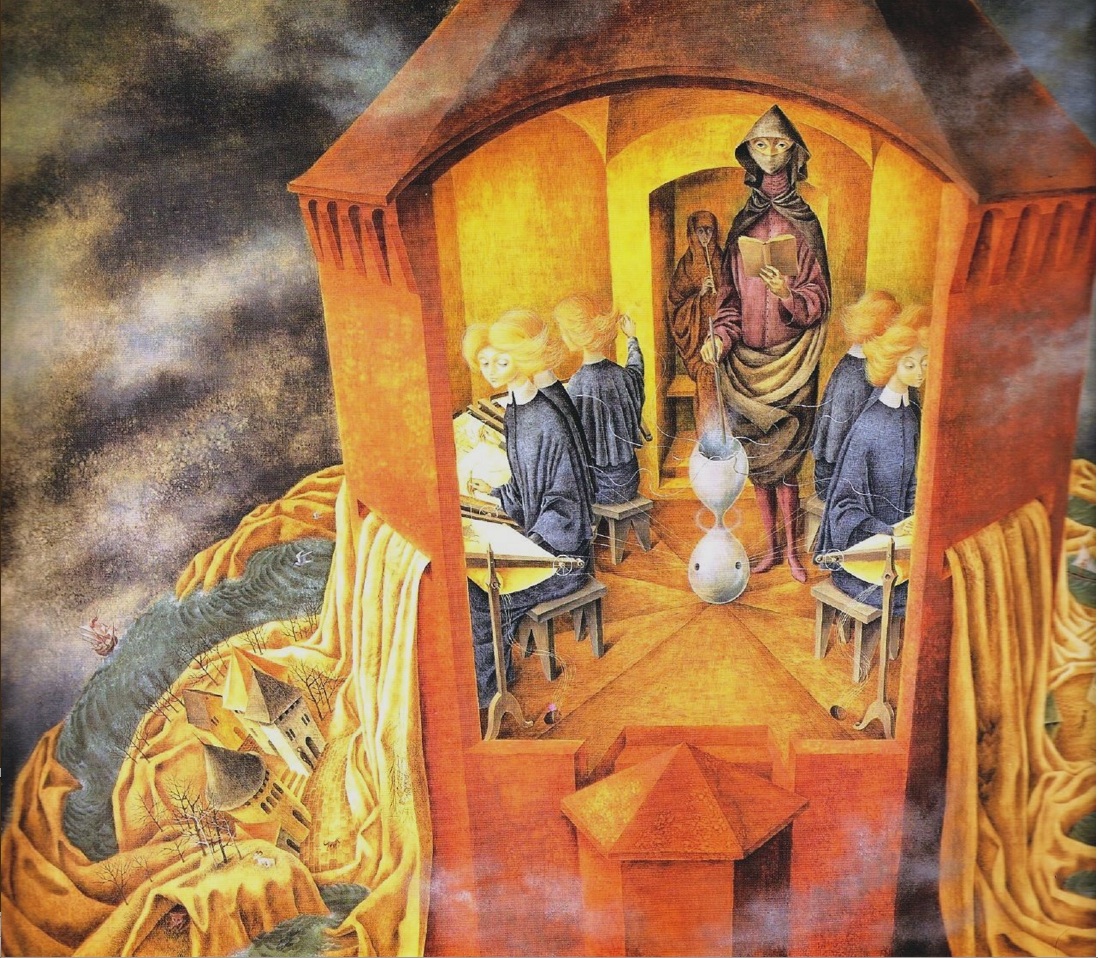
BORDANDO el MANTO TERRESTRE by Remedios Varo

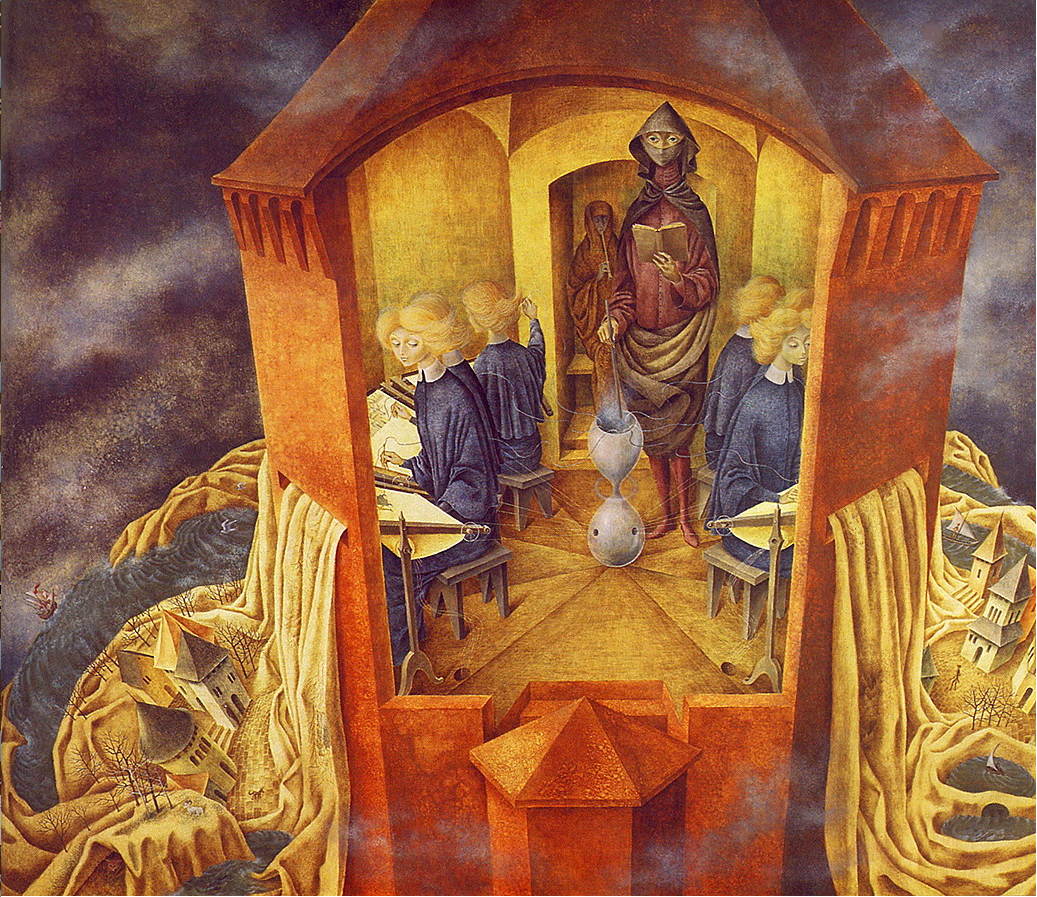
Remedios Varo“Bordando el Manto Terrestre” [ Embroidering the Earth’s Mantle ] (1961) by Remedios Varo.

The Cowpattyhammer management apologizes for having closed “Make It New!” so abruptly.

One of the casualties was that we never got a chance to look at this painting by the Spanish-Mexican painter and anarchist, Remedios Varo. The title means “Embroidering the Earth’s Mantle,” and the imagery is probably the closest we got to the “secret” that was such an important part of the discussion. My own feeling is that with the exception of the sculpture of the tall Aborigine woman and her daughter that introduced the previous thread, this extraordinary painting was probably the most relevant.

You can click here to look at the painting in more detail. Once you have moved in, the definition of the graphic is quite high so you can zoom in as much as you like. Indeed, I’d be very interested to hear what you see.

In addition, if there are any matters arising from the previous thread do feel free to comment below — the management is very grateful to the increasing numbers of people who visited the site in the last weeks of the discussion, and would be very pleased to have more feedback.

Christopher Woodman

………THE COMMENTS THAT FOLLOW DEVELOP THE THREAD

MAKE IT NEW!

MAKE IT NEW!

 Aborigine Woman

Many thanks to AUSTRAVELPHOTOGRAPHY for the photo. 

People have always felt the world was going down the tubes — from “hey, look at her!” to “ubi sunt,” indeed long before anybody ever thought to make it new!

One of the cultures I most admire is that of the indigenous people of Australia. What culture has ever produced greater artists, richer myths, or more healing images? Yet when they lost their past, all 30,000 years of it, it took just a few decades to bankrupt them entirely, economically, culturally, emotionally and spiritually. On the other hand, the tragedy was caused as much by our culture’s inability to cope with change as it was with theirs. They couldn’t deal with us any more than we could deal with them, a heart-breaking impasse for everybody involved right to the end, and still with us.

Two observations on “Make It New” with regard to the gifts of these extraordinary people.

The Australian aborigines were always in a sense  “contemporary” — they were “cartoon” artists, after all, and every image and artifact they made was “pop” in the sense that everybody was a fan, everybody loved it, read it and danced to it. Secondly, their culture didn’t change — for whatever reason they were locked in a time-warp, as we might say looking out into space, and as a result nothing ever became “dated” what is more “old fashioned” for them. “Make it new?” Why everything was new already!

I make these observations very much without blame — Jared Diamond’s Guns, Germs and Steel combined with James C. Scott’s The Art of NOT Being Governed confirmed what I had always suspected, that the Australian aborigines’ lack of ‘development’ had nothing whatever to do with inferior genes, hands or minds. On the other hand, they didn’t “change” at all in our sense — but that’s not quite the same as I have come to understand the word in Buddhist terms. The Buddha insisted over and over again that denying change was as self-destructive as any form of greed, control or domination. Anicca, or “impermanence” as it’s usually translated when the sutras are rendered into English, is the only certainty in life, says the Buddha, and holding on to things as if they weren’t going to change is the root of all suffering. That’s the fundamental Buddhist teaching, in fact, that Change and the inevitable Suffering that arises out of it are the fundamental truths of all being

What’s really different about our times, it seems to me, is what is happening to time itself — the speed of change, as if we were already strapped in the rocket that will deliver us from our dwindling planet into the arms of space.

Try this to put our own sense of time into perspective:

I never even heard of television until I was 8 and didn’t live with a set until I was 42! Even more astonishing, I learned all my maths and physics without a calculator, sailed all over the world without a GPS or other electronic aid, and didn’t touch a computer keyboard until I was 52, the same age at which I published my first poem. And if that last one doesn’t put the word “dated” into perspective for a poet in America, what does?

But we’ll come back to that.

I just want to add that I’m not a Buddhist, whatever that might mean, and feel very strongly that in the light of Eternity there are other “universal truths” beside CHANGE and SUFFERING. Indeed, one of the reasons the aborigines are so important to me is that they tell me more than any other people I have ever encountered about who I really am — particularly as I look in the mirror on my birthday, not a pretty sight at all at 74. But then the old wizened aborigine that looks back at me over my shoulder tells me that nothing that really matters is ever outdated. Change is nothing in the light of eternity, he tells me — and I don’t mean by that Heaven or Eternal Life, God forbid, or indeed anything my new-age friends in white call ‘Spiritual.’ I mean eternity in the sense that I believe Einstein imagined it, or Stephen Hawking in his space-age body, our own little naked good-fella in Cambridge, who grappled with the dreaming that is  Cern. Or what surely must have occupied the mind of Galileo Galilei during those 8 years under house arrest in Florence or me here at my tiny speck of a desk in Chiang Mai.

Do you think when the first white man arrived in Australia an aboriginal would have had a problem showing him a God-particle? Had the white man been able to ask, that is? Had he had the intelligence or expertise to navigate that sort of thinking?

d of course, had the good-fella been willing to betray such truths by sharing them with such a big, crude, ignorant stranger?

Christopher Woodman

………THE COMMENTS THAT FOLLOW DEVELOP THE THREAD

THE MYSTERY OF BARABAR & THE MARABAR CAVES

“Having seen one such cave, having seen three, four, fourteen, twenty-four, the visitor returns…uncertain whether he has had an interesting experience or a dull experience or any experience at all. He finds it difficult to discuss the caves, or to keep them apart in his mind…”……………………………………E. M. Forster, A Passage to India

Click on the cave to expand it, and give thanks to Tim Makins for his beautiful and informative site. This particular cave is called ‘Vadathika’ and is at Barabar north of Gaya in Bihar State, one of four carved in granite at the behest of the great Buddhist Emperor Asoka (269-232 B.C.).

……………..what are they?

………….who goes into them?

……….what comes out of them?

“… An entrance was necessary, so mankind made one.

“…But elsewhere, deeper in the granite, are there certain chambers that have no entrances? Chambers never unsealed since the arrival of the gods? Local report declares that these exceed in number those that can be visited, as the dead exceed the living – four hundred of them, four thousand or million. Nothing is inside them, they were sealed up before the creation of pestilence or treasure; if mankind grew curious and excavated, nothing, nothing would be added to the sum of good or evil. One of them is rumoured within the boulder that swings on the summit of the highest of the hills; a bubble-shaped cave that has neither ceiling nor floor, and mirrors its own darkness in every direction infinitely. If the boulder falls and smashes, the cave will smash too – empty as an Easter egg. The boulder because of its hollowness sways in the wind, and even moves when a crow perches upon it; hence its name and the name of its stupendous pedestal: the Kawa Dol.”
………………………………………………………….E. M. Forster, A Passage to India

……“If the doors of perception were cleansed everything would appear to man
…….as it is, infinite.  For man has closed himself up till he sees all things thro’ 
…….narrow chinks of his cavern.”.
.
…………….                            …
William Blake, The Marriage of Heaven and Hell

My mind enters here, William Blake’s ‘Sconfitta,’ among many other dark cavern-like places — including the cave in A Passage to India, of course, and still asking not just about Adela and Dr Aziz but about Morgan. For this was in fact E.M.Forster’s last novel, as hard as that may be to believe. 1924.

In 1964 I was a Research Student at King’s College and he sat at the High Table every evening. Everyone called him just “Morgan,” and I wondered at his smallness, availability and shyness. Or 1965, maybe, or 1966? — I was so troubled with entrances, with drugs, sex, music, speed as in over the ground, and children, lots of them, and of course Leavis, Lewis, Yehudi Menuhin playing all six Solo Sonatas and Partitas in King’s College Chapel, visions in Fiesole in August and nightmares in the orchard at Grantchester in October, Beatles-live the same evening at a cinema on Regent St. with the locals — no, I don’t remember when. And even more important, my first entrances elsewhere and beyond, as troubling as any Marabar Cave and as easy to get into yet hard to get out of in one piece.

So what happens anyway?

Christopher Woodman

………THE COMMENTS THAT FOLLOW DEVELOP THE THREAD

KIM, KIPLING & KAMAKURA

“He lived a life as wild as that of the Arabian Nights, but
missionaries and secretaries of charitable societies could
not see the beauty of it.” ………..

Each of the first three chapters of Kim (1901-2) is introduced by a stanza from Kipling’s poem, “The Buddha at Kamakura,” which he wrote after a visit to Japan in 1892. It’s by no means his best poem, but it’s certainly one of the most detailed and challenging ones he ever wrote on the subject of East and West from a religious point of view. Needless to say, the poem must have interested Kipling a lot for him to have selected stanzas from it for such a crucial introduction.

And they’re not easy ones either, so Kipling must have wanted readers to spend some time figuring out what they meant. Most importantly, they’re not about exotic adventure in India, or even about India, for that matter, but rather move toward the quieter, deeper, more universal themes in Kim, many of which would be new to readers even today.

Kamakura is the 44 foot high, 800 year old bronze Amitaba Buddha near Tokyo so much loved by the people of Japan — ‘Amitaba’ is  the Japanese Buddha of love, a ‘Savior Buddha,’ really, and closely related in his origins to the female goddess Kwan Im in China. Kipling makes sure the reader knows it is precisely this Buddha and this place he is referring to by introducing Chapter I with the phrase, “And there is a Japanese idol at Kamakura“–  and of course the word “idol” was intended to provoke a negative response. The verses, on the other hand, succeed in doing just the opposite — which, I would argue, is precisely why they are there.…………………………………

………………………………..Kim,  Chapter I:
………………………..O ye who tread the Narrow Way
………………………..By  Tophet -flare to Judgment Day,
………………………. To Buddha at Kamakura!

…………………………………Kim,  Chapter II:
…………………………And whoso will, from Pride released,
…………………………Contemning neither creed nor priest,
…………………………May feel the Soul of all the East
…………………………About him at Kamakura.

…………………………………Kim,  Chapter III:
…………………………Yea, voice of every Soul that clung
…………………………To life that strove from rung to rung
…………………………When Devadatta’s rule was young,
…………………………The warm wind brings Kamakura.

The first stanza tries to soften Christian distaste for other religions by appealing to the warm atmosphere at Kamakura.  Both “Tophet-flare” and “Judgement Day” are harsh Biblical allusions that contrast strongly with the gentle peace embodied in the place, Kamakura, and of course in the last line of every stanza in the poem. Chapter Two’s stanza, on the other hand,  praises Western, non-orthodox free-thinkers who take pride in their open-mindedness to “other creeds” (this is the age of “Spritualism,” don’t forget, Theosophy, Anthroposophy, and there were big personalities involved  in those movements too, needless to say).  The appeal to these two, diametrically opposed groups of people at the beginning of the novel shows the degree to which Kipling’s own heart was engaged in quite a different spriritual dimension in Kim.

The third introductory stanza is much more ambiguous. Devadatta was a very close disciple of the Buddha who actually rejected the Master’s “Middle Way,” preferring to stay behind in the old elitist spiritual life as an ascetic in the forest. Devadatta did not join the Buddha in his later, more gentle, holistic phase, and there is even a legend that he tried to kill the Buddha to prevent him from attaining Enlightenment. The stanza seems to suggest that whoever such people are, they are conservative and therefore unwilling, or not yet ready, in any case,  to move on. They belong to an earlier world order.

In fact, Kipling did not include this 3rd stanza in the full version of “The Buddha at Kamakura,” which he first published in 1892 in an article in the Times called “The Edge of the East,” an article specifically about Japan. The poem as a whole was eventually added to the collection called The Five Nations in 1903,  two years after the publication of Kim. In that version he included the following, much easier, more straightforward stanza, part of which is also quoted in the body of the first chapter of Kim, so we’re in the same place:

………………………..Yea, every tale Ananda heard,
………………………..Of birth as fish or beast or bird,
………………………..While yet in lives the Master stirred,
………………………..The warm wind brings Kamakura.

Ananda was the closest friend of the Buddha, if one would dare to say that about the Buddha, implying as it does some attachment on his part as well. In any case, this stanza would seem to celebrate the supportive presence of the Buddha in the pre-conscious mind,  so to speak, i.e. in those beings who have not yet had the chance to experience life as a fully conscious human being.

This is mainly just a hunch, but my feeling is that Kipling was addressing in both these last two stanzas the vast majority of Westerners, busy people too set in their ways to understand Eastern spiritual practices in their hearts. He seems to be saying that with a little help they could still come to respect and even be inspired by devotion like that shown to Amitaba Buddha at Kamakura, which has certainly proven to be true in our times.

The overall message in the introductory stanzas is one of love and respect for all people who worship out of the heart, whatever their creed or the form of their worship. It is indeed a blessing to find yourself among such devoted people, the poem says, so “be gentle” and respect them. “Feel the Soul of all the East
,” open yourselves up to “the warm wind of Kamakura.”

An extraordinary message for 1892, or anytime!

Christopher Woodman

…………………………………………… “Kamakura
Great Buddha, with an enlarged detail of a man standing on the hands.”
……………….Photo published in Brinkley’s Japan, a Guide Book (ca. 1890).
………………………..The Buddha at Kamakura
…………………“And there is a Japanese idol at Kamakura”

………………………..O ye who tread the Narrow Way
………………………..By Tophet -flare to Judgment Day,
………………………..Be gentle when the ‘heathen’ pray
………………………..To Buddha at Kamakura!

………………………..To him the Way, the Law, apart,
………………………..Whom Maya held beneath her heart,
………………………..Ananda’s Lord, the Bodhisat,
………………………..The Buddha of Kamakura.

………………………. For though he neither burns nor sees,
………………………..Nor hears ye thank your Deities,
………………………..Ye have not sinned with such as these,
………………………..His children at Kamakura.

………………………..Yet spare us still the Western joke
………………………..When joss-sticks turn to scented smoke
………………………..The little sins of little folk
………………………..That worship at Kamakura.

………………………..The grey-robed, gay-sashed butterflies
………………………..That flit beneath the Master’s eyes.
………………………..He is beyond the Mysteries
………………………..But loves them at Kamakura.

………………………..And whoso will, from Pride released,
………………………..Contemning neither creed nor priest,
………………………..May feel the Soul of all the East
………………………..About him at Kamakura.

………………………..Yea, every tale Ananda heard,
………………………..Of birth as fish or beast or bird,
………………………..While yet in lives the Master stirred,
………………………..The warm wind brings Kamakura.

………………………..Till drowsy eyelids seem to see
………………………..A-flower ‘neath her golden htee
………………………..The Shwe-Dagon flare easterly
………………………..From Burmah to Kamakura,

………………………..And down the loaded air there comes
………………………..The thunder of Thibetan drums,
………………………..And droned — “Om mane padme hums ” —
………………………..A world’s-width from Kamakura.

………………………..Yet Brahmans rule Benares still,
………………………..Buddh-Gaya’s ruins pit the hill,
………………………..And beef-fed zealots threaten ill
………………………..To Buddha and Kamakura.

………………………..A tourist-show, a legend told,
………………………..A rusting bulk of bronze and gold,
………………………..So much, and scarce so much, ye hold
………………………..The meaning of Kamakura?

………………………..But when the morning prayer is prayed,
………………………..Think, ere ye pass to strife and trade,
………………………..Is God in human image made
………………………..No nearer than Kamakura?

………………………………………………………Rudyard Kipling, 1892

………THE COMMENTS THAT FOLLOW DEVELOP THE THREAD

An Obituary for W.F.Kammann: OUR SEVEREST CRITIC & BEST FRIEND.

.

…….The Temple Boy Who’s Not There

………………O, Flatbush Bill’s
………………the Steinway grand
………………of soup and barrel organs—
………………never short on time or change
………………he’s like a man made man
………………on his toes all the time,
………………a flyweight cockerel
………………stretching out the limits of each night
………………like a massive tenor in full flight
………………or temple gong so boozed
………………and tendrilled mothers
………………light their morning fires by the
………………rumble, cooking in the dark for several lives
………………of hungry monks and temple brats
………………just to share the merit—
………………whereas none of them can hold
………………a candle to our bowlful Bill’s
………………Brooklyn breadth
………………………………………..and warble.

………………So when the monks at Wat Phra Singh
………………offered him the post of Temple Boy
………………I wrote this poem
………………so they would know what
………………not to expect
………………or how to rise, or even bow,
…………………………………………………before him!

………………Yes, he’s better west, this Mister Bill—
………………the east’s too trim for so much
………………common sense and willingness to volunteer
………………or even rest
…………………………………at full stretch.

………………Coast, I’d say, choir master fiend
………………and rabble rouser—
…………………….homeless husband,
………………………………bubble buster,
………………saffron cockney on a Buddha barrow,
………………mighty long-armed-dharma duster-upper!

………………Damn, I say, let him
………………rest upon his lusty laurel laughter—
………………toast, and share it!

…………………………….from Fig Leaf Sutras: A Memoir in Poems
………………………………………………………
(unpublished).

Note on the title: “Who’s Not There” is a play on the word “Tathãgata” — “The Once-Born.” That’s how we talked together, Bill and I — ‘Koan chat’ — he pulling up the  ladder behind him in his Patzcuaro retreat,  me in Chiang Mai.


I met Bill for the first time in Carroll Gardens, Brooklyn, 40 years ago — I was teaching at the Brooklyn Polytechnic Preparatory School in Bayridge at the time.  Bill himself was born in Flatbush but raised  in Upper New York State, which he loved just as much as The City: the big river, the forests, the myths and legends. And he was equally over-educated, of course.  A natural musician, he spent 7 years at the  famous Mozarteum in Salzburg, Austria — and in due course became, as you might have predicted, the director of one of the largest shelters for the Homeless in the Five Boroughs. A dedicated Buddhist, he was at the same time both a charismatic Choirmaster and a leading member of the NY Tibet Center. In the second half of his life he devoted himself to Tibetan Studies, Meditation, Bird Watching, and eventually Cowpattyhammering.

One of the original Scarriet/Harriet survivors, Bill Kammann was the author of Cowpattyhammer’s all-time most popular thread, Pop Goes the Weasel with its 127 Mozartean comments, i.e. that brilliant yet scurrilous! He was also the co-author of the ground-breaking threads, Kim, Kipling and Kakamura and The Mystery of Barabar and the Maramar Caves — they kept us occupied for many months each. And

What more could one say?

For the last decade of his life Bill lived in a beautiful house overlooking Patzcuaro in Mexico, and is survived by his mid-wife wife, Becky Hamilton, and their diver-son, Matthew Kammann. In 2014 the latter became a very important contributor to Cowpattyhammer disguised as an Intergalactic Visitor called ‘Omino 23.’ I learned a great deal from Omino 23 but never knew who he was until much later. Indeed, Matthew had first arrived on my doorstep in Chiang Mai way back in September 2001 — we watched the Twin Towers come down together on my very first television set.

Can you imagine?

For what it was like for the three of us, Bill, Matthew and myself, you might visit Click Thrice, Then Let Me Know (May 28th, 2014). You can start with ‘Omino 23’ at his clearest and most generous in Comment 9 and go straight on to Bill’s beautiful translation of Rilke’s “Der Panther” at the very end. Indeed, the brief  juxtaposition there  is the whole Cowpattyhammer kit-and-kaboodle in a nutshell, isn’t it — I mean, the four feet of the panther my friend trotting behind?

Pure koan schtick!!!

In Southeast Asia the Buddhist faithful, mainly mothers, get up very early to cook special meals for the monks who file through their villages barefoot at 6am on their daily alms round, and that’s what my Obituary for Bill is about too. The women fill the bowls and then kneel down for a blessing. No word is spoken during the whole exchange, and nobody serves what is more is served.

Some thought Bill was a bit cavalier not to notice what was being given sometimes, sometimes even a bit mean — like the monks not seeming to notice either. But by those who knew Bill well he is sorely missed just as he was, indeed irreplaceable.

A Great Soul has departed.

…………………C. W. (Chiang Mai, 12/12/2024)

…………………


……..+………+………+………+………+………+………+………+………+………+………+………+………+………+………+………

The present Post, An Obituary for Bill, is one of the last 2010 Threads. If you want to get back to the earlier, often more topical 2010 threads, you should enter the site with the URL: https://cowpattyhammer.wordpress.com and then scroll back toward September 2009 where it all began (scroll, don’t just click, as there is a lot to get through). And don’t forget to click on “Older Entries” at the end of each section — that will take you right on to the end.

Of course you can also click on the small ARCHIVES window at the bottom  of the left hand Index and scroll down to the very earliest posts by Date. The Categories window just below that can direct you even more specifically.

Alternatively you can now move on to the next thread, THE ADORATION OF ANYTHING YOU THINK YOU OWN IS FIRE!


POEMS THAT HAVE SPOKEN TO US IN THE PAST

The Christos Acheiropoietos or ‘Christ-not-made-by-hand’, a much revered 12th century Russian Orthodox icon, celebrates the miracle in which Jesus healed King Abgar of Edessa by sending him an image of his face imprinted on a piece of linen cloth. Such an icon is said to have been “written” by the word of God, not painted by a person.

Poems that have spoken to us in the past have, like friends, the absolute right to our special attention in the present.

Our doors are always open to them, so to speak, and because such poems have already proved their trustworthiness, the critical small-talk can be skipped over. They’re let straight into our most intimate spaces, they’re sat down to supper and even have the right to stay all night if they wish.

However much of an historical accident the elevation of  “In A Station of the Metro” or “The Red Wheelbarrow” might have been, they have now become close friends to most contemporary poets and readers. A poem that reaches this level doesn’t have to prove anything any more. It simply is.

Which is true of many older works of sacred art, of course, like the Willendorf Venus (28,000 BC), the Lady of Warka (3100 BC), and Our Lady of Guadalupe (1531). Closer to home, nursery rhymes, Saturday Evening Post covers, and relics from our childhood altars, or those of our grandparents, Irish, Tamil, Armenian or Hmong, such artifacts are permanently numinous. However kitschy they might have been at the start they have achieved the status of  “antiques” — even if they were just five-and-dime store knick-knacks to begin with. They’ve been rubbed all over with the wax of human love, familiarity and coherence, and as a result have a sheen deeper than intention, or skill, or even what they might, or might not, have meant, or mean. Indeed, like all great religious ‘icons,’ they mean without meaning, and can speak and weep through the humblest paste and cardboard.

~

Scrabbling around in the trunk at the foot of my bed, I discovered the following poem. It illustrates beautifully what I mean because it got placed there during a period in my life when I was down on my knees most of the time. At this point I’ve lost all connection to the religious content of the poem, I’m afraid,  yet still it speaks to me with utter conviction, sincerity and passion — indeed, as I feel it must have spoken to Simone Weil, “Love” having been among her favorite poems as well.

Look at “Love” through Simone Weil’s eyes and I think you’ll see what I mean when I say that certain poems like friends are hors de contest.

Christopher Woodman

.


.…………………………………………..LOVE

………………….Love bade me welome; yet my soul drew back,
……………………..Guilty of dust and sin.
………………….But quick-eyed Love, observing me grow slack
……………………….From my first entrance in,
………………….Drew nearer to me, sweetly questioning
………………………..If I lack’d anything.

………………….“A guest,” I answer’d, “worthy to be here:”
……………………… Love said, “you shall be he.”
…………………“I, the unkind, ungrateful? Ah, my dear,
………………………..I cannot look on Thee.”
………………….Love took me by my hand and smiling did reply,
……………………….“Who made the eyes but I?”

…………………“Truth, Lord; but I have marr’d them: let my shame
……………………….Go where it doth deserve.”
…………………“And know you not,” says Love, “Who bore the blame?”
………………………“My dear, then I will serve.”
…………………“You must sit down,” says Love, “and taste my meat.”
……………….. …….So I did sit and eat.

…………………………………………………………………………George Herbert

.

The Pushcart Nomination for Unpoet goes to Scarriet’s Christopher Woodman

Though the Orwellian Poetry Foundation’s Blog: Harriet banned Scarriet’s Christopher Woodman, that hasn’t stopped him.   His poem “”He Mistakes Her Kingdom for a Horse” appears in this Fall’s  The Beloit Poetry Journal, and was nominated by them for a Pushcart Prize.

C & H MarketAlso forthcoming is Christopher’s “The Frangipani Tree,” a poem about his lovely wife, Homprang.  It will appear in the Fall Issue of The Atlanta Review —  it’s the same poem Martin Earl praised on Harriet just one month before Christopher was made “unperson” by the staff.

So here at Scarriet, you might wonder: does censorship work?  Does banning prevent dangerous poets from speaking the truth in verse?  Christopher theorized that his poems got taken because he’s got name recognition from Scarriet and Foetry, but I don’t believe that for a moment.  He writes great poetry and has persistence.  He does this despite thousands of miles and despite Harriet.

And I’m so happy to be able to congratulate him.

–Alan Cordle