…………………
I am on the side of angels and of dirt.”
…Sir Stanley Spencer (1891-1959)
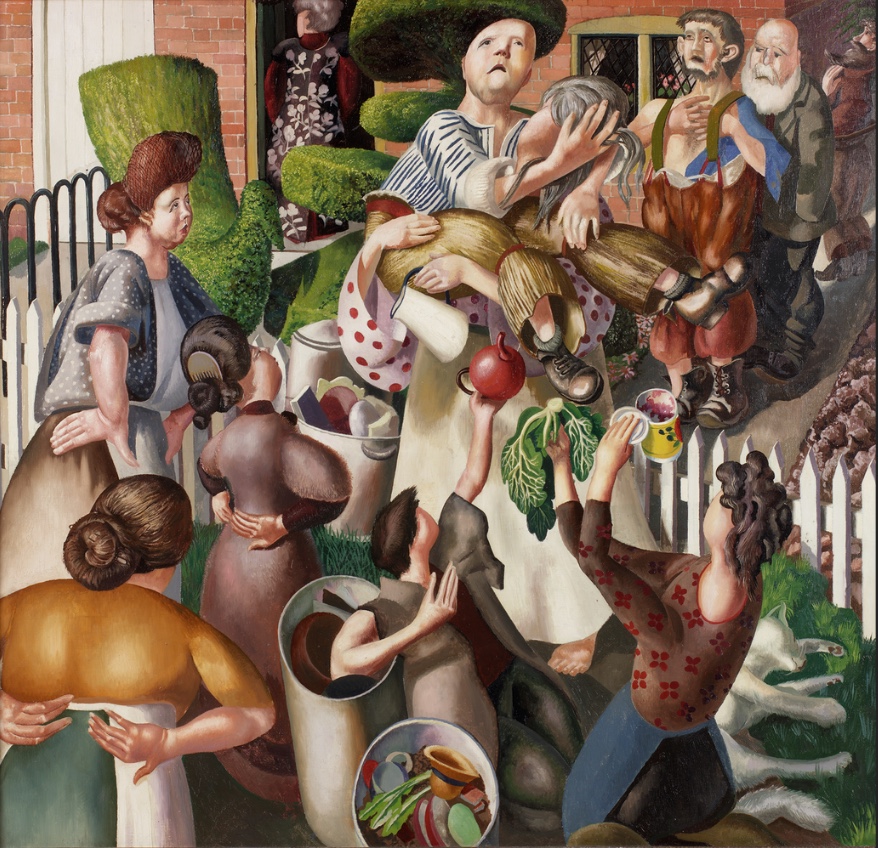
 The Lovers (The Dustman) (1934)
Sir Stanley Spencer
A “dustman” in England is what Americans call a “garbageman,” and Stanley Spencer loved to see the “dustbins” set out every Tuesday morning in the streets of his beloved Cookham. In the painting he is himself a dustman with his trousers tied up tightly just below the knee — to prevent the vermin from climbing up inside them! Like a grown-up difficult child he is in the arms of his wife who is holding some left-over milk for him while he twists her thick grey hair in his fingers — which he so loved to do! The other women are offering him bits of sacred garbage too: a broken teapot, some cabbage leaves, an empty jam tin…
The painting was submitted by the artist to the Royal Academy for the 1935 Summer Exhibition and was rejected. As a result, Stanley Spencer, already a revered painter at 45, resigned from the Academy.
[N.B. I have to show you the whole unpublished poem because the entire thread is about how failure can also be a kind of forgiveness… (Oct. 17th, 2026 )
…………GRAVITY’S RAINBOW:
…………SUNDAY IN THE PARK WITH SIR STANLEY
………………..O rejoice in the women,
………………..And the white perfect ducks
………………..With their fashionable heads in the mud,
………………..How they tether themselves down
………………..With pegs in the ground
………………..So they won’t float up in the air,
………………..The feathery dry air that is brighter than gold
………………..But stays unredeemed on the shelf.………………..For the ducks like the women
………………..Turn weight upside down
………………..By the water on Sunday to stay down,
………………..Not to be better, or up nearer the sun
………………..With the buskers, fine philharmonic
………………..Conductors, preachers, teachers,
………………..Invalids in chariots, toddlers and clowns —
………………..Ah those sweet little flippers that tickle the air,
………………..As pliant as play-dough or beeswax,
………………..Useless as paperweight slippers,
………………..Ballast for butterflies, barbells for kittens —
………………..Perfect as the lead in the magician’s tight furnace
………………..Or the sticky brown muck in God’s oven.………………..“O the big wide basket of my body,”
………………..The duck woman cries,
………………..“O the piles of starched linen, the fillips,
………………..The white cotton aprons and tea-towels
………………..Folded so nicely in my trembling arms,
………………..Down on my knees by the pool!………………..“Take this fine little turn-up,
………………..For example,” she says,
………………..“Do you see how it’s paddled and done?
………………..“The masterful curl at the end of the tail,
………………..How the bottom turns upward as if at a ball,
………………..The crinoline, the petticoats,
………………..The old-fashioned drawers that kick highest of all —
………………..And O how they flutter with each do-si-do,
………………..And how the heart goes — can’t you feel it?
………………..And aren’t it worth the applause?”……………….. “Come on in then, come on in!”
………………..The duck-caller cries,
………………..And when she comes in on his arm
………………..To waddle like a lover on the velvety floor,
………………..Or soon to be mother,
………………..Which is very good too,
………………..How he dips by the water for a nod or a snooze
………………..Any day in the park, old poet by the pool —
………………..Takes his nap on a folding green chair and the paper,
………………..A moist royal nap amongst women,
………………..Head-over-heels in God’s pool.…………………………Christopher Woodman
……………………………. from GALILEO’S SECRET: Two Decades of
……………………………..poems under House Arrest. [unpublished]”
NOTE: “Gravity’s Rainbow” from the very end of GALILEO’S SECRET, has in itself a considerable bibliography just waiting to be discovered by some ardent young academic a few years after Christopher Woodman’s death. “And the guy never got published,” the lucky student may recount breathlessly to his friends over his latte at Starbucks, “so nobody’s ever done him!”
“I can’t wait!” says Christopher.”
…………………THE DISCUSSION CONTINUES IN THE COMMENTS

 The stone cross in question was erected as a memorial to a much loved daughter who died on the rocks below on August 7th, 1845 — its inscription reads simply, À MA FILLE/ 7 AOUT/ 1845. Over time the local people have realized that this solitary, wind-swept cross has come to have a life of its own, and that it’s power resides in the mysterious phrase, “la-croix-ma-fille.” Indeed, this tragic stone cross has become a sort of magical ‘hex’ or ‘totem’ for the Le Croisic community, a ‘spirit house’ one might even call it (‘hôtel’ in French also means ‘altar’ when translated into English). Whatever, the local people know that what they now call La-Croix-Ma-Fille can reach out to their storm-bound loved ones as they struggle to stay off the terrible rocks below, that in the darkest moments its power guides and protects them like a lighthouse or an angel, and brings them safely home to the hearth in one piece.