FIG LEAF SUTRAS: at the Roots of the Tree.


updated September 14th, 2025

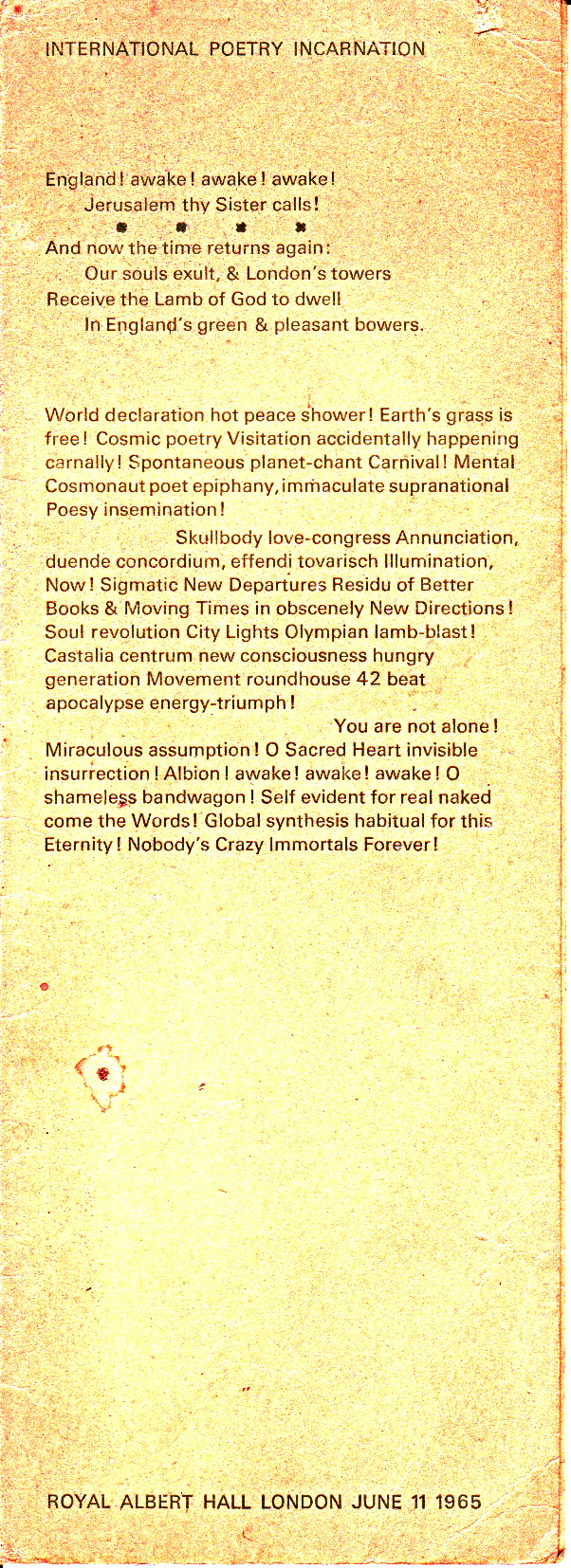
At an important moment in my life, Jerome Rothenberg and his Technicians of the Sacred: A Range of Poetries from Africa, America, Asia, Europe and Oceania appeared on the scene, helping me to understand how much poetry meant to me personally as opposed to what I was doing with it as a flamboyant  25 year old graduate student in Renaissance Studies at Cambridge. It was 1965, the  year of the International Poetry Incarnation at the Royal Albert Hall in London, and everything in the world was loosening up just then. European students were getting themselves ready to come out on the streets of Paris in just 3 more years, and the Tibetans, having escaped over the Himalayas in just 1959, were busy learning English and French and, of course, how to talk to people — which they had never done before in our sense. And there was lots going on in America too, needless to say — that’s why some were here!

The International Poetry Incarnation was the moment when the ‘Beats’ descended on London to put Modern American Poetry on the map, as the British critic, Eric Mottram, put it — ‘on the mat’ would better describe what I saw at the time. (You can CLICK HERE to read more about the event including who was there and what they did.) And this certainly fired me up, indeed I’m not sure I ever cooled down what is more got my feet back on the ground. An odd metaphor because although it’s true, my subsequent life as a father, teacher, builder, gardener and blue-water sailor defined me more as a worker than as a dreamer. And I don’t particularly value feet-on-the-ground anyway, unless they’re naturally bare, of course —  like  ‘good-fella’ feet, I mean, and would you say they were on the ground?

What I liked about Jerome Rothenberg was his way of chanting, winging it, voicing his own verbal rituals and transliterations, and of course his Native American and Oceanic tapes which he played at the Polytechnic of Central London. That was one of the new Technical Colleges springing up all over the U.K. with the very first ‘Modern Poetry’ departments in Europe. I myself wasn’t yet involved in ‘creative writing’ and wouldn’t take it up seriously for another 25 years — I taught poetry but I didn’t write it. Indeed, years before I started writing it I moved up to Scotland with a Himalayan refugee who badly needed shelter. That was the Lama Chögyam Trungpa, of course, almost 30 by then and already astonishingly articulate, in English! But he was also in a very vulnerable position as he was paralyzed on one side and drinking heavily plus downing whatever was handed to him by his adoring disciples — they just drifted into Garwald like ghosts with their bottles and bags. And it was in this milieu that I helped Trungpa ‘invent’ his own way of ‘writing’ Modern American Poetry long before I began to write poetry myself — you can GO HERE AGAIN & SCROLL DOWN for a glimpse of how that ‘transliteration’ worked. Needless to say, my household in Scotland fell apart very rapidly, and I had to go deeper and deeper into the woods as well as way, way out to sea, literally as well as figuratively, indeed to get so lost I could only start all over again — which is the subject of the latter (chronologically earlier) parts of FIG LEAF SUTRAS: A Memoir in Poems: 1994-2024 (unpublished).……[To see better you can click on the Bo Tree above — at home in Chiang Mai.]

~…………….~…………….~…………….~

There’s an aspect to all this that I rarely talk about but need to, it’s so near the roots of my ‘Fig Leaf Trajectories.’ So forgive me if I go back a bit and tell my story all over again on another level.

I came to King’s College, Cambridge, from Yale in 1962 as a 23 year old Kellett Fellow  — my thesis topic had already been approved by C.S.Lewis and, after Lewis’ death, was supervised by the distinguished Cambridge Professor of English and WWII Singapore survivor, G.G.Hough, whose life experience had led him to many of the same interests as my own including Edmund Spenser and C.G.Jung. With the latter’s trust and encouragement, my unfinished thesis won a Research Fellowship in 1965, one of the highest honors at Cambridge at the time, and my academic future seemed assured. But I was impatient, on fire almost, and to make a long and foolish story very short, I resigned my Fellowship at Christ’s College, sold my beautiful windmill, and went off to Scotland with my young family by the one hand and my new friend Trungpa by the other. I became a Trustee of the new Samye-Ling Tibetan Centre in Eskdalemuir and at the same time renovated a huge pile of stone called ‘Garwald House’ — to put Trungpa & entourage in (we the family lived in the servants’ quarters). I also took a job teaching the teenage children of Scottish shepherds and mill-workers nothing they wanted to learn — Langholm Academy, 18 miles down the road, the closest job I could find and certainly the most difficult I ever had. (I tried for months not to use ‘the Belt,’ and I failed — from the students’ point of view, of course, they won. And that was also Hugh MacDiarmid’s school!)

But there was one more life-changing twist to this transition. Just before I left Cambridge, the formidable Shakespearean scholar and Mistress of Girton College, M.C.Bradbrook, was charged with the task of examining me and my 400pps thesis orally, which she certainly did. “Too psychological,” she implied — too “Jungian,” “too Buddhist for an English dissertation” quite specifically — indeed, during my ‘Viva’ in her rooms at Girton we talked mainly about my relationship with the Lama Trungpa. (“Why?” was her question over and over again. “How could you?”) And to make a short story even shorter, Polyphonic Narrative in Elizabethan Literature exited with the traditional “M.Litt (Cantab.)” —  a grand-sounding degree, certainly, but not the shiny new “PhD” my thesis was registered for, and that I would have very much needed had I gone home to continue the same sort of work in the States.

The disaster sent more than ripples through the graduate student community at Cambridge — everybody else felt their own necks must surely be on the block if mine was. But I was already way up in the hills of Dumfriesshire by the time I heard the news, many miles from the nearest shop by a one track road with sheep lying all over it. And I never went back to Cambridge — which I probably should have, but that’s where I was and still am, never going back anywhere. And today I’m even a bit proud of myself for not having challenged the decision — and I’m sure both the English Faculty and my advisor, Professor Hough, must have been very relieved indeed that I just moved on.

At this point I want to say that I harbor no hard feelings toward M.C.Bradbrook, indeed I think her decision was actually helpful to me as I could never have become the sort of literary scholar the degree was supposed to prepare me for. And I did moon the establishment, which was certainly how my behavior felt to Muriel Bradbrook. Cambridge at the time was a ‘scientific’ university which didn’t teach ‘Modern Poetry’ as an academic subject at all, just Chaucer, Milton, and Wordsworth along with assumptions about Classical Languages and Prosody. Of course there were active poets in Cambridge, many of them, but at Cambridge that’s what you did with your life, not what you ‘read!’ At Cambridge you gossiped about contemporary poets in your ‘rooms’ like T.R.Henn did about W.B.Yeats in his, for example (I was there — crowded, fascinating!), but you didn’t ‘study’ them! And yes, in many ways I still sympathize with that position, and am very glad I was there and not somewhere else.

The fact is that I just didn’t fit in, at least with the establishment I didn’t. But for me Cambridge was the most wonderful place to be just as I was and as it was — not fitting-in was just what I needed. Of course Cambridge has always been one of the great Thinking Places of the world, and I still get fired up just thinking about the profound scholarship combined with quotidian genius-folly of Christopher Smart in the 18th Century, for example, what is more about Samuel Taylor Coleridge in the 19th (he quit twice!) or Ludwig Wittgenstein in the 20th (say no more!). In my own time E.M.Forster ate at the high table at King’s every evening, Thom Gunn was still a phantom presence, and F.R.Leavis talked about everything you’re not supposed to.

In some ways I was over-the-top too, of course I was, but I know I was also appreciated for my energy, resourcefulness, and courage — I was often asked to head this or that, for example, local community-boards, societies. But I was also considered disrespectful by some, a little dangerous even, and I was certainly not the only one who got dished. Any day, rain or shine, you could see what appeared to be a tramp on an old bicycle with a torn gown, disheveled hair, and wild, wild eyes with his basket stuffed with books and his paper-bag lunch. He often talked informally while eating his lunch in a drafty courtyard at Downing College with anyone interested, and there were many outliers there beside me. Because that was F.R.Leavis himself, one of the greatest 20th Century English Literary Critics, still there and still on fire in words not just about D.H.Lawrence but about “Tom” (T.S. Eliot) as well. In many ways his renegade status as an Engaged Critic suited him even better than a Chair would have. He felt good in his own skin like that — more an outcast Prophet than a Professor.      ………………………… [Photo: Stefan Collini on F.R.Leavis, TLS, Sept. 2000]

Another inspiration at the time was the newly arrived polyglot American, George Steiner. He was even more threatening as he ‘read’ not just ‘English’ but all the European languages (‘read’ is what you did at Cambridge as no Lectures or Course Work were required for a graduate degree at the time). George Steiner was not invited to become a University Lecturer — but don’t worry, he lectured still but unofficially, with people sitting in the aisles and on the window sills, just to get an ear in! Although he was Senior Tutor at the new Churchill College (I ‘tutored’ his undergraduates in Shakespeare), his association with me made the C.U. Faculty of English worry even more about what they were going to do with Christopher Woodman. And I solved that for them by just doing it myself, absconding with the Tibetans!

I just want to add that it’s a mystery to me why I was so good at Literary Criticism in the first place, and why I won all those prizes. Because I wasn’t cut out to be an Academic — Polyphonic Narrative in Elizabethan Literature was beautiful scholarship but at the same time a touchy-feely pot-boiler just waiting to be satirized by Vladimir Nabokov. For I was as much into Jerome Rothenberg as Edmund Spenser, and most of all bringing up children, building the most beautiful tree-houses in the world for them and then steadfastly sailing away with everybody on board. Indeed, after ‘going down’ from Cambridge in 1969 I eventually became the person you see in the photo. It’s 1980, I think, in the Windward Islands somewhere, possibly even  Jean Rhys’ Dominica, and I’m all of 40 already — another decade to go before I would write the first (i.e. last) poem in this book just below.

All I know that’s important is laid out in FIG LEAF SUTRAS — “the radiant cruelty of what is,” as James Agee put it in Let Us Now Praise Famous Men (cited on the title page). The book moves backwards in time, starting as it does in Chiang Mai and reversing its way through three decades of basements, boats, broken hearts, temples, revelations and scribblings to where I am now, just Lung Kip. That’s what I’m called here in Chiang Mai, “the old guy who is older than your father.”

James Agee was dead at 45 — this book is about what there is to add after you’re 70.

Trust in water
words white
and buoyant like
an iron hospice bed
and do not fear
to live or hope
beyond the soft
morning light
or soft voices
of the children
in the park.

These are the very last words in FIG LEAF SUTRAS: A Memoir in Poems, 1995-2025, though chronologically they are the youngest. They first began to compose themselves very near the beginning in a basement in Carroll Gardens, Brooklyn (“basement” is a recurring image in the book). The fact that FIG LEAF SUTRAS is a young man’s book written by a much older man may be one of it’s most positive characteristics — that such poetry can mature even as fresh wine does in an aging dark cellar.

Like blessings, Christopher

…………….

.


.……..+………+………+………+………+………+………+…….


[There are no ‘Major Threads’ devoted to my 3rd book,  FIG LEAF SUTRAS, as the poems for it were collected after I stopped writing-about-writing in this Blog. In a sense it is itself about writing-about-writing from beginning to end, which is why this Preface is so autobiographical.

[If you haven’t yet seen it you should have a look at THE HARD PART FIRST which digs a bit more deeply around the Roots of the Tree in the present  thread.]

[You can also go on to the 2nd Preface, On Living with GALILEO’S SECRET, or choose another Thread from the ***MAJOR THREADS*** listed in the left hand margin.]


FOR THOSE LIKE GALILEO

Peniche Original

 A Péniche on the Canal de Bourgogne.
(Click to see the Other World better.)

……….
….from FOR THOSE LIKE GALILEO WHO NO LONGER READ
……………………………………………..Le Canal de Bourgogne

……………….So where are they now the poems
……………….For those who do no longer read
……………….But lose their way in words,
……………….Their overheated selves
……………….Closed down like God’s own
……………….Disowned fools in
……………….Damp, forgotten locks
……………….And other fasts and solitudes—
……………….Fisher kings, tall stilt-legged birds,
……………….The mist-wrapped walker with
……………….The busy dog and old felt hat—
……………….Mute, pre-dawn souls bewildered by
……………….The wash and roar of meanings when it’s all
……………….Gunnel-rubbing function transport
……………….Pumping huge breast-plates of
……………….Greased iron up and down
……………….A ruined cut?

……………………………from GALILEO’S SECRET: Two Decades of
……………………………….Poems under House Arrest.
…………………………………………..(unpublished fragment)

…………………………..………

To pass through the Tunnel click on the Stamp.

A personal Note:
The venerable industrial canal has provided much of the transport for heavy cargo in Europe right up to the present, yet few of us are familiar with the gates, cranks and levers, or understand the complex hydraulics of the dams and reservoirs that feed them. The 242kms Canal de Bourgogne, a truly sacred relic with its 189 shaded locks, ascends 400 meters vertically in the Burgundy region of central France and then descends to meet the Yonne and the Seine rivers and on down through Paris to Le Havre and the sea. An engineering masterpiece, the canal linked the Mediterranean with the English Channel and at the same time put the finishing touches on one of the most beautiful old-world landscapes in Europe. Much less known is the fact that it came to shelter a unique community of people who lived on boats, and whose identity was formed not by place or jurisdiction, but by how they worked apart and at the same time respected each other.

The Canal de Bourgogne is one of the places I have loved most in my long life away from home. I still rejoice in the thought of it but know it’s unlikely I shall ever visit it again as it’s no longer a place to work one’s way through, just to play around in, to pretend. For that reason I’m not really very interested in it anymore  — it was ‘working my way through it’ that so engaged me right from my first passage 50 years ago to the moment when it was closed to heavy traffic in the 1990s. “Se frayer un passage” (“to ‘force’ or ‘work’ one’s way through something, like a blacksmith ‘works’ wrought-iron) is what the French “bateliers” (‘barge people’) have always called working their huge 125ft steel barges through the complex system of wrought-iron gates, sluice valves, levers and ladders for days on end to wherever they happened to be going  — and it could be grand places too, Marseille,  Lyon, Paris — or anywhere in Holland, Belgium, Germany, indeed all the way from the Rhone to the Rhine and back again to humble St Jean de Losne on the Saône or Conflans-sur-Seine. And they did all that not only with 350 tons of sand, stone, coal or grain on board, but with the whole family — home was aboard and everybody was there all the time!

Alone and always pushing the limits, the bateliers are fiercely proud of who they are and what they do to this day, indeed as proud as the ‘Roma,’ Tinkers,’ or ‘Travelers’ in Ireland and the U.K. or the ‘Gitanes’ in France are proud, all unique people who work their way stealthily through long, hard, isolated lives on the back roads of modern life. Deracinated and forever on the move, they dedicate their lives to wrestling with the loss of so much that was once so kind and familiar, and to watching the world self-destruct on the high roads. And that’s heroic, isn’t it, even if it means you look down on everybody else? (I add that last while bowing, quietly, as a poet, out of sight myself.)
)…………………………………………C.W. (photo March 2nd, 2025)

.

……….A Batelier family photographed at home on a Sunday.

A sensitive reader who has been through a Galileo-like “house arrest,” and I think many of us have, will understand the extreme dislocation, the burden, the longing  and the loneliness he must have experienced. Even more importantly, such a person may have experienced the mysterious resolution at the end of the poem, of being as alone as that yet well and whole at last.

………………
CONTINUED IN  THE FOLLOWING DISCUSSION.

MAKE IT NEW!

 Aborigine Woman

Many thanks to AUSTRAVELPHOTOGRAPHY for the photo. 

People have always felt the world was going down the tubes — from “hey, look at her!” to “ubi sunt,” indeed long before anybody ever thought to make it new!

One of the cultures I most admire is that of the indigenous people of Australia. What culture has ever produced greater artists, richer myths, or more healing images? Yet when they lost their past, all 30,000 years of it, it took just a few decades to bankrupt them entirely, economically, culturally, emotionally and spiritually. On the other hand, the tragedy was caused as much by our culture’s inability to cope with change as it was with theirs. They couldn’t deal with us any more than we could deal with them, a heart-breaking impasse for everybody involved right to the end, and still with us.

Two observations on “Make It New” with regard to the gifts of these extraordinary people.

The Australian aborigines were always in a sense  “contemporary” — they were “cartoon” artists, after all, and every image and artifact they made was “pop” in the sense that everybody was a fan, everybody loved it, read it and danced to it. Secondly, their culture didn’t change — for whatever reason they were locked in a time-warp, as we might say looking out into space, and as a result nothing ever became “dated” what is more “old fashioned” for them. “Make it new?” Why everything was new already!

I make these observations very much without blame — Jared Diamond’s Guns, Germs and Steel combined with James C. Scott’s The Art of NOT Being Governed confirmed what I had always suspected, that the Australian aborigines’ lack of ‘development’ had nothing whatever to do with inferior genes, hands or minds. On the other hand, they didn’t “change” at all in our sense — but that’s not quite the same as I have come to understand the word in Buddhist terms. The Buddha insisted over and over again that denying change was as self-destructive as any form of greed, control or domination. Anicca, or “impermanence” as it’s usually translated when the sutras are rendered into English, is the only certainty in life, says the Buddha, and holding on to things as if they weren’t going to change is the root of all suffering. That’s the fundamental Buddhist teaching, in fact, that Change and the inevitable Suffering that arises out of it are the fundamental truths of all being

What’s really different about our times, it seems to me, is what is happening to time itself — the speed of change, as if we were already strapped in the rocket that will deliver us from our dwindling planet into the arms of space.

Try this to put our own sense of time into perspective:

I never even heard of television until I was 8 and didn’t live with a set until I was 42! Even more astonishing, I learned all my maths and physics without a calculator, sailed all over the world without a GPS or other electronic aid, and didn’t touch a computer keyboard until I was 52, the same age at which I published my first poem. And if that last one doesn’t put the word “dated” into perspective for a poet in America, what does?

But we’ll come back to that.

I just want to add that I’m not a Buddhist, whatever that might mean, and feel very strongly that in the light of Eternity there are other “universal truths” beside CHANGE and SUFFERING. Indeed, one of the reasons the aborigines are so important to me is that they tell me more than any other people I have ever encountered about who I really am — particularly as I look in the mirror on my birthday, not a pretty sight at all at 74. But then the old wizened aborigine that looks back at me over my shoulder tells me that nothing that really matters is ever outdated. Change is nothing in the light of eternity, he tells me — and I don’t mean by that Heaven or Eternal Life, God forbid, or indeed anything my new-age friends in white call ‘Spiritual.’ I mean eternity in the sense that I believe Einstein imagined it, or Stephen Hawking in his space-age body, our own little naked good-fella in Cambridge, who grappled with the dreaming that is  Cern. Or what surely must have occupied the mind of Galileo Galilei during those 8 years under house arrest in Florence or me here at my tiny speck of a desk in Chiang Mai.

Do you think when the first white man arrived in Australia an aboriginal would have had a problem showing him a God-particle? Had the white man been able to ask, that is? Had he had the intelligence or expertise to navigate that sort of thinking?

d of course, had the good-fella been willing to betray such truths by sharing them with such a big, crude, ignorant stranger?

Christopher Woodman

………THE COMMENTS THAT FOLLOW DEVELOP THE THREAD

KIM, KIPLING & KAMAKURA

“He lived a life as wild as that of the Arabian Nights, but
missionaries and secretaries of charitable societies could
not see the beauty of it.” ………..

Each of the first three chapters of Kim (1901-2) is introduced by a stanza from Kipling’s poem, “The Buddha at Kamakura,” which he wrote after a visit to Japan in 1892. It’s by no means his best poem, but it’s certainly one of the most detailed and challenging ones he ever wrote on the subject of East and West from a religious point of view. Needless to say, the poem must have interested Kipling a lot for him to have selected stanzas from it for such a crucial introduction.

And they’re not easy ones either, so Kipling must have wanted readers to spend some time figuring out what they meant. Most importantly, they’re not about exotic adventure in India, or even about India, for that matter, but rather move toward the quieter, deeper, more universal themes in Kim, many of which would be new to readers even today.

Kamakura is the 44 foot high, 800 year old bronze Amitaba Buddha near Tokyo so much loved by the people of Japan — ‘Amitaba’ is  the Japanese Buddha of love, a ‘Savior Buddha,’ really, and closely related in his origins to the female goddess Kwan Im in China. Kipling makes sure the reader knows it is precisely this Buddha and this place he is referring to by introducing Chapter I with the phrase, “And there is a Japanese idol at Kamakura“–  and of course the word “idol” was intended to provoke a negative response. The verses, on the other hand, succeed in doing just the opposite — which, I would argue, is precisely why they are there.…………………………………

………………………………..Kim,  Chapter I:
………………………..O ye who tread the Narrow Way
………………………..By  Tophet -flare to Judgment Day,
………………………. To Buddha at Kamakura!

…………………………………Kim,  Chapter II:
…………………………And whoso will, from Pride released,
…………………………Contemning neither creed nor priest,
…………………………May feel the Soul of all the East
…………………………About him at Kamakura.

…………………………………Kim,  Chapter III:
…………………………Yea, voice of every Soul that clung
…………………………To life that strove from rung to rung
…………………………When Devadatta’s rule was young,
…………………………The warm wind brings Kamakura.

The first stanza tries to soften Christian distaste for other religions by appealing to the warm atmosphere at Kamakura.  Both “Tophet-flare” and “Judgement Day” are harsh Biblical allusions that contrast strongly with the gentle peace embodied in the place, Kamakura, and of course in the last line of every stanza in the poem. Chapter Two’s stanza, on the other hand,  praises Western, non-orthodox free-thinkers who take pride in their open-mindedness to “other creeds” (this is the age of “Spritualism,” don’t forget, Theosophy, Anthroposophy, and there were big personalities involved  in those movements too, needless to say).  The appeal to these two, diametrically opposed groups of people at the beginning of the novel shows the degree to which Kipling’s own heart was engaged in quite a different spriritual dimension in Kim.

The third introductory stanza is much more ambiguous. Devadatta was a very close disciple of the Buddha who actually rejected the Master’s “Middle Way,” preferring to stay behind in the old elitist spiritual life as an ascetic in the forest. Devadatta did not join the Buddha in his later, more gentle, holistic phase, and there is even a legend that he tried to kill the Buddha to prevent him from attaining Enlightenment. The stanza seems to suggest that whoever such people are, they are conservative and therefore unwilling, or not yet ready, in any case,  to move on. They belong to an earlier world order.

In fact, Kipling did not include this 3rd stanza in the full version of “The Buddha at Kamakura,” which he first published in 1892 in an article in the Times called “The Edge of the East,” an article specifically about Japan. The poem as a whole was eventually added to the collection called The Five Nations in 1903,  two years after the publication of Kim. In that version he included the following, much easier, more straightforward stanza, part of which is also quoted in the body of the first chapter of Kim, so we’re in the same place:

………………………..Yea, every tale Ananda heard,
………………………..Of birth as fish or beast or bird,
………………………..While yet in lives the Master stirred,
………………………..The warm wind brings Kamakura.

Ananda was the closest friend of the Buddha, if one would dare to say that about the Buddha, implying as it does some attachment on his part as well. In any case, this stanza would seem to celebrate the supportive presence of the Buddha in the pre-conscious mind,  so to speak, i.e. in those beings who have not yet had the chance to experience life as a fully conscious human being.

This is mainly just a hunch, but my feeling is that Kipling was addressing in both these last two stanzas the vast majority of Westerners, busy people too set in their ways to understand Eastern spiritual practices in their hearts. He seems to be saying that with a little help they could still come to respect and even be inspired by devotion like that shown to Amitaba Buddha at Kamakura, which has certainly proven to be true in our times.

The overall message in the introductory stanzas is one of love and respect for all people who worship out of the heart, whatever their creed or the form of their worship. It is indeed a blessing to find yourself among such devoted people, the poem says, so “be gentle” and respect them. “Feel the Soul of all the East
,” open yourselves up to “the warm wind of Kamakura.”

An extraordinary message for 1892, or anytime!

Christopher Woodman

…………………………………………… “Kamakura
Great Buddha, with an enlarged detail of a man standing on the hands.”
……………….Photo published in Brinkley’s Japan, a Guide Book (ca. 1890).
………………………..The Buddha at Kamakura
…………………“And there is a Japanese idol at Kamakura”

………………………..O ye who tread the Narrow Way
………………………..By Tophet -flare to Judgment Day,
………………………..Be gentle when the ‘heathen’ pray
………………………..To Buddha at Kamakura!

………………………..To him the Way, the Law, apart,
………………………..Whom Maya held beneath her heart,
………………………..Ananda’s Lord, the Bodhisat,
………………………..The Buddha of Kamakura.

………………………. For though he neither burns nor sees,
………………………..Nor hears ye thank your Deities,
………………………..Ye have not sinned with such as these,
………………………..His children at Kamakura.

………………………..Yet spare us still the Western joke
………………………..When joss-sticks turn to scented smoke
………………………..The little sins of little folk
………………………..That worship at Kamakura.

………………………..The grey-robed, gay-sashed butterflies
………………………..That flit beneath the Master’s eyes.
………………………..He is beyond the Mysteries
………………………..But loves them at Kamakura.

………………………..And whoso will, from Pride released,
………………………..Contemning neither creed nor priest,
………………………..May feel the Soul of all the East
………………………..About him at Kamakura.

………………………..Yea, every tale Ananda heard,
………………………..Of birth as fish or beast or bird,
………………………..While yet in lives the Master stirred,
………………………..The warm wind brings Kamakura.

………………………..Till drowsy eyelids seem to see
………………………..A-flower ‘neath her golden htee
………………………..The Shwe-Dagon flare easterly
………………………..From Burmah to Kamakura,

………………………..And down the loaded air there comes
………………………..The thunder of Thibetan drums,
………………………..And droned — “Om mane padme hums ” —
………………………..A world’s-width from Kamakura.

………………………..Yet Brahmans rule Benares still,
………………………..Buddh-Gaya’s ruins pit the hill,
………………………..And beef-fed zealots threaten ill
………………………..To Buddha and Kamakura.

………………………..A tourist-show, a legend told,
………………………..A rusting bulk of bronze and gold,
………………………..So much, and scarce so much, ye hold
………………………..The meaning of Kamakura?

………………………..But when the morning prayer is prayed,
………………………..Think, ere ye pass to strife and trade,
………………………..Is God in human image made
………………………..No nearer than Kamakura?

………………………………………………………Rudyard Kipling, 1892

………THE COMMENTS THAT FOLLOW DEVELOP THE THREAD