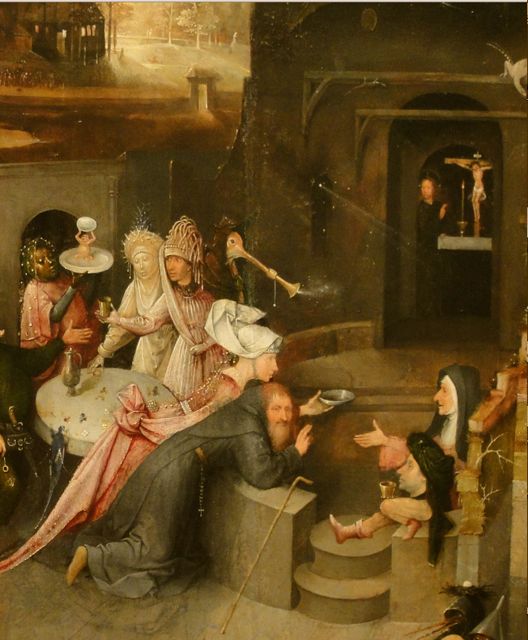
THE ADORATION OF ANYTHING YOU THINK YOU OWN IS FIRE


.For a closer view of this detail click here. For the whole tryptich click here.

The Adoration of anything you think you own is idolatrous.

The Adoration of anything you think you own, even Poetry, even Baseball, is idolatrous because, like the Critic on his knees in this painting, the fire’s in your own head. You worship at the shrine but you’re looking not into it but out at us. You’re looking back at your audience to be sure they’ll know how astute and well-informed you are, and, of course, how properly dressed. In turn, your ‘readers’ have a choice — to play ball or cry FIRE!

With regard to baseball, the strange beauty and fascination of it have never been explored more deeply than in the following poem. So what is it? And why has the discussion of poetry on Scarriet becoming so ugly and savage?

Christopher Woodman

.

………………………..The Crowd at the Ball Game

………………………..The crowd at the ball game
………………………..is moved uniformly

………………………..by a spirit of uselessness
………………………..which delights them —

………………………..all the exciting detail
………………………..of the chase

………………………..and the escape, the error
………………………..the flash of genius —

………………………..all to no end save beauty
………………………..the eternal –

………………………..So in detail they, the crowd,
………………………..are beautiful

………………………..for this
………………………..to be warned against

………………………..saluted and defied —
………………………..It is alive, venomous

………………………..it smiles grimly
………………………..its words cut —

………………………..The flashy female with her
………………………..mother, gets it —

………………………..The Jew gets it straight – it
………………………..is deadly, terrifying —

………………………..It is the Inquisition, the
………………………..Revolution

………………………..It is beauty itself
………………………..that lives

………………………..day by day in them
………………………..idly —

………………………..This is
………………………..the power of their faces

………………………..It is summer, it is the solstice
………………………..the crowd is

………………………..cheering, the crowd is laughing
………………………..in detail

………………………..permanently, seriously
………………………..without thought
………………………………………………..William Carlos Williams (Dial, 1923)

[This poem has been posted twice  on this site, here and here. The response has been desultory, though the themes have been crying out for discussion.]

………THE COMMENTS THAT FOLLOW DEVELOP THE THREAD

POEMS THAT HAVE SPOKEN TO US IN THE PAST

The Christos Acheiropoietos or ‘Christ-not-made-by-hand’, a much revered 12th century Russian Orthodox icon, celebrates the miracle in which Jesus healed King Abgar of Edessa by sending him an image of his face imprinted on a piece of linen cloth. Such an icon is said to have been “written” by the word of God, not painted by a person.

Poems that have spoken to us in the past have, like friends, the absolute right to our special attention in the present.

Our doors are always open to them, so to speak, and because such poems have already proved their trustworthiness, the critical small-talk can be skipped over. They’re let straight into our most intimate spaces, they’re sat down to supper and even have the right to stay all night if they wish.

However much of an historical accident the elevation of  “In A Station of the Metro” or “The Red Wheelbarrow” might have been, they have now become close friends to most contemporary poets and readers. A poem that reaches this level doesn’t have to prove anything any more. It simply is.

Which is true of many older works of sacred art, of course, like the Willendorf Venus (28,000 BC), the Lady of Warka (3100 BC), and Our Lady of Guadalupe (1531). Closer to home, nursery rhymes, Saturday Evening Post covers, and relics from our childhood altars, or those of our grandparents, Irish, Tamil, Armenian or Hmong, such artifacts are permanently numinous. However kitschy they might have been at the start they have achieved the status of  “antiques” — even if they were just five-and-dime store knick-knacks to begin with. They’ve been rubbed all over with the wax of human love, familiarity and coherence, and as a result have a sheen deeper than intention, or skill, or even what they might, or might not, have meant, or mean. Indeed, like all great religious ‘icons,’ they mean without meaning, and can speak and weep through the humblest paste and cardboard.

~

Scrabbling around in the trunk at the foot of my bed, I discovered the following poem. It illustrates beautifully what I mean because it got placed there during a period in my life when I was down on my knees most of the time. At this point I’ve lost all connection to the religious content of the poem, I’m afraid,  yet still it speaks to me with utter conviction, sincerity and passion — indeed, as I feel it must have spoken to Simone Weil, “Love” having been among her favorite poems as well.

Look at “Love” through Simone Weil’s eyes and I think you’ll see what I mean when I say that certain poems like friends are hors de contest.

Christopher Woodman

.


.…………………………………………..LOVE

………………….Love bade me welome; yet my soul drew back,
……………………..Guilty of dust and sin.
………………….But quick-eyed Love, observing me grow slack
……………………….From my first entrance in,
………………….Drew nearer to me, sweetly questioning
………………………..If I lack’d anything.

………………….“A guest,” I answer’d, “worthy to be here:”
……………………… Love said, “you shall be he.”
…………………“I, the unkind, ungrateful? Ah, my dear,
………………………..I cannot look on Thee.”
………………….Love took me by my hand and smiling did reply,
……………………….“Who made the eyes but I?”

…………………“Truth, Lord; but I have marr’d them: let my shame
……………………….Go where it doth deserve.”
…………………“And know you not,” says Love, “Who bore the blame?”
………………………“My dear, then I will serve.”
…………………“You must sit down,” says Love, “and taste my meat.”
……………….. …….So I did sit and eat.

…………………………………………………………………………George Herbert

.