SAVAGE BEAUTY (do I dare? do I dare?)

Huay Tung (Brian) Naam Tok Dtaat Mook — a hidden waterfall on the Huay Tung. Over 300 feet high, Dtaat Mook is rarely visited by ordinary people, encircled as it is by the dark rituals that protect the jungle. My intrepid friend, Brian Hayden, photographed three odd fires beside the track as we made our way up the mountain, all three of which contained the charred remains of broken bamboo poles tightly wrapped in saffron robes and bound with plastic string. Click about and see what you can see —  if you dare, if you dare.

………………………

Huay Tung Hex (small)

………………………
………THE COMMENTS THAT FOLLOW DEVELOP THE THREAD

CLICK THRICE, THEN LET ME KNOW

…“I want poems that don’t tell secrets but are full of them.”
………………………………………………………………………….Stanley Kunitz

SONY DSC
………photos by Brigitte Garnier

..So what do people do?
..Is what they do who they are?
..Click twice on each, then let me know.
………………………….Christopher

..
………THE COMMENTS THAT FOLLOW DEVELOP THE THREAD

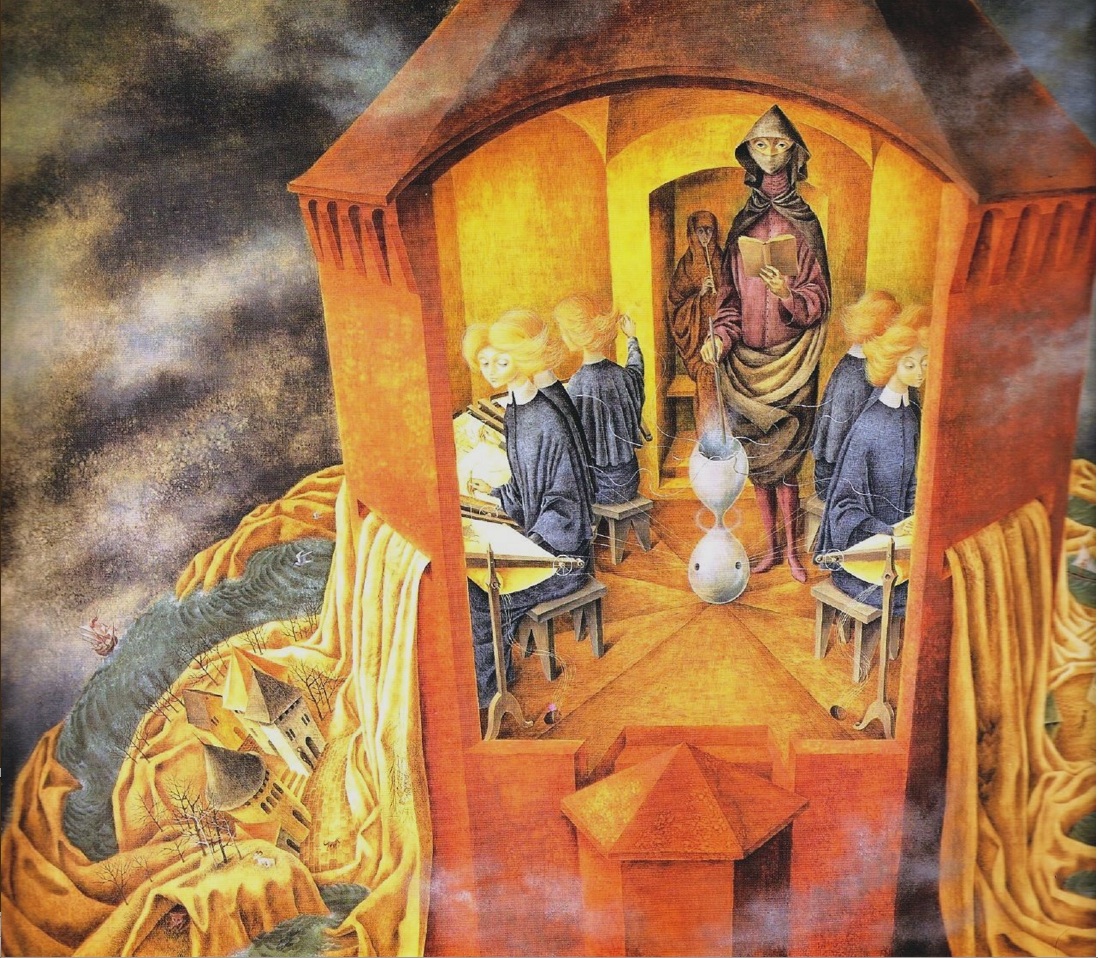
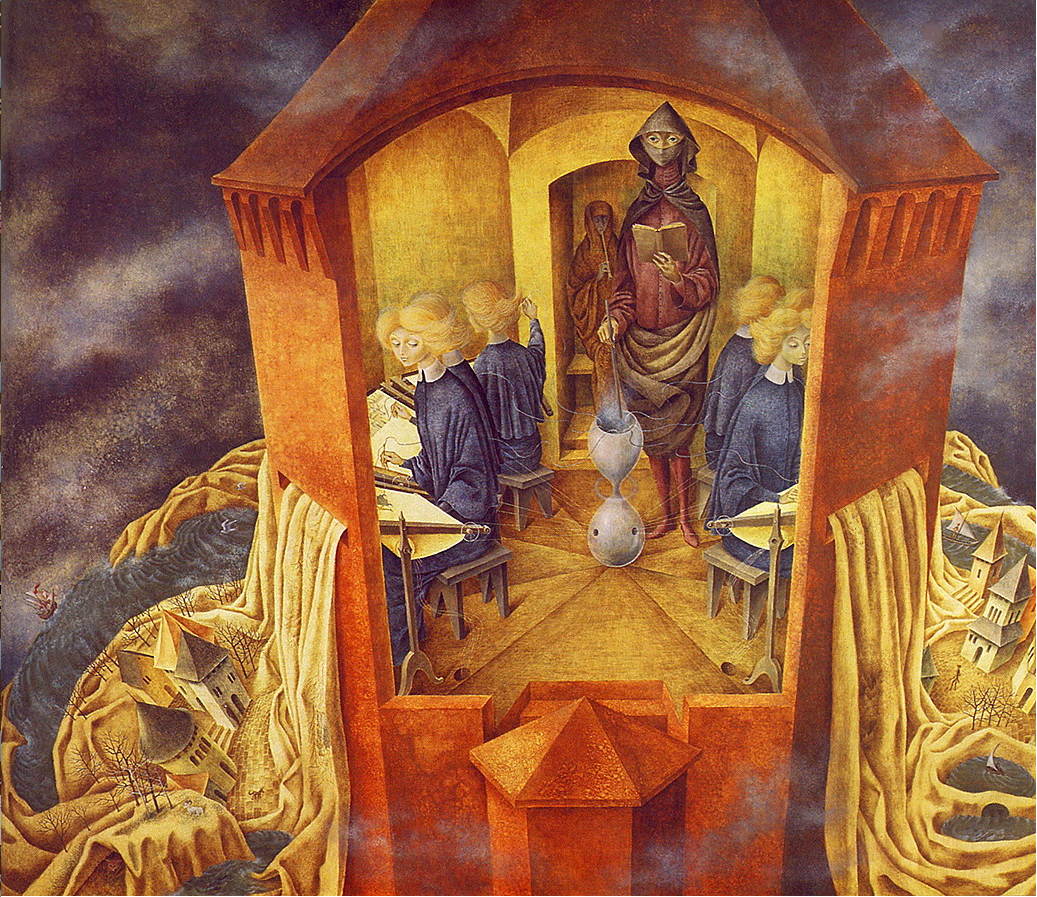
BORDANDO el MANTO TERRESTRE by Remedios Varo

Remedios Varo“Bordando el Manto Terrestre” [ Embroidering the Earth’s Mantle ] (1961) by Remedios Varo.

The Cowpattyhammer management apologizes for having closed “Make It New!” so abruptly.

One of the casualties was that we never got a chance to look at this painting by the Spanish-Mexican painter and anarchist, Remedios Varo. The title means “Embroidering the Earth’s Mantle,” and the imagery is probably the closest we got to the “secret” that was such an important part of the discussion. My own feeling is that with the exception of the sculpture of the tall Aborigine woman and her daughter that introduced the previous thread, this extraordinary painting was probably the most relevant.

You can click here to look at the painting in more detail. Once you have moved in, the definition of the graphic is quite high so you can zoom in as much as you like. Indeed, I’d be very interested to hear what you see.

In addition, if there are any matters arising from the previous thread do feel free to comment below — the management is very grateful to the increasing numbers of people who visited the site in the last weeks of the discussion, and would be very pleased to have more feedback.

Christopher Woodman

………THE COMMENTS THAT FOLLOW DEVELOP THE THREAD

MAKE IT NEW!

MAKE IT NEW!

 Aborigine Woman

Many thanks to AUSTRAVELPHOTOGRAPHY for the photo. 

People have always felt the world was going down the tubes — from “hey, look at her!” to “ubi sunt,” indeed long before anybody ever thought to make it new!

One of the cultures I most admire is that of the indigenous people of Australia. What culture has ever produced greater artists, richer myths, or more healing images? Yet when they lost their past, all 30,000 years of it, it took just a few decades to bankrupt them entirely, economically, culturally, emotionally and spiritually. On the other hand, the tragedy was caused as much by our culture’s inability to cope with change as it was with theirs. They couldn’t deal with us any more than we could deal with them, a heart-breaking impasse for everybody involved right to the end, and still with us.

Two observations on “Make It New” with regard to the gifts of these extraordinary people.

The Australian aborigines were always in a sense  “contemporary” — they were “cartoon” artists, after all, and every image and artifact they made was “pop” in the sense that everybody was a fan, everybody loved it, read it and danced to it. Secondly, their culture didn’t change — for whatever reason they were locked in a time-warp, as we might say looking out into space, and as a result nothing ever became “dated” what is more “old fashioned” for them. “Make it new?” Why everything was new already!

I make these observations very much without blame — Jared Diamond’s Guns, Germs and Steel combined with James C. Scott’s The Art of NOT Being Governed confirmed what I had always suspected, that the Australian aborigines’ lack of ‘development’ had nothing whatever to do with inferior genes, hands or minds. On the other hand, they didn’t “change” at all in our sense — but that’s not quite the same as I have come to understand the word in Buddhist terms. The Buddha insisted over and over again that denying change was as self-destructive as any form of greed, control or domination. Anicca, or “impermanence” as it’s usually translated when the sutras are rendered into English, is the only certainty in life, says the Buddha, and holding on to things as if they weren’t going to change is the root of all suffering. That’s the fundamental Buddhist teaching, in fact, that Change and the inevitable Suffering that arises out of it are the fundamental truths of all being

What’s really different about our times, it seems to me, is what is happening to time itself — the speed of change, as if we were already strapped in the rocket that will deliver us from our dwindling planet into the arms of space.

Try this to put our own sense of time into perspective:

I never even heard of television until I was 8 and didn’t live with a set until I was 42! Even more astonishing, I learned all my maths and physics without a calculator, sailed all over the world without a GPS or other electronic aid, and didn’t touch a computer keyboard until I was 52, the same age at which I published my first poem. And if that last one doesn’t put the word “dated” into perspective for a poet in America, what does?

But we’ll come back to that.

I just want to add that I’m not a Buddhist, whatever that might mean, and feel very strongly that in the light of Eternity there are other “universal truths” beside CHANGE and SUFFERING. Indeed, one of the reasons the aborigines are so important to me is that they tell me more than any other people I have ever encountered about who I really am — particularly as I look in the mirror on my birthday, not a pretty sight at all at 74. But then the old wizened aborigine that looks back at me over my shoulder tells me that nothing that really matters is ever outdated. Change is nothing in the light of eternity, he tells me — and I don’t mean by that Heaven or Eternal Life, God forbid, or indeed anything my new-age friends in white call ‘Spiritual.’ I mean eternity in the sense that I believe Einstein imagined it, or Stephen Hawking in his space-age body, our own little naked good-fella in Cambridge, who grappled with the dreaming that is  Cern. Or what surely must have occupied the mind of Galileo Galilei during those 8 years under house arrest in Florence or me here at my tiny speck of a desk in Chiang Mai.

Do you think when the first white man arrived in Australia an aboriginal would have had a problem showing him a God-particle? Had the white man been able to ask, that is? Had he had the intelligence or expertise to navigate that sort of thinking?

d of course, had the good-fella been willing to betray such truths by sharing them with such a big, crude, ignorant stranger?

Christopher Woodman

………THE COMMENTS THAT FOLLOW DEVELOP THE THREAD

POEMS THAT HAVE SPOKEN TO US IN THE PAST

The Christos Acheiropoietos or ‘Christ-not-made-by-hand’, a much revered 12th century Russian Orthodox icon, celebrates the miracle in which Jesus healed King Abgar of Edessa by sending him an image of his face imprinted on a piece of linen cloth. Such an icon is said to have been “written” by the word of God, not painted by a person.

Poems that have spoken to us in the past have, like friends, the absolute right to our special attention in the present.

Our doors are always open to them, so to speak, and because such poems have already proved their trustworthiness, the critical small-talk can be skipped over. They’re let straight into our most intimate spaces, they’re sat down to supper and even have the right to stay all night if they wish.

However much of an historical accident the elevation of  “In A Station of the Metro” or “The Red Wheelbarrow” might have been, they have now become close friends to most contemporary poets and readers. A poem that reaches this level doesn’t have to prove anything any more. It simply is.

Which is true of many older works of sacred art, of course, like the Willendorf Venus (28,000 BC), the Lady of Warka (3100 BC), and Our Lady of Guadalupe (1531). Closer to home, nursery rhymes, Saturday Evening Post covers, and relics from our childhood altars, or those of our grandparents, Irish, Tamil, Armenian or Hmong, such artifacts are permanently numinous. However kitschy they might have been at the start they have achieved the status of  “antiques” — even if they were just five-and-dime store knick-knacks to begin with. They’ve been rubbed all over with the wax of human love, familiarity and coherence, and as a result have a sheen deeper than intention, or skill, or even what they might, or might not, have meant, or mean. Indeed, like all great religious ‘icons,’ they mean without meaning, and can speak and weep through the humblest paste and cardboard.

~

Scrabbling around in the trunk at the foot of my bed, I discovered the following poem. It illustrates beautifully what I mean because it got placed there during a period in my life when I was down on my knees most of the time. At this point I’ve lost all connection to the religious content of the poem, I’m afraid,  yet still it speaks to me with utter conviction, sincerity and passion — indeed, as I feel it must have spoken to Simone Weil, “Love” having been among her favorite poems as well.

Look at “Love” through Simone Weil’s eyes and I think you’ll see what I mean when I say that certain poems like friends are hors de contest.

Christopher Woodman

.


.…………………………………………..LOVE

………………….Love bade me welome; yet my soul drew back,
……………………..Guilty of dust and sin.
………………….But quick-eyed Love, observing me grow slack
……………………….From my first entrance in,
………………….Drew nearer to me, sweetly questioning
………………………..If I lack’d anything.

………………….“A guest,” I answer’d, “worthy to be here:”
……………………… Love said, “you shall be he.”
…………………“I, the unkind, ungrateful? Ah, my dear,
………………………..I cannot look on Thee.”
………………….Love took me by my hand and smiling did reply,
……………………….“Who made the eyes but I?”

…………………“Truth, Lord; but I have marr’d them: let my shame
……………………….Go where it doth deserve.”
…………………“And know you not,” says Love, “Who bore the blame?”
………………………“My dear, then I will serve.”
…………………“You must sit down,” says Love, “and taste my meat.”
……………….. …….So I did sit and eat.

…………………………………………………………………………George Herbert

.