On Living with GALILEO’S SECRET.

Wildfire #1 (AP Photo/Noah Berger – Las Vegas, Sept.9th, 2020)

What is really different about our times is what is happening to Time itself. Because we assume the quicker the better, and behave as if we were on top of a powerful rocket that would deliver us from all our problems as soon as it got up a bit more speed. And we really are living like that right now, even as the rockets underneath us are disintegrating in balls of fire, clouds of ash, pollution and pestilence.

We forget entirely that the rocket is a very primitive form of locomotion, indeed on the same tinker-toy scale as the internal combustion engine. Because the latter’s hot, noisy, smelly technology with its flashing lights, sirens and big boots has been with us for just a bit over two life-times, don’t forget, and is, like the steam engine before it, the ham-fisted fire-power-in-your-face that has poisoned the whole of our planet in just two centuries. The irony is that as a method of propulsion the rocket won’t get us very far into space anyway — why, even our own moon is a dangerous long shot in a fiery tin-can like that.

But there are other people who don’t want to go, unassimilated stragglers washed up on alien shores who remember and weep. For example this quite recent, Studs Terkel-type interviewee:

I ought to say right here that I take no particular position — I’m no more this or that, both of which some suspect I am and criticize me for it too, either for being it or for not really being it. I can just say that in the light of what we now call ‘light-years’ there is for me something more important than the Impermanence and Suffering of the Buddha or even, for that matter, the personal Sin and Redemption of Jesus.

That’s why the indigenous people up the road are so important to me, because Animists can tell me so much more about who I am right here right now without any of the higher stuff. When I look in the mirror these days it’s not an elevated sight either, because it’s one of their old wizened ‘good-fella’ faces that looks back at me now and tells me that nothing that really matters is ever outdated what is more undreamt. That’s what I’m about, that’s the gist of who I am and what I believe.

A single lifetime is the only thing worth having in the light-years of the multiverse we live in, that’s all. And to be honest, I never think about Heaven or Eternal Life, or pay much attention to what my New-Age friends call “Spiritual” like “Good Karma” and “Future Lives.” I’m concerned with something much simpler than all that, more fundamental, close, intimate and familiar, a living ‘hunch’ that can’t be taught but is there in the nature of things for anybody anywhere and on any level. And I certainly don’t mean anything like the genius theories of the scientists who are trying to get all the forces in the cosmos to come together at last and make sense out of everything. Making sense, I’m afraid, isn’t me at all.

Of course in the end even Einstein couldn’t manage to reconcile the beautiful Unified Field Theory with the messy Quantum Physics that is still bewitching all the sciences. With the most celebrated mind on earth, Albert Einstein worked tirelessly on one beautiful yet inexplicable hunch alone at home in Princeton for three decades, thinking and thinking but never publishing anything. And then he died. He was 76, and left no further Papers, just unforgettable glimpses of who he was as a person. Indeed, is there any human face more companionable and liberating than Albert Einstein’s the older he got?

Was he bitter that he couldn’t work it out in the end, do you think? Did he feel discouraged? humiliated? left behind?  Or was he at last, as I believe with all my heart and soul he must have been with a face like that, “like honey, like water?” * 

That’s what I want to say.

That’s what I want to say as well, more or less.

Because I’ve been thinking again about the life of another great one, our own little ‘Good-fella’ physicist, Stephen Hawking, who confronted Infinity so bravely in his twisted, space-age body while grappling with the dreaming underground at Cern and among the dishes at Socorro while at the same time grappling with two women in two marriages in the same body in a real bed on earth. Extraordinary, miraculous  —  altogether beyond belief!

……………………But superstition, like belief, must die,
……………………And what remains when disbelief has gone?
………………………………………………………..Philip Larkin, Church Going

And thinking much, much more as well about Galileo Galilei, about what must have occupied him, indeed obsessed him during those grievous last years side-lined at Il Gioiello — the world’s greatest scientist with no instruments to measure things with, or paper on which to write them down, or audience to give him feedback. I want to know, what did Galileo glimpse in his own private dreaming? Where did it go for him between the cracks of the very lonely empirical floor under his feet, a loneliness that must certainly have been deepened by the loss of his beloved daughter, Suor Maria Celeste, ‘Virginia,’ as he called her as a little girl, who died in her cell just two years after he was placed under house-arrest? Though she was 34 and a close neighbor in Arcetri, he scarcely saw her because she never came out of San Matteo — her father had put her there at just 13 because he had never married her mother and so the poor girl could never be married. Can you imagine? And on top of everything else? And there were still 6 more years to go for him with both her cloister and her grave just a bit higher up the Florentine slope over his head from where he lived.

And, finally,  what are we ever going to do about this little scene, or at least what is a poet as old as I am going to do about it?

James Cook  Aboriginal Elder and granddaughter

“Do you think that when the first white man arrived in Australia 250 years ago, a Native Australian would have had a problem showing him a ‘God-particle’ had he asked? I mean, had the white man been able to ask the venerable Elder and his perplexed young granddaughter that question — had the European had the expertise to navigate that sort of thinking, or the language to discuss it with a Master so skilled in the bright art of dreaming for 30,000 years?

“And of course, had the Good-Fella Grand Master been willing to betray such Truths by sharing them with such a big, crude, ignorant stranger, a nobody from nowhere who couldn’t read anything were it thrust straight in his face or passed right under his feet. (‘And those feet, grand-dad, did you see what he’d done to his feet?’)”


*..“Every individual … has to retain his way of thinking if he does not want to get lost in the maze of possibilities. However, nobody is sure of having taken the right road, me the least.”

74 year old Albert Einstein in a reply to an unknown, 20 year old amateur science-buff named John Moffat (May 25th, 1953).
John Moffat has become one of our most important  physicists and, seven decades after his letter to Albert Einstein, is still working on the same unresolved issue. His most recent  theory  is called  ‘
Inhomogeneous Cosmology.’


.

1

THE PAST CATCHING UP  WITH THE PRESENT.

Speaking as a very new old poet I have an important question.

How many Americans today can afford to live and at the same time learn and grow wings in myth-time, something which human beings do quite naturally in smaller, less competitive, more egalitarian communities? What does a contemporary American have to do to succeed in a creative activity, I want to know, and I’m asking the question quite specifically about Poetry, that most private and introspective of the arts — the writing, the publishing, and the business  of poetry among us? Precisely what does one have to do to succeed in poetry in America today?

“Succeed?” you ask?

“Be fulfilled” maybe. Or just “satisfied” in the sense of “sufficient,” the “having enough” feeling  that lies at the heart of communities NOT so in thrall to ownership.

Like bards singing the blues all over the world — resisting tyranny, celebrating love, living grief or just loosening limbs & tongues. In Anatolia, Namibia, Patagonia, Connemara, Turtle Mountain, Papua New Guinea, Sapmi, Bali, Broome (Rubibi), Mindanao, down on the Bayou, up in Peru. And with so little, sometimes even with nothing.

“Lazy” we call those peoples who only “work” when they have to — “undeveloped,” we say, “left behind.” James C. Scott calls what they do  “the art of NOT being governed.”

The richest country on earth, so far ahead and at the same time so far behind. Pray, what are we doing at home in the Land of the Free, crazed as we are with work, debt, and self-slaughter? Terrible word, but that’s why Shakespeare coined it!

.


..……..+………+………+………+………+………+………+…….……..+………+………+………+………+………+………+…….

You can now can move on to the third of the Prefaces:  GILDING THE PIECES:  for LA-CROIX-MA-FILLE.

Alternatively you can visit the first Major Thread  on GALILEO’S SECRET ,  FOR THOSE LIKE GALILEO WHO NO LONGER READ .

If you wish you can choose another Thread from the Index in the left-hand margin.


IN PURSUIT OF THE STILL UNWEIGHED: Off the Record at Eighty.

…………………
I am on the side of angels and of dirt.”
…Sir Stanley Spencer (1891-1959)

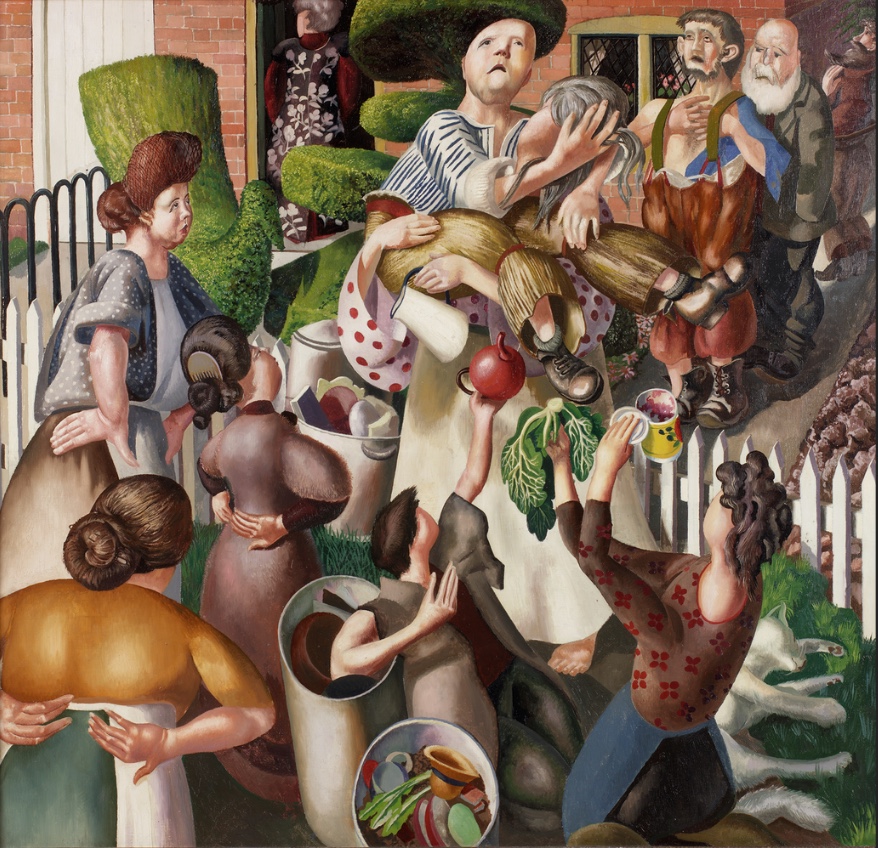
  The Lovers (The Dustman)  (1934)
Sir Stanley Spencer

A “dustman” in England is what Americans call a “garbageman,” and Stanley Spencer loved to see the “dustbins” set out every Tuesday morning in the streets of  his beloved Cookham. In  the painting he is himself a dustman with his trousers tied up tightly just below the knee — to prevent the vermin from climbing up inside them! Like a grown-up difficult child he is in the arms of his wife who is holding some left-over milk for him while he twists her thick grey hair in his fingers — which  he so loved to do! The other women are offering him bits of sacred garbage too: a broken teapot, some cabbage leaves, an empty jam tin…

The painting was submitted by the artist to the Royal Academy for the 1935 Summer Exhibition and was rejected. As a result, Stanley Spencer, already a revered painter at 45, resigned from the Academy.

[N.B. I have to show you the whole unpublished poem because the entire thread is about how  failure can also be a kind of forgiveness… (Oct. 17th, 2026 )


…………GRAVITY’S RAINBOW:
…………SUNDAY IN THE PARK WITH SIR STANLEY

………………..O rejoice in the women,
………………..And the white perfect ducks
………………..With their fashionable heads in the mud,
………………..How they tether themselves down
………………..With pegs in the ground
………………..So they won’t float up in the air,
………………..The feathery dry air that is brighter than gold
………………..But stays unredeemed on the shelf.

………………..For the ducks like the women
………………..Turn weight upside down
………………..By the water on Sunday to stay down,
………………..Not to be better, or up nearer the sun
………………..With the buskers, fine philharmonic
………………..Conductors, preachers, teachers,
………………..Invalids in chariots, toddlers and clowns —
………………..Ah those sweet little flippers that tickle the air,
………………..As pliant as play-dough or beeswax,
………………..Useless as paperweight slippers,
………………..Ballast for butterflies, barbells for kittens —
………………..Perfect as the lead in the magician’s tight furnace
………………..Or the sticky brown muck in God’s oven.

………………..“O the big wide basket of my body,”
………………..The duck woman cries,
………………..“O the piles of starched linen, the fillips,
………………..The white cotton aprons and tea-towels
………………..Folded so nicely in my trembling arms,
………………..Down on my knees by the pool!

………………..“Take this fine little turn-up,
………………..For example,” she says,
………………..“Do you see how it’s paddled and done?
………………..“The masterful curl at the end of the tail,
………………..How the bottom turns upward as if at a ball,
………………..The crinoline, the petticoats,
………………..The old-fashioned drawers that kick highest of all —
………………..And O how they flutter with each do-si-do,
………………..And how the heart goes — can’t you feel it?
………………..And aren’t it worth the applause?”

……………….. “Come on in then, come on in!”
………………..The duck-caller cries,
………………..And when she comes in on his arm
………………..To waddle like a lover on the velvety floor,
………………..Or soon to be mother,
………………..Which is very good too,
………………..How he dips by the water for a nod or a snooze
………………..Any day in the park, old poet by the pool —
………………..Takes his nap on a folding green chair and the paper,
………………..A moist royal nap amongst women,
………………..Head-over-heels in God’s pool.

…………………………Christopher Woodman
……………………………. from GALILEO’S SECRET: Two Decades of
……………………………..poems under House Arrest. [unpublished]”

NOTE: “Gravity’s Rainbow” from the very end of GALILEO’S SECRET, has in itself a considerable bibliography just waiting to be discovered by some ardent young academic a few years after Christopher Woodman’s death. “And the guy never got published,” the lucky student  may recount breathlessly to his friends over his latte at Starbucks, “so  nobody’s ever done him!”

“I can’t wait!” says Christopher.”

…………………THE DISCUSSION CONTINUES IN THE COMMENTS

HOW BAD IS THE DEVIL?

Mantegna 466

At the very end of his life, Andrea Mantegna inscribed the answer to the question on the tree in this delicate cameo-painting of Delilah snipping away at Samson’s hair — as if the fountain next to the tree weren’t clarification enough.

If it’s hard to read the words on the tree, you can click on the tree itself to read them more easily — and if that’s still not enough you can click yet again on the bigger picture. Then it’s a piece of cake — that is, the riddle’s a piece of cake, not the beautiful, dignified, introspective young woman trimming the hair of her grizzled, old, pumped-up and psyched-out lover, the act that reduces all men to the divine fools they are destined to be. Because the Divine Fool is the true message of the Samson story, it seems to me, that is if you read the details of the story very carefully — or, alternatively, if you carefully and exhaustively read your own life, or even read me if you know where to look — which is why I am writing what follows, to find out.

I’m going to leave some space on that now, for reflection.

[ADDED A WEEK LATER]

My reflections on Mantegna’s dictum, foemina diabolo tribus assibus est mala peior, are developed day by day in the Comments below, and if you are interested in such things I hope you will be able to read them with as much hope for an answer as I posted them. On the other hand, if you’re impatient you can skip ahead to a specific discussion of HOW BAD IS THE DEVIL IN THE END.  But fasten your seat belts as you scroll down, because jumping ahead is going to make for a very fast ride!

And those of you who start at the beginning, be warned as well: the discussion that follows thrives on hair-pins and other sticky corners, and very often paints itself into untenable places as well — I do hope you’ll be charitable and forgive me for all the dead-ends. I’m an Old Father William, and all I can tell you is that this is how it goes. Indeed, that’s part of the riddle of knowing where you are in the space you inhabit, and it doesn’t much matter whether it’s on earth, in space, buried in your own person or in some other idea or dimension, or perhaps even suited up in a New Age space-vehicle transitting infinity to arrive where you actually are, like in Carl Sagan’s Contact.

Wrapped up in your own cocoon like Eve, in other words, even if you’re a man and not yet ready to be that beautiful, powerful, and fey. Or a snake with your own tail in your mouth like Satan in the Garden of Eden — indeed, you may even be impatient enough to want to go straight to the discussion for men and women who are no longer inhabitants of the Garden of Eden but would like to know what really happened back then.

……….1.) CLICK HERE TO START AT THE BEGINNING OF THE END.

Or if, like most of my friends, you’re more interested in my own demise as a soi-disant angel and poet yet again you can begin at that end:

……….2.) CLICK HERE FOR THE END OF WHAT WAS ACHIEVED IN
………………..THIS THREAD
.

And finally, if you don’t want to begin at any end but just keep on fooling around like Old Father William:

……….3.) CLICK ON THE END OF HIS NOSE TO SEE HOW
………………..EVERYTHING GOES
.

Christopher Woodman,
Chiang Mai, March 3rd, 2016
….

THIS THREAD IS CONTINUED IN THE COMMENTS THAT FOLLOW.


MAKE IT NEW!

 Aborigine Woman

Many thanks to AUSTRAVELPHOTOGRAPHY for the photo. 

People have always felt the world was going down the tubes — from “hey, look at her!” to “ubi sunt,” indeed long before anybody ever thought to make it new!

One of the cultures I most admire is that of the indigenous people of Australia. What culture has ever produced greater artists, richer myths, or more healing images? Yet when they lost their past, all 30,000 years of it, it took just a few decades to bankrupt them entirely, economically, culturally, emotionally and spiritually. On the other hand, the tragedy was caused as much by our culture’s inability to cope with change as it was with theirs. They couldn’t deal with us any more than we could deal with them, a heart-breaking impasse for everybody involved right to the end, and still with us.

Two observations on “Make It New” with regard to the gifts of these extraordinary people.

The Australian aborigines were always in a sense  “contemporary” — they were “cartoon” artists, after all, and every image and artifact they made was “pop” in the sense that everybody was a fan, everybody loved it, read it and danced to it. Secondly, their culture didn’t change — for whatever reason they were locked in a time-warp, as we might say looking out into space, and as a result nothing ever became “dated” what is more “old fashioned” for them. “Make it new?” Why everything was new already!

I make these observations very much without blame — Jared Diamond’s Guns, Germs and Steel combined with James C. Scott’s The Art of NOT Being Governed confirmed what I had always suspected, that the Australian aborigines’ lack of ‘development’ had nothing whatever to do with inferior genes, hands or minds. On the other hand, they didn’t “change” at all in our sense — but that’s not quite the same as I have come to understand the word in Buddhist terms. The Buddha insisted over and over again that denying change was as self-destructive as any form of greed, control or domination. Anicca, or “impermanence” as it’s usually translated when the sutras are rendered into English, is the only certainty in life, says the Buddha, and holding on to things as if they weren’t going to change is the root of all suffering. That’s the fundamental Buddhist teaching, in fact, that Change and the inevitable Suffering that arises out of it are the fundamental truths of all being

What’s really different about our times, it seems to me, is what is happening to time itself — the speed of change, as if we were already strapped in the rocket that will deliver us from our dwindling planet into the arms of space.

Try this to put our own sense of time into perspective:

I never even heard of television until I was 8 and didn’t live with a set until I was 42! Even more astonishing, I learned all my maths and physics without a calculator, sailed all over the world without a GPS or other electronic aid, and didn’t touch a computer keyboard until I was 52, the same age at which I published my first poem. And if that last one doesn’t put the word “dated” into perspective for a poet in America, what does?

But we’ll come back to that.

I just want to add that I’m not a Buddhist, whatever that might mean, and feel very strongly that in the light of Eternity there are other “universal truths” beside CHANGE and SUFFERING. Indeed, one of the reasons the aborigines are so important to me is that they tell me more than any other people I have ever encountered about who I really am — particularly as I look in the mirror on my birthday, not a pretty sight at all at 74. But then the old wizened aborigine that looks back at me over my shoulder tells me that nothing that really matters is ever outdated. Change is nothing in the light of eternity, he tells me — and I don’t mean by that Heaven or Eternal Life, God forbid, or indeed anything my new-age friends in white call ‘Spiritual.’ I mean eternity in the sense that I believe Einstein imagined it, or Stephen Hawking in his space-age body, our own little naked good-fella in Cambridge, who grappled with the dreaming that is  Cern. Or what surely must have occupied the mind of Galileo Galilei during those 8 years under house arrest in Florence or me here at my tiny speck of a desk in Chiang Mai.

Do you think when the first white man arrived in Australia an aboriginal would have had a problem showing him a God-particle? Had the white man been able to ask, that is? Had he had the intelligence or expertise to navigate that sort of thinking?

d of course, had the good-fella been willing to betray such truths by sharing them with such a big, crude, ignorant stranger?

Christopher Woodman

………THE COMMENTS THAT FOLLOW DEVELOP THE THREAD