FIG LEAF SUTRAS: at the Roots of the Tree.


updated September 14th, 2025

At an important moment in my life, Jerome Rothenberg and his Technicians of the Sacred: A Range of Poetries from Africa, America, Asia, Europe and Oceania appeared on the scene, helping me to understand how much poetry meant to me personally as opposed to what I was doing with it as a flamboyant  25 year old graduate student in Renaissance Studies at Cambridge. It was 1965, the  year of the International Poetry Incarnation at the Royal Albert Hall in London, and everything in the world was loosening up just then. European students were getting themselves ready to come out on the streets of Paris in just 3 more years, and the Tibetans, having escaped over the Himalayas in just 1959, were busy learning English and French and, of course, how to talk to people — which they had never done before in our sense. And there was lots going on in America too, needless to say — that’s why some were here!

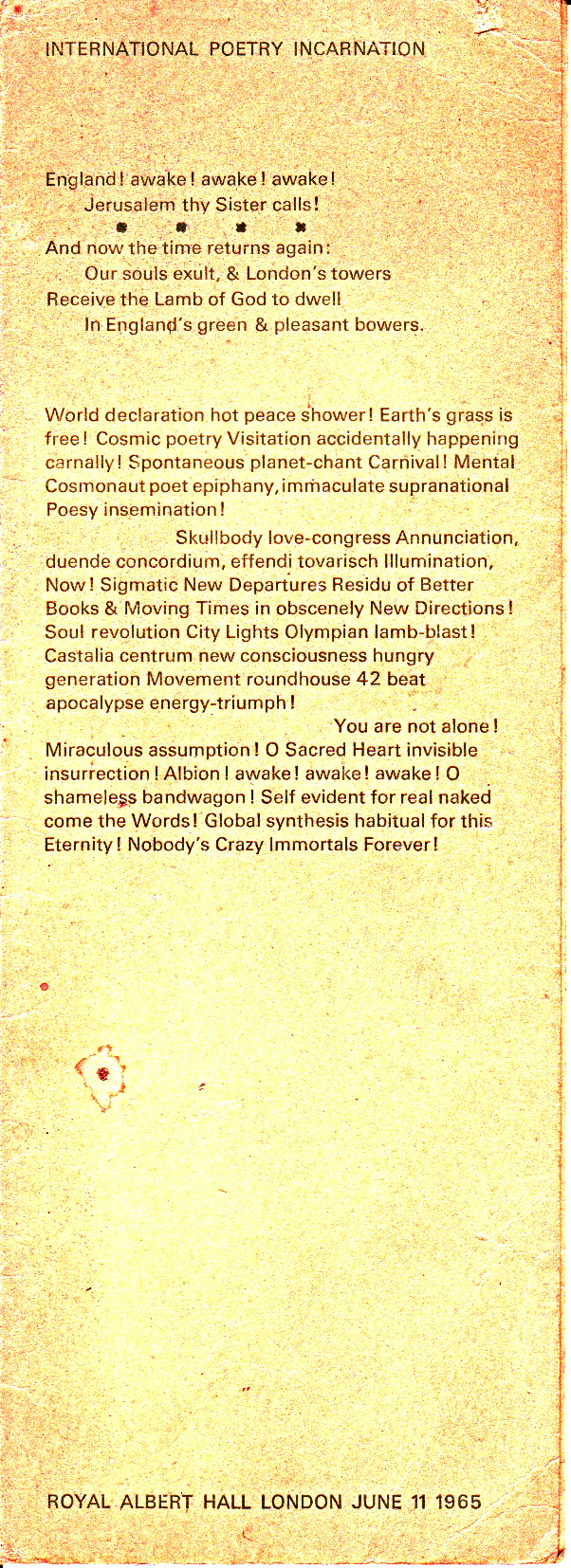
The International Poetry Incarnation was the moment when the ‘Beats’ descended on London to put Modern American Poetry on the map, as the British critic, Eric Mottram, put it — ‘on the mat’ would better describe what I saw at the time. (You can CLICK HERE to read more about the event including who was there and what they did.) And this certainly fired me up, indeed I’m not sure I ever cooled down what is more got my feet back on the ground. An odd metaphor because although it’s true, my subsequent life as a father, teacher, builder, gardener and blue-water sailor defined me more as a worker than as a dreamer. And I don’t particularly value feet-on-the-ground anyway, unless they’re naturally bare, of course —  like  ‘good-fella’ feet, I mean, and would you say they were on the ground?

What I liked about Jerome Rothenberg was his way of chanting, winging it, voicing his own verbal rituals and transliterations, and of course his Native American and Oceanic tapes which he played at the Polytechnic of Central London. That was one of the new Technical Colleges springing up all over the U.K. with the very first ‘Modern Poetry’ departments in Europe. I myself wasn’t yet involved in ‘creative writing’ and wouldn’t take it up seriously for another 25 years — I taught poetry but I didn’t write it. Indeed, years before I started writing it I moved up to Scotland with a Himalayan refugee who badly needed shelter. That was the Lama Chögyam Trungpa, of course, almost 30 by then and already astonishingly articulate, in English! But he was also in a very vulnerable position as he was paralyzed on one side and drinking heavily plus downing whatever was handed to him by his adoring disciples — they just drifted into Garwald like ghosts with their bottles and bags. And it was in this milieu that I helped Trungpa ‘invent’ his own way of ‘writing’ Modern American Poetry long before I began to write poetry myself — you can GO HERE AGAIN & SCROLL DOWN for a glimpse of how that ‘transliteration’ worked. Needless to say, my household in Scotland fell apart very rapidly, and I had to go deeper and deeper into the woods as well as way, way out to sea, literally as well as figuratively, indeed to get so lost I could only start all over again — which is the subject of the latter (chronologically earlier) parts of FIG LEAF SUTRAS: A Memoir in Poems: 1994-2024 (unpublished).……[To see better you can click on the Bo Tree above — at home in Chiang Mai.]

~…………….~…………….~…………….~

There’s an aspect to all this that I rarely talk about but need to, it’s so near the roots of my ‘Fig Leaf Trajectories.’ So forgive me if I go back a bit and tell my story all over again on another level.

I came to King’s College, Cambridge, from Yale in 1962 as a 23 year old Kellett Fellow  — my thesis topic had already been approved by C.S.Lewis and, after Lewis’ death, was supervised by the distinguished Cambridge Professor of English and WWII Singapore survivor, G.G.Hough, whose life experience had led him to many of the same interests as my own including Edmund Spenser and C.G.Jung. With the latter’s trust and encouragement, my unfinished thesis won a Research Fellowship in 1965, one of the highest honors at Cambridge at the time, and my academic future seemed assured. But I was impatient, on fire almost, and to make a long and foolish story very short, I resigned my Fellowship at Christ’s College, sold my beautiful windmill, and went off to Scotland with my young family by the one hand and my new friend Trungpa by the other. I became a Trustee of the new Samye-Ling Tibetan Centre in Eskdalemuir and at the same time renovated a huge pile of stone called ‘Garwald House’ — to put Trungpa & entourage in (we the family lived in the servants’ quarters). I also took a job teaching the teenage children of Scottish shepherds and mill-workers nothing they wanted to learn — Langholm Academy, 18 miles down the road, the closest job I could find and certainly the most difficult I ever had. (I tried for months not to use ‘the Belt,’ and I failed — from the students’ point of view, of course, they won. And that was also Hugh MacDiarmid’s school!)

But there was one more life-changing twist to this transition. Just before I left Cambridge, the formidable Shakespearean scholar and Mistress of Girton College, M.C.Bradbrook, was charged with the task of examining me and my 400pps thesis orally, which she certainly did. “Too psychological,” she implied — too “Jungian,” “too Buddhist for an English dissertation” quite specifically — indeed, during my ‘Viva’ in her rooms at Girton we talked mainly about my relationship with the Lama Trungpa. (“Why?” was her question over and over again. “How could you?”) And to make a short story even shorter, Polyphonic Narrative in Elizabethan Literature exited with the traditional “M.Litt (Cantab.)” —  a grand-sounding degree, certainly, but not the shiny new “PhD” my thesis was registered for, and that I would have very much needed had I gone home to continue the same sort of work in the States.

The disaster sent more than ripples through the graduate student community at Cambridge — everybody else felt their own necks must surely be on the block if mine was. But I was already way up in the hills of Dumfriesshire by the time I heard the news, many miles from the nearest shop by a one track road with sheep lying all over it. And I never went back to Cambridge — which I probably should have, but that’s where I was and still am, never going back anywhere. And today I’m even a bit proud of myself for not having challenged the decision — and I’m sure both the English Faculty and my advisor, Professor Hough, must have been very relieved indeed that I just moved on.

At this point I want to say that I harbor no hard feelings toward M.C.Bradbrook, indeed I think her decision was actually helpful to me as I could never have become the sort of literary scholar the degree was supposed to prepare me for. And I did moon the establishment, which was certainly how my behavior felt to Muriel Bradbrook. Cambridge at the time was a ‘scientific’ university which didn’t teach ‘Modern Poetry’ as an academic subject at all, just Chaucer, Milton, and Wordsworth along with assumptions about Classical Languages and Prosody. Of course there were active poets in Cambridge, many of them, but at Cambridge that’s what you did with your life, not what you ‘read!’ At Cambridge you gossiped about contemporary poets in your ‘rooms’ like T.R.Henn did about W.B.Yeats in his, for example (I was there — crowded, fascinating!), but you didn’t ‘study’ them! And yes, in many ways I still sympathize with that position, and am very glad I was there and not somewhere else.

The fact is that I just didn’t fit in, at least with the establishment I didn’t. But for me Cambridge was the most wonderful place to be just as I was and as it was — not fitting-in was just what I needed. Of course Cambridge has always been one of the great Thinking Places of the world, and I still get fired up just thinking about the profound scholarship combined with quotidian genius-folly of Christopher Smart in the 18th Century, for example, what is more about Samuel Taylor Coleridge in the 19th (he quit twice!) or Ludwig Wittgenstein in the 20th (say no more!). In my own time E.M.Forster ate at the high table at King’s every evening, Thom Gunn was still a phantom presence, and F.R.Leavis talked about everything you’re not supposed to.

In some ways I was over-the-top too, of course I was, but I know I was also appreciated for my energy, resourcefulness, and courage — I was often asked to head this or that, for example, local community-boards, societies. But I was also considered disrespectful by some, a little dangerous even, and I was certainly not the only one who got dished. Any day, rain or shine, you could see what appeared to be a tramp on an old bicycle with a torn gown, disheveled hair, and wild, wild eyes with his basket stuffed with books and his paper-bag lunch. He often talked informally while eating his lunch in a drafty courtyard at Downing College with anyone interested, and there were many outliers there beside me. Because that was F.R.Leavis himself, one of the greatest 20th Century English Literary Critics, still there and still on fire in words not just about D.H.Lawrence but about “Tom” (T.S. Eliot) as well. In many ways his renegade status as an Engaged Critic suited him even better than a Chair would have. He felt good in his own skin like that — more an outcast Prophet than a Professor.      ………………………… [Photo: Stefan Collini on F.R.Leavis, TLS, Sept. 2000]

Another inspiration at the time was the newly arrived polyglot American, George Steiner. He was even more threatening as he ‘read’ not just ‘English’ but all the European languages (‘read’ is what you did at Cambridge as no Lectures or Course Work were required for a graduate degree at the time). George Steiner was not invited to become a University Lecturer — but don’t worry, he lectured still but unofficially, with people sitting in the aisles and on the window sills, just to get an ear in! Although he was Senior Tutor at the new Churchill College (I ‘tutored’ his undergraduates in Shakespeare), his association with me made the C.U. Faculty of English worry even more about what they were going to do with Christopher Woodman. And I solved that for them by just doing it myself, absconding with the Tibetans!

I just want to add that it’s a mystery to me why I was so good at Literary Criticism in the first place, and why I won all those prizes. Because I wasn’t cut out to be an Academic — Polyphonic Narrative in Elizabethan Literature was beautiful scholarship but at the same time a touchy-feely pot-boiler just waiting to be satirized by Vladimir Nabokov. For I was as much into Jerome Rothenberg as Edmund Spenser, and most of all bringing up children, building the most beautiful tree-houses in the world for them and then steadfastly sailing away with everybody on board. Indeed, after ‘going down’ from Cambridge in 1969 I eventually became the person you see in the photo. It’s 1980, I think, in the Windward Islands somewhere, possibly even  Jean Rhys’ Dominica, and I’m all of 40 already — another decade to go before I would write the first (i.e. last) poem in this book just below.

All I know that’s important is laid out in FIG LEAF SUTRAS — “the radiant cruelty of what is,” as James Agee put it in Let Us Now Praise Famous Men (cited on the title page). The book moves backwards in time, starting as it does in Chiang Mai and reversing its way through three decades of basements, boats, broken hearts, temples, revelations and scribblings to where I am now, just Lung Kip. That’s what I’m called here in Chiang Mai, “the old guy who is older than your father.”

James Agee was dead at 45 — this book is about what there is to add after you’re 70.

Trust in water
words white
and buoyant like
an iron hospice bed
and do not fear
to live or hope
beyond the soft
morning light
or soft voices
of the children
in the park.

These are the very last words in FIG LEAF SUTRAS: A Memoir in Poems, 1995-2025, though chronologically they are the youngest. They first began to compose themselves very near the beginning in a basement in Carroll Gardens, Brooklyn (“basement” is a recurring image in the book). The fact that FIG LEAF SUTRAS is a young man’s book written by a much older man may be one of it’s most positive characteristics — that such poetry can mature even as fresh wine does in an aging dark cellar.

Like blessings, Christopher

…………….

.


.……..+………+………+………+………+………+………+…….


[There are no ‘Major Threads’ devoted to my 3rd book,  FIG LEAF SUTRAS, as the poems for it were collected after I stopped writing-about-writing in this Blog. In a sense it is itself about writing-about-writing from beginning to end, which is why this Preface is so autobiographical.

[If you haven’t yet seen it you should have a look at THE HARD PART FIRST which digs a bit more deeply around the Roots of the Tree in the present  thread.]

[You can also go on to the 2nd Preface, On Living with GALILEO’S SECRET, or choose another Thread from the ***MAJOR THREADS*** listed in the left hand margin.]


IN PURSUIT OF THE STILL UNWEIGHED: Off the Record at Eighty.

…………………
I am on the side of angels and of dirt.”
…Sir Stanley Spencer (1891-1959)

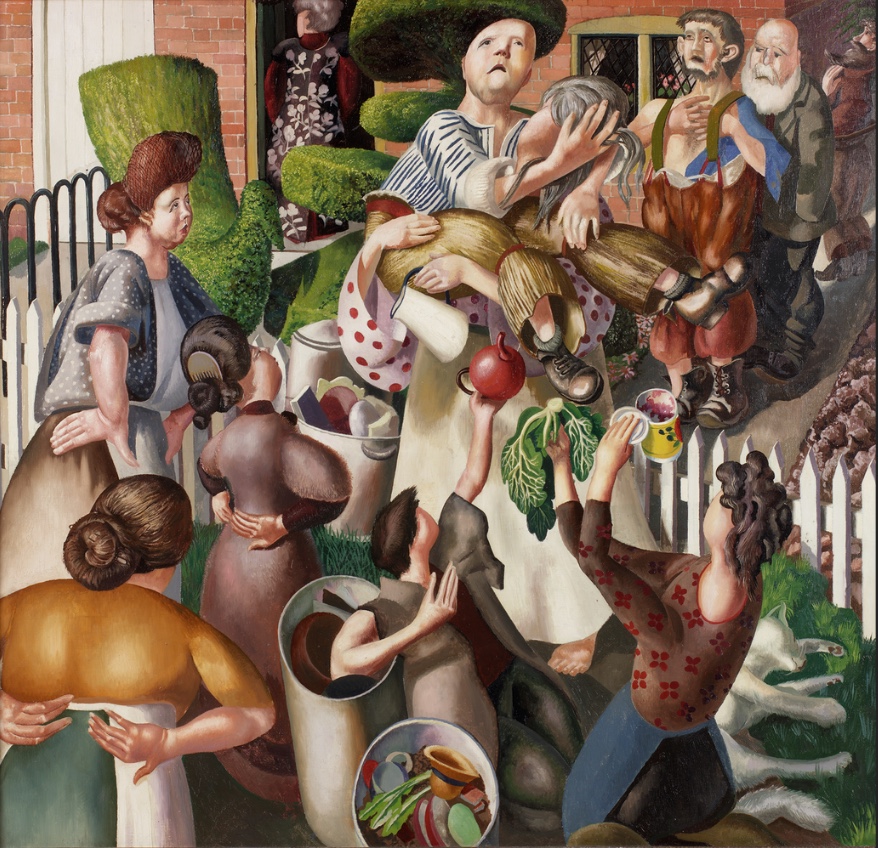
  The Lovers (The Dustman)  (1934)
Sir Stanley Spencer

A “dustman” in England is what Americans call a “garbageman,” and Stanley Spencer loved to see the “dustbins” set out every Tuesday morning in the streets of  his beloved Cookham. In  the painting he is himself a dustman with his trousers tied up tightly just below the knee — to prevent the vermin from climbing up inside them! Like a grown-up difficult child he is in the arms of his wife who is holding some left-over milk for him while he twists her thick grey hair in his fingers — which  he so loved to do! The other women are offering him bits of sacred garbage too: a broken teapot, some cabbage leaves, an empty jam tin…

The painting was submitted by the artist to the Royal Academy for the 1935 Summer Exhibition and was rejected. As a result, Stanley Spencer, already a revered painter at 45, resigned from the Academy.

[N.B. I have to show you the whole unpublished poem because the entire thread is about how  failure can also be a kind of forgiveness… (Oct. 17th, 2026 )


…………GRAVITY’S RAINBOW:
…………SUNDAY IN THE PARK WITH SIR STANLEY

………………..O rejoice in the women,
………………..And the white perfect ducks
………………..With their fashionable heads in the mud,
………………..How they tether themselves down
………………..With pegs in the ground
………………..So they won’t float up in the air,
………………..The feathery dry air that is brighter than gold
………………..But stays unredeemed on the shelf.

………………..For the ducks like the women
………………..Turn weight upside down
………………..By the water on Sunday to stay down,
………………..Not to be better, or up nearer the sun
………………..With the buskers, fine philharmonic
………………..Conductors, preachers, teachers,
………………..Invalids in chariots, toddlers and clowns —
………………..Ah those sweet little flippers that tickle the air,
………………..As pliant as play-dough or beeswax,
………………..Useless as paperweight slippers,
………………..Ballast for butterflies, barbells for kittens —
………………..Perfect as the lead in the magician’s tight furnace
………………..Or the sticky brown muck in God’s oven.

………………..“O the big wide basket of my body,”
………………..The duck woman cries,
………………..“O the piles of starched linen, the fillips,
………………..The white cotton aprons and tea-towels
………………..Folded so nicely in my trembling arms,
………………..Down on my knees by the pool!

………………..“Take this fine little turn-up,
………………..For example,” she says,
………………..“Do you see how it’s paddled and done?
………………..“The masterful curl at the end of the tail,
………………..How the bottom turns upward as if at a ball,
………………..The crinoline, the petticoats,
………………..The old-fashioned drawers that kick highest of all —
………………..And O how they flutter with each do-si-do,
………………..And how the heart goes — can’t you feel it?
………………..And aren’t it worth the applause?”

……………….. “Come on in then, come on in!”
………………..The duck-caller cries,
………………..And when she comes in on his arm
………………..To waddle like a lover on the velvety floor,
………………..Or soon to be mother,
………………..Which is very good too,
………………..How he dips by the water for a nod or a snooze
………………..Any day in the park, old poet by the pool —
………………..Takes his nap on a folding green chair and the paper,
………………..A moist royal nap amongst women,
………………..Head-over-heels in God’s pool.

…………………………Christopher Woodman
……………………………. from GALILEO’S SECRET: Two Decades of
……………………………..poems under House Arrest. [unpublished]”

NOTE: “Gravity’s Rainbow” from the very end of GALILEO’S SECRET, has in itself a considerable bibliography just waiting to be discovered by some ardent young academic a few years after Christopher Woodman’s death. “And the guy never got published,” the lucky student  may recount breathlessly to his friends over his latte at Starbucks, “so  nobody’s ever done him!”

“I can’t wait!” says Christopher.”

…………………THE DISCUSSION CONTINUES IN THE COMMENTS

HOW BAD IS THE DEVIL?

Mantegna 466

At the very end of his life, Andrea Mantegna inscribed the answer to the question on the tree in this delicate cameo-painting of Delilah snipping away at Samson’s hair — as if the fountain next to the tree weren’t clarification enough.

If it’s hard to read the words on the tree, you can click on the tree itself to read them more easily — and if that’s still not enough you can click yet again on the bigger picture. Then it’s a piece of cake — that is, the riddle’s a piece of cake, not the beautiful, dignified, introspective young woman trimming the hair of her grizzled, old, pumped-up and psyched-out lover, the act that reduces all men to the divine fools they are destined to be. Because the Divine Fool is the true message of the Samson story, it seems to me, that is if you read the details of the story very carefully — or, alternatively, if you carefully and exhaustively read your own life, or even read me if you know where to look — which is why I am writing what follows, to find out.

I’m going to leave some space on that now, for reflection.

[ADDED A WEEK LATER]

My reflections on Mantegna’s dictum, foemina diabolo tribus assibus est mala peior, are developed day by day in the Comments below, and if you are interested in such things I hope you will be able to read them with as much hope for an answer as I posted them. On the other hand, if you’re impatient you can skip ahead to a specific discussion of HOW BAD IS THE DEVIL IN THE END.  But fasten your seat belts as you scroll down, because jumping ahead is going to make for a very fast ride!

And those of you who start at the beginning, be warned as well: the discussion that follows thrives on hair-pins and other sticky corners, and very often paints itself into untenable places as well — I do hope you’ll be charitable and forgive me for all the dead-ends. I’m an Old Father William, and all I can tell you is that this is how it goes. Indeed, that’s part of the riddle of knowing where you are in the space you inhabit, and it doesn’t much matter whether it’s on earth, in space, buried in your own person or in some other idea or dimension, or perhaps even suited up in a New Age space-vehicle transitting infinity to arrive where you actually are, like in Carl Sagan’s Contact.

Wrapped up in your own cocoon like Eve, in other words, even if you’re a man and not yet ready to be that beautiful, powerful, and fey. Or a snake with your own tail in your mouth like Satan in the Garden of Eden — indeed, you may even be impatient enough to want to go straight to the discussion for men and women who are no longer inhabitants of the Garden of Eden but would like to know what really happened back then.

……….1.) CLICK HERE TO START AT THE BEGINNING OF THE END.

Or if, like most of my friends, you’re more interested in my own demise as a soi-disant angel and poet yet again you can begin at that end:

……….2.) CLICK HERE FOR THE END OF WHAT WAS ACHIEVED IN
………………..THIS THREAD
.

And finally, if you don’t want to begin at any end but just keep on fooling around like Old Father William:

……….3.) CLICK ON THE END OF HIS NOSE TO SEE HOW
………………..EVERYTHING GOES
.

Christopher Woodman,
Chiang Mai, March 3rd, 2016
….

THIS THREAD IS CONTINUED IN THE COMMENTS THAT FOLLOW.


CONFESSIONS OF AN OPIUM EATER: The New Critical Habit and How I Broke It.

As someone trained in the 60s at Yale and Cambridge who caught the bug from W.K.Wimsatt, sipped sherry with I.A.Richards and E.M. Forster on the same couch at Kings, shared a bag lunch with F.R.Leavis in a cold brick corner of some unrecorded quadrangle at Darwin, and suffered a nervous breakdown when a close disciple of Wittgenstein played with his head and his wife somewhere down the Huntington Road toward Girton, mostly on a bicycle, he had the New Criticism in his blood — and it’s a rush, I tell you.

And that’s a major part of the problem for any New Critic, to resist the thrill of using the gift of the academic gab as if it were a divine right — and I had a lot of that sort of chutzpah too, which I’ve now partly outgrown and partly forgotten. Indeed, that gift has bedevilled me both as a teacher and a poet all my life — because I so loved being a Guardian of the Poetry Threshold, I got so high on it, so vatic and blissfully feathered, I was not to be trusted on the ground at all. And even in my twilight years here on my other planet, I can still hold forth for hours and hours on a text, and the few people that somehow find their way to my table in Chiang Mai and ask the wrong question, e.g. anything to do with poetry, are still in mortal danger.

The danger is the way we New Critics deliver the message that only specially trained people can get the full meaning out of poetry, and even worse, that poetry that’s good is difficult. And, of course, the assumption that we cannot navigate it without a highly trained pilot in the wheel-house!

New Critics have become heavy pushers of that line, and far from increasing the popularity of poetry, their critical ‘gifts’ have crippled those who would like to hear about it just as much as those who would like to write it. For just like heroin, the effects of the New Criticism are as irresistible as they are destructive, and we’ve all ended up hooked on a kind of poetry that simply can never deliver enough. Indeed, the habit gets bigger and bigger even as we get smaller and smaller and more and more isolated from the world of real people down below.

Enter American poetry today. Enter the New Critical Angel.

Angels? Well, Kierkegaard can tell you just how dangerous “great moments” can be, and how disastrously misleading, but there’s another picture that works for me too. In the well-known Tibetan mandala, ‘The Wheel of Life,’ the angels at the very top are either blissfully at ease or blissfully exerting power. At the very bottom are the ghosts in hell, thirsty, hungry, endlessly tormented, abject victims of their own ignorance. Human beings are exquisitely poised between the two extremes and, the Buddha says, that’s a better place to be than even among the angels — because humans are the only beings that have any real hope of seeing things as they are, and thus achieving freedom from self-serving prejudice. And why? Ghosts suffer, angels live in bliss, but only human beings know both at once. When at last the heavens begin to change after countless aeons, and the slightest crack appears in the firmament, which inevitably it does, says the Buddha, an angel is unable to adapt. An angel’s attachment to bliss, permanence and control is so insidious it falls headlong into the very deepest hell at the first hint of dissatisfaction. Even an animal, it is said, is better off at that moment than an angel.

Instructional, and the curse of all inflation.

What I did about the potential Angel in myself, the Poet-written-Big in my nature, was truly radical. I simply placed a moratorium upon myself as a writer, and from my teen years in the 1950s until I felt at last safe enough to try again in the ’90s, I just didn’t write poetry at all, or at least I just wrote love poems and gave them away. Because I always knew secretly I was a poet, but a poet who couldn’t be trusted to write poetry as it should be written, with restraint, patience and integrity. Like T.E.Lawrence on the road to Damascus in 1918, I realized that “all established reputations were founded, like myself, on fraud,” and in my own humble way I wanted to avoid that pitfall. Even though I was very young and not remotely anything special, just living in a special time and place, I knew I had to be careful. And in the end I did manage to stay me, and not become just another fiddling angel. I arrested my development, went into artistic hibernation, and emerged 30 years later to publish my first poem at 52 without any established reputation at all to get in the way, or any schtick or obfuscation.

Here’s a poem about all this — it’s still a ‘new critical’ type poem, for sure, but I don’t think I’ve ever said it better. And there is room for this type of poem on Parnassus too, it’s just a lot harder to keep your head at such a heady level and, of course, to keep the hat off.

………………….SAMSON BETWEEN THE PILLARS,
………………….SAUL AND LAWRENCE ON THE ROAD
.
………………………….There was knocking but
………………………….no door into that heroic
………………………….world but first
………………………………………………..bowing out of it,
………………………….deferring gracefully to those
………………………….small private abstentions
………………………….that had murmured all
………………………….along just behind the
………………………….uncompromising hard
………………………………………………….god’s brilliance.

…………………………Like all things likely shorn
…………………………undressed ears can hear
………………………….the faintest abdication
…………………………………………………………..knocking.

………………………….Each white petal’s fall or
………………………….slightest finger’s white
…………………………………………………….print in soot,
………………………….every clean track or dry
………………………….tear knocks too against
…………………………………………………….that solitude.

………………………….Even the infinitesimal shock
………………………….of a single naked
……………………………………………………….snow-flake
………………………….slipping through some
………………………….daedalian avenue before
………………………..aall that slicked-back tar
………………………….can even wink at such
………………………….quick celestial skin
……………………………………………………is knocking—
………………………….just as veiled eyes seeing
………………………….too many fine things done
………………………….for the good in Damascus
………………………….turn toward whatever
………………………….violence or private wailing
……………………………………………………..wall closing
………………………….even as the bluntest flint
………………………….tapping, tapping opens.

………………………………….from LA-CROIX-MA-FILLE:
…………………………………………Hexes, Ruins, Riddles & Relics.

………………………………………………….(unpublished)

NOTE: In the final days of his Arab campaign in 1918, and while actually on the road to Damascus, T.E. Lawrence realized “all established reputations were founded like myself on fraud.” He changed his name, enlisted initially in the Tank Corp and then the RAF as an ordinary mechanic, and died on a motorcycle on a small country lane in 1935. Having tried his best to expunge himself while still alive, everybody walked behind his casket to the local graveyard including Winston Churchill, Charlotte Shaw and her husband, George Bernard, and E.M.Forster.

Christopher Woodman


……….+………+………+………+………+………+………+………+………+………+………+………+………+………+………+………..+………+………+………

If you are unsure where to go next on the Site, you can return to A COMPLETE DIRECTORY.

A great many of the early articles in the COWPATTY ARCHIVE are not listed in the Index on the left — there just wasn’t enough room for them all. To access this earlier material, you can enter the site with the URL: https://cowpattyhammer.wordpress.com. and then scroll back toward October 2009 where it all began. But don’t forget to click on “OLDER ENTRIES” at the end of each section.

You can also click on the small ARCHIVES window at the bottom  of the left hand Index and scroll down to the very earliest DATES or the CATEGORIES . The latter may be able to direct you even more specifically to what interests you.

You can now move on to the next thread, A HAPPY CHRISTMAS TO ALL MEN AND WOMEN BLESSED BY WINGS IN A SIMILAR FIX


A Letter To Tom about “Rhyme”


Tony Woodman and me at the Gran Prix of Czechoslovakia, Brno, 1963

Dear Tom……………………………………………………[November 22nd, 2009]
My hunch is that your emphasis on “rhyme” in your previous article is going to be misunderstood. I think it will give those who don’t want to hear you at all the excuse not to read you, and may weaken your argument even for those that are willing to give what you say a try.

Let me say this first: I’m a curious critic because I’m so sophisticated yet so naive and trusting — I know so much (or at least ought to, considering the length of my education) and yet am so obviously an innocent. I deliberately didn’t say ‘ill-informed’ there, because what I do know I know quite well, and my eyes are always wide-open. It’s just that I’ve only been engaged with the history of ‘Modern Poetry’ since I started writing it in 1990, and I was already 50 by then. I’ve never sat in a Modern Poetry lecture, for example, never participated in a Writing Workshop, and only rarely attended a Poetry Reading. I’ve got Gawain and the Green Knight, all of Chaucer, The Faerie Queene, George Herbert, Christopher Smart, John Clare and Emily Dickinson on my shelves here in Chiang Mai, but very few literary-critical texts written after Wimsatt & Brooks.

The fact is I only came up against ‘Modernism’ when I realized that the 10 precious packets I had sent to a much-respected University Poetry Series between 1994 and 2006 were probably never opened, and that my 8 packets to yet another up-and-coming Press hadn’t deterred its editor from sending me a form letter purporting to be a personal critique of my work. The letter, almost identical copies of which have subsequently emerged, suggested that for a certain sum the editor would help me to improve my book and that I could then resubmit it to his/her competition. I remember that moment very well — I was at my desk with my cheque book in hand when I was first alerted to the existence of Foetry.com which had already started to investigate the letters. When I then complained about my own letter on Poets & Writers (Nov 2006), I was scolded by a well-known critic for my limited understanding of publishing poetry in America today, while the very same judges who had abused me were praised for their hard work and integrity.

That was hard for me — and still is.

But the critic who attacked me on P&W was partly right, of course — even at 66 I was uppity and ignorant, and was nowhere near ready to concede that the situation I found myself in was ‘normal’ what is more ethically acceptable or conducive to the development of good poetry in me or anyone else in America. And the next thing I knew I found myself banned on-line for discussing my disquiet, first by the P&W blog, then by the AoAP blog, and finally by the Poetry Foundation’s new and wonderful Blog Harriet — not a very promising start to my new career, and particularly not at 69.

So what can you call me, then, and how can my input be more useful?

Hardly a “noble savage,” as my style is too perfect even if my content is analphabet. Yet I am a peasant in poetry when you compare me with somebody like David Lehman, for example, what is more Stephen Burt — and indeed, one of the reasons I got put “on moderation” at Blog:Harriet so early was that I annoyed a lot of people who knew a whole lot more than I did about the poetry business, and wanted me to be more practical, respectful, and compliant. Because after all, who was I to strew the nice Harriet ground with metaphors that exploded with such devastating effect, even taking out the management? And my cow pat hammer, that was the last straw [open the ‘Comments,’ then ‘Show More Comments,” then scroll down to July 6th, 2009, “Footnote for Posterity”]. And I was fired a few days later.

What I do have (and this is all about that word “rhyme,” of course, Tom) is my Rip Van Winkle status, a contemporary poet back from the dead. Because my anomaly is that I was so highly educated in the History of Literature (Columbia, Yale, King’s College, Cambridge, summa cum laude, phi beta kappa, Dino Bigongiari Prize for Italian Studies, Woodrow Wilson at Yale, Kellett Fellow at King’s [after Lionel Trilling and Norman Podhoretz but before David Lehman], C.S.Lewis & G.G.Hough as my Supervisors for my work on Edmund Spenser, Tutor for George Steiner at Churchill, Research Fellow at Christ’s) — yet I never got formally educated in Modern Poetry, not once. So I go straight from the ’30s in which I was born and jump straight to the ’90s in which I got published by Marilyn Hacker in The Kenyon Review — sans mentor, sans prize, sans compromise! Indeed, I will be forever grateful to Marilyn Hacker — and to the likes of James Laughlin (only just legible on his old Remington), Theodore & Renee Weiss (I was one of the last QR Finalists, and I still have his notes in pencil), Joseph Parisi ( who read my long poem, Works & Days,  3 times!), and Alice Quinn (who suggested The Kenyon Review for my Connemara Trousers). They made not just my day but my life!

Yes, a “noble non-starter,” I might be called, playing on that P & W critic’s “loser.” Or a “noble non-accredited accomplisher” perhaps.   Because the irony is that in the end my publishing credits have turned out to be not bad at all, considering my age and when I started.

So back to  “rhyme,” then, Tom. I’m sure you know exactly what you mean by the word, and you do know the literary-historical details like the back of your hand. But what you don’t know first hand is the snobbery that lies behind the creation of Modernism, the revulsion with which those early 20th century poets around Pound and Hilda Dolittle rejected the late 19th century mush so loved by those who had just emerged from the crude working class.  Because Edgar Guest/Hallmark-type “rhyme” was not the side of the verse they specifically despised, but rather the feel-good sentimentality which went along with the satisfaction you got when you at last sat down to ‘dinner’ together around a ‘table’ or ‘read’ together  in the ‘parlor’ — which factory workers were still not going to do in Britain or America for some time to come. On the other hand, after 1916 “A Heap O’Livin” sold over a million copies — which opens up a huge social and educational grey area in the History of American Poetry, one which is not yet quite out of the bag like what actually happened when my ancestors put in to Plymouth.

That’s what I know about more than most of you who are reading this and interested in our struggle. Because I was brought up in the 19th century, and I was a snob and “mush” made me feel unclean too, so I know the feeling only too well. I spent my early years in Gladstone, New Jersey, after all, the so-called “Gold Coast,” and in my American childhood I never sat down with a worker, or a so-called ‘person of color,’ or a Catholic who wasn’t a descendant of Diamond Jim Brady (my mother’s family in Boston in the 20s didn’t socialize with the Kennedys, who were Irish like the servants, and my mother was terribly distressed when I named my second daughter “Delia Hilary Orlando Woodman,” (Irish plus a name which could be mistaken for someone of Italian descent???).

And to our great credit, but goodness knows why, we ran, my two brothers and I — my younger brother, Loring, westward to the Gros Ventre in Wyoming, myself eastward across the Atlantic to Cambridge and then on up to remote Eskdalemuir, and Tony just really really fast (he was the first American to have a big success in Gran Prix motorcycle racing in Europe until he broke his back in the Northwest 200 in Ireland in 1965). And how I ran, and kept bees, and fiddled around with Trungpa Rimpoche, and sailed, but mostly just fell in love with my wonderfully wrong women — and little by little I sloughed off that good taste and sense of superiority which went along with the family silver (I still have a trunkful somewhere, and enough 18th century willow pattern china to serve you all at once, though goodness knows where that is as well) — and here I am now writing to you like the fool…

No, it’s not the rhyme, Tom — it’s the snobbery of a new intellectual class that is still not too secure and needs to put a lot of distance between itself and the upper working-class poetry that makes sense when you finally arrive on the first rung of the new upwardly mobile America.

And should the ‘petit bourgeois poetry’ of the 19th and early 20th centuries be re-evaluated, then, should that forgotten corpus be restored to grace? Hardly, but the alternative “Make it New” movement at the opposite extreme must be re-assessed as ‘petit-bourgeois poetry’s’ shadow, in the Jungian sense, so that those aspects of our western poetry tradition that got debased and/or hidden by ‘Modernism’ can be brought out into the open and liberated — like feeling, like music, like value and meaning and even, when its applicable, like rhyme. Indeed, all the underpinnings of Modernism must be fearlessly re-examined, and it’s tendency to sew new clothes for the emperor ruthlessly exposed, as we’re doing — and how the courtiers do kick and howl!

That’s our theme, of course, and it’s a big one, and one for which I think I’m well-equipped even with just a small cow pat as a hammer in my hand.

Christopher
Read the rest of this entry »