FOR THOSE LIKE GALILEO

Peniche Original

 A Péniche on the Canal de Bourgogne.
(Click to see the Other World better.)

……….
….from FOR THOSE LIKE GALILEO WHO NO LONGER READ
……………………………………………..Le Canal de Bourgogne

……………….So where are they now the poems
……………….For those who do no longer read
……………….But lose their way in words,
……………….Their overheated selves
……………….Closed down like God’s own
……………….Disowned fools in
……………….Damp, forgotten locks
……………….And other fasts and solitudes—
……………….Fisher kings, tall stilt-legged birds,
……………….The mist-wrapped walker with
……………….The busy dog and old felt hat—
……………….Mute, pre-dawn souls bewildered by
……………….The wash and roar of meanings when it’s all
……………….Gunnel-rubbing function transport
……………….Pumping huge breast-plates of
……………….Greased iron up and down
……………….A ruined cut?

……………………………from GALILEO’S SECRET: Two Decades of
……………………………….Poems under House Arrest.
…………………………………………..(unpublished fragment)

…………………………..………

To pass through the Tunnel click on the Stamp.

A personal Note:
The venerable industrial canal has provided much of the transport for heavy cargo in Europe right up to the present, yet few of us are familiar with the gates, cranks and levers, or understand the complex hydraulics of the dams and reservoirs that feed them. The 242kms Canal de Bourgogne, a truly sacred relic with its 189 shaded locks, ascends 400 meters vertically in the Burgundy region of central France and then descends to meet the Yonne and the Seine rivers and on down through Paris to Le Havre and the sea. An engineering masterpiece, the canal linked the Mediterranean with the English Channel and at the same time put the finishing touches on one of the most beautiful old-world landscapes in Europe. Much less known is the fact that it came to shelter a unique community of people who lived on boats, and whose identity was formed not by place or jurisdiction, but by how they worked apart and at the same time respected each other.

The Canal de Bourgogne is one of the places I have loved most in my long life away from home. I still rejoice in the thought of it but know it’s unlikely I shall ever visit it again as it’s no longer a place to work one’s way through, just to play around in, to pretend. For that reason I’m not really very interested in it anymore  — it was ‘working my way through it’ that so engaged me right from my first passage 50 years ago to the moment when it was closed to heavy traffic in the 1990s. “Se frayer un passage” (“to ‘force’ or ‘work’ one’s way through something, like a blacksmith ‘works’ wrought-iron) is what the French “bateliers” (‘barge people’) have always called working their huge 125ft steel barges through the complex system of wrought-iron gates, sluice valves, levers and ladders for days on end to wherever they happened to be going  — and it could be grand places too, Marseille,  Lyon, Paris — or anywhere in Holland, Belgium, Germany, indeed all the way from the Rhone to the Rhine and back again to humble St Jean de Losne on the Saône or Conflans-sur-Seine. And they did all that not only with 350 tons of sand, stone, coal or grain on board, but with the whole family — home was aboard and everybody was there all the time!

Alone and always pushing the limits, the bateliers are fiercely proud of who they are and what they do to this day, indeed as proud as the ‘Roma,’ Tinkers,’ or ‘Travelers’ in Ireland and the U.K. or the ‘Gitanes’ in France are proud, all unique people who work their way stealthily through long, hard, isolated lives on the back roads of modern life. Deracinated and forever on the move, they dedicate their lives to wrestling with the loss of so much that was once so kind and familiar, and to watching the world self-destruct on the high roads. And that’s heroic, isn’t it, even if it means you look down on everybody else? (I add that last while bowing, quietly, as a poet, out of sight myself.)
)…………………………………………C.W. (photo March 2nd, 2025)

.

……….A Batelier family photographed at home on a Sunday.

A sensitive reader who has been through a Galileo-like “house arrest,” and I think many of us have, will understand the extreme dislocation, the burden, the longing  and the loneliness he must have experienced. Even more importantly, such a person may have experienced the mysterious resolution at the end of the poem, of being as alone as that yet well and whole at last.

………………
CONTINUED IN  THE FOLLOWING DISCUSSION.

IN PURSUIT OF THE STILL UNWEIGHED: Off the Record at Eighty.

…………………
I am on the side of angels and of dirt.”
…Sir Stanley Spencer (1891-1959)

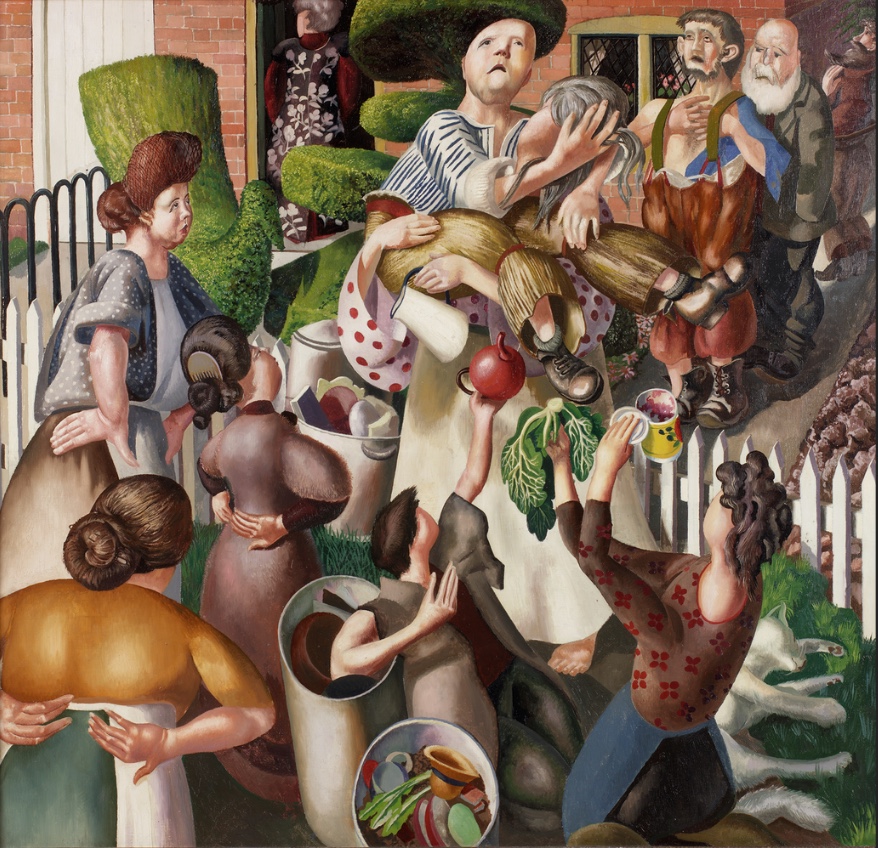
  The Lovers (The Dustman)  (1934)
Sir Stanley Spencer

A “dustman” in England is what Americans call a “garbageman,” and Stanley Spencer loved to see the “dustbins” set out every Tuesday morning in the streets of  his beloved Cookham. In  the painting he is himself a dustman with his trousers tied up tightly just below the knee — to prevent the vermin from climbing up inside them! Like a grown-up difficult child he is in the arms of his wife who is holding some left-over milk for him while he twists her thick grey hair in his fingers — which  he so loved to do! The other women are offering him bits of sacred garbage too: a broken teapot, some cabbage leaves, an empty jam tin…

The painting was submitted by the artist to the Royal Academy for the 1935 Summer Exhibition and was rejected. As a result, Stanley Spencer, already a revered painter at 45, resigned from the Academy.

[N.B. I have to show you the whole unpublished poem because the entire thread is about how  failure can also be a kind of forgiveness… (Oct. 17th, 2026 )


…………GRAVITY’S RAINBOW:
…………SUNDAY IN THE PARK WITH SIR STANLEY

………………..O rejoice in the women,
………………..And the white perfect ducks
………………..With their fashionable heads in the mud,
………………..How they tether themselves down
………………..With pegs in the ground
………………..So they won’t float up in the air,
………………..The feathery dry air that is brighter than gold
………………..But stays unredeemed on the shelf.

………………..For the ducks like the women
………………..Turn weight upside down
………………..By the water on Sunday to stay down,
………………..Not to be better, or up nearer the sun
………………..With the buskers, fine philharmonic
………………..Conductors, preachers, teachers,
………………..Invalids in chariots, toddlers and clowns —
………………..Ah those sweet little flippers that tickle the air,
………………..As pliant as play-dough or beeswax,
………………..Useless as paperweight slippers,
………………..Ballast for butterflies, barbells for kittens —
………………..Perfect as the lead in the magician’s tight furnace
………………..Or the sticky brown muck in God’s oven.

………………..“O the big wide basket of my body,”
………………..The duck woman cries,
………………..“O the piles of starched linen, the fillips,
………………..The white cotton aprons and tea-towels
………………..Folded so nicely in my trembling arms,
………………..Down on my knees by the pool!

………………..“Take this fine little turn-up,
………………..For example,” she says,
………………..“Do you see how it’s paddled and done?
………………..“The masterful curl at the end of the tail,
………………..How the bottom turns upward as if at a ball,
………………..The crinoline, the petticoats,
………………..The old-fashioned drawers that kick highest of all —
………………..And O how they flutter with each do-si-do,
………………..And how the heart goes — can’t you feel it?
………………..And aren’t it worth the applause?”

……………….. “Come on in then, come on in!”
………………..The duck-caller cries,
………………..And when she comes in on his arm
………………..To waddle like a lover on the velvety floor,
………………..Or soon to be mother,
………………..Which is very good too,
………………..How he dips by the water for a nod or a snooze
………………..Any day in the park, old poet by the pool —
………………..Takes his nap on a folding green chair and the paper,
………………..A moist royal nap amongst women,
………………..Head-over-heels in God’s pool.

…………………………Christopher Woodman
……………………………. from GALILEO’S SECRET: Two Decades of
……………………………..poems under House Arrest. [unpublished]”

NOTE: “Gravity’s Rainbow” from the very end of GALILEO’S SECRET, has in itself a considerable bibliography just waiting to be discovered by some ardent young academic a few years after Christopher Woodman’s death. “And the guy never got published,” the lucky student  may recount breathlessly to his friends over his latte at Starbucks, “so  nobody’s ever done him!”

“I can’t wait!” says Christopher.”

…………………THE DISCUSSION CONTINUES IN THE COMMENTS

HOW BAD IS THE DEVIL?

Mantegna 466

At the very end of his life, Andrea Mantegna inscribed the answer to the question on the tree in this delicate cameo-painting of Delilah snipping away at Samson’s hair — as if the fountain next to the tree weren’t clarification enough.

If it’s hard to read the words on the tree, you can click on the tree itself to read them more easily — and if that’s still not enough you can click yet again on the bigger picture. Then it’s a piece of cake — that is, the riddle’s a piece of cake, not the beautiful, dignified, introspective young woman trimming the hair of her grizzled, old, pumped-up and psyched-out lover, the act that reduces all men to the divine fools they are destined to be. Because the Divine Fool is the true message of the Samson story, it seems to me, that is if you read the details of the story very carefully — or, alternatively, if you carefully and exhaustively read your own life, or even read me if you know where to look — which is why I am writing what follows, to find out.

I’m going to leave some space on that now, for reflection.

[ADDED A WEEK LATER]

My reflections on Mantegna’s dictum, foemina diabolo tribus assibus est mala peior, are developed day by day in the Comments below, and if you are interested in such things I hope you will be able to read them with as much hope for an answer as I posted them. On the other hand, if you’re impatient you can skip ahead to a specific discussion of HOW BAD IS THE DEVIL IN THE END.  But fasten your seat belts as you scroll down, because jumping ahead is going to make for a very fast ride!

And those of you who start at the beginning, be warned as well: the discussion that follows thrives on hair-pins and other sticky corners, and very often paints itself into untenable places as well — I do hope you’ll be charitable and forgive me for all the dead-ends. I’m an Old Father William, and all I can tell you is that this is how it goes. Indeed, that’s part of the riddle of knowing where you are in the space you inhabit, and it doesn’t much matter whether it’s on earth, in space, buried in your own person or in some other idea or dimension, or perhaps even suited up in a New Age space-vehicle transitting infinity to arrive where you actually are, like in Carl Sagan’s Contact.

Wrapped up in your own cocoon like Eve, in other words, even if you’re a man and not yet ready to be that beautiful, powerful, and fey. Or a snake with your own tail in your mouth like Satan in the Garden of Eden — indeed, you may even be impatient enough to want to go straight to the discussion for men and women who are no longer inhabitants of the Garden of Eden but would like to know what really happened back then.

……….1.) CLICK HERE TO START AT THE BEGINNING OF THE END.

Or if, like most of my friends, you’re more interested in my own demise as a soi-disant angel and poet yet again you can begin at that end:

……….2.) CLICK HERE FOR THE END OF WHAT WAS ACHIEVED IN
………………..THIS THREAD
.

And finally, if you don’t want to begin at any end but just keep on fooling around like Old Father William:

……….3.) CLICK ON THE END OF HIS NOSE TO SEE HOW
………………..EVERYTHING GOES
.

Christopher Woodman,
Chiang Mai, March 3rd, 2016
….

THIS THREAD IS CONTINUED IN THE COMMENTS THAT FOLLOW.