Gilding the Pieces: LA-CROIX-MA-FILLE.

Fan Tail 450
The old Impington Windmill at Histon, Cambs, 1967.

Histon is the small village near Cambridge where Christopher Woodman began to restore an old windmill in the 1960s. The ‘fan-tail’ which you see here drives a series of cogs and shafts that turn the whole top of the mill so the wind-blades always face the wind. This meant that when Christopher Woodman looked out of his window from the Miller’s Cottage each morning, having completed that part of the restoration, he was never quite sure where he was as the world changed all its coordinates when the wind shifted directions in the night.

.
PARTINGS & RESTORATIONS

…………………………………………………..updated May 12th, 2022
To start with, I have very few friends who read poetry and even fewer who read the poetry I write. This is partly because at two very important junctures in my life I quit poetry altogether, and as a poet I have no past.

The first time I quit was in my teens when I stopped writing because I knew my poetry was fake. Even at sixteen I was aware that I wrote poetry because I wanted to be a poet, and would cobble together anything and call it a poem for that reason. CW Yearbook 1957Indeed, I was aware that I was putting on a mask in order to hide my own struggle with myself, not to express it — I couldn’t tell anybody that but knew it myself. That’s one of the reasons I’m still so interested in W.B.Yeats who was an out-of-touch adolescent with similar obsessions all his life. On the other hand, right from the start Yeats built on an ancient mythology that had everything to say in itself however much he fudged it, and of course he was also a genius in so many other ways. I posed as Yeats did but with a great deal less skill and with no effective schtick of my own at all. I pretended to be Shelley, for example, and even nourished the fantasy that my boy’s boarding school was the school that imprisoned 19 year old Percy Bysshe’s 16 year old Harriet! But all the same I did get a superb education there and, perhaps even more importantly, the experience of waking up among the magical New Hampshire lakes and forests for five of my most sensitive years.

I also arrived with a beautiful soprano voice, and from the age of 11 sang solos in the St. Paul’s School boy’s choir, Handel to Mendelssohn. I did it for that long because my voice remained clear as a bell until I was all of 15, no less. And of course I was just getting ready to quit poetry at the same time that my voice was finally changing, and little did I realize what all that would mean for the latter part of my life!

To finish up the First Parting, then, I fell in love with the girl in the red silk dress at 17, married her at 20, and had my first child as a sophomore at Columbia in 1960, just 5 days after I turned 21. I loved my young wife to distraction too but lost her not so long after I married her, just one single fraught decade out of 8 of them — and lost her in much the same way as both the hero and the author lost Yvonne de Galais in Le Grand Meaulnes, that most important of all tropes.

At a séance in New Haven, Conn., 1962.

It was thus that women trumped poetry in my life, and in a sense still do. But I’m not in any way a threat to anybody, not even to myself, nor have I ever been ‘any of the above’ what is more promiscuous. On the contrary, I’ve been much too fond of my wives even when the marriages failed, and they were long ones, an inspired 10+ years each. That always made it especially hard to let them go and, like Alain-Fournier, to my detriment I didn’t.

Women have always been it in my poetry as well — as it was for the Troubadors, for Dante and Petrarch, for Goethe and Coleridge to John Fowles and his mentor, Alain-Fournier. On the other hand, this pedigree has had less to do with my personal relationships with the women I have loved than with what might be called my ‘magical thinking.’ Indeed, it lies at the core of my inner life as a seriously engaged Buddhist/Christian/Animist who remains both an undeveloped enfant terrible and an old hurt soul to this day. As silly as all that may sound, I wouldn’t be me without any of it!

And just to mention that I’m now in the 30th year of a marriage with a very real, dynamic, professional woman, Homprang Chaleekanha, and if you want to know more about that sort of love relationship you should read the last of my 3 books, Fig Leaf Sutras: a Memoir in Poems, 1994-2024. I just hope you will be able to get hold of it soon. Indeed, it’s out there right now, fishing with the very brightest feathers and most succulent bait it can manage.)

The Second Parting was not with writing poetry but with studying the history of it as a graduate student at King’s College, Cambridge. C.S.Lewis accepted my research proposal based on the reading of Edmund Spenser’s The Faerie Queene I had developed under Professor Harry Berger at Yale, and C.S.Lewis was my Supervisor until he passed away leaving me just with the title of my thesis, “Polyphonic Narrative in Elizabethan Literature” — which remains to this day the origin of my style, my imagery, and my modus vivendi both as a poet and as a person.

That Second Parting happened just four years after my brother Tony’s accident in 1965, and was certainly hastened by it. In the interval I had won a Research Fellowship at Christ’s College and at the same time become Chairman of the Cambridge University Buddhist Society, a delicate balancing act if there ever was one. And what I did after that shocked everybody, even myself — I resigned my Fellowship at Christ’s, sold my beloved windmill in Histon, packed up my beautiful wife and by then 3 little girls, and went off to Scotland with a Tibetan Lama. But the really devastating event in that Second Parting was the moment when my beautiful wife, aka ‘the girl in the red silk dress,’ departed with another of the Lama’s disciples, and I found myself at 29 alone with 3 small children and a whole lot of relics already — memories, images, artifacts, whatever you want to call them — all of which are covered in the gold leaf that has always sanctified my turbulent, topsy-turvy past.

Indeed, “La-Croix-Ma-Fille!” used to be called “Gold Leaf on the Waters” but has now moved on to a title that’s more like life as mine actually turned out to be. And how I hope you will be able to get hold of my book in the very near future as it’s so winsome and so longs to be read. It’s out trolling at the moment too — you can click on the title, “LA-CROIX-MA-FiILLE!” to see what it’s doing right now.

……………………………..My fingers ache with so much crossing,
………………………………………………………..Christopher

RELOCATIONS & RECASTINGS


Tea break at the Old Windmill with Sophia & Delia in the sandpit.

Christopher Woodman restored the old ‘Impington Windmill’ in the village of Histon while living in the Miller’s Cottage at the base of the mill in the 1960s — those are wooden cog-wheels that he’s sitting on which he intended to restore as well. He had already rebuilt the whole fan-tail porch in hard wood and recovered the dome-like cap as well with lap-strake cedar. Fortunately there were blacksmiths in Cambridgeshire at the time who still knew how to find and/or recast the broken iron parts of the machinery just as his writing attempts to relocate and sometimes to recast the missing parts of himself and his life. Much of that was also involved in his 400pps Cambridge thesis, “Polyphonic Narrative in Elizabethan Literature,” which was not liked at all by any.

1910

This is an old photo of the ‘Impington Windmill’ in 1910 with young women in white bonnets picking strawberries for the Chivers jam factory in the nearby village. If you look closely you can see two figures standing on the fantail of the mill. There are also two horse-drawn wagons, and the overseer is wearing a suit and fine hat. This is very much the worlds of both Tess of the d’Urbervilles (1891) and Le Grand Meaulnes (1913), remnants of both of which were still there in rural England and France when Christopher Woodman arrived just 50 years later. The miller’s cottage where he lived with his wife and children is visible just to the left of the mill, indeed his third and youngest daughter, Antonia Unity, was born in the cottage in 1967.

1

THIS IS THE END OF THE THIRD SHORT PREFACE...


 ……..+………+………+………+………+………+………+……. ……..+………+………+………+………+………+………+…….+…….+…….
[To exit this Preface you can visit  LA CROIX MA FILLE! ,  the ***FIRST MAJOR THREAD*** on this particular theme.

[Alternatively you can go on to the   ***FIRST MAJOR THREAD*** in the Index:  FOR THOSE LIKE GALILEO WHO NO LONGER READ .

[You could also choose any other title from the Index in the left-hand Margin.]


IN PURSUIT OF THE STILL UNWEIGHED: Off the Record at Eighty.

…………………
I am on the side of angels and of dirt.”
…Sir Stanley Spencer (1891-1959)

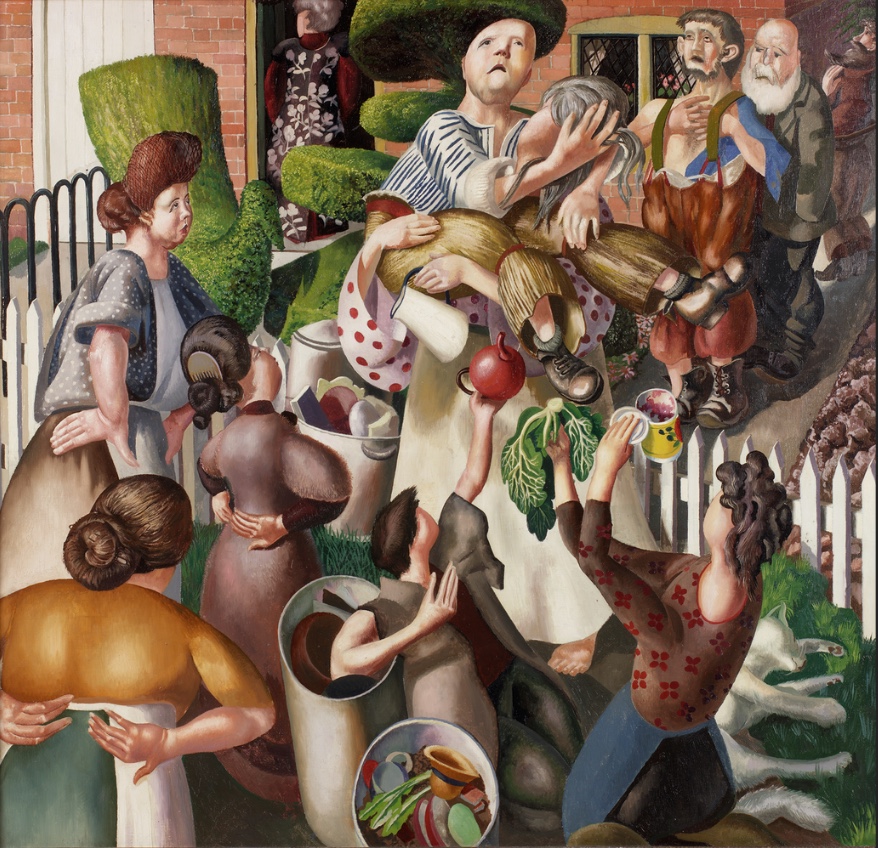
  The Lovers (The Dustman)  (1934)
Sir Stanley Spencer

A “dustman” in England is what Americans call a “garbageman,” and Stanley Spencer loved to see the “dustbins” set out every Tuesday morning in the streets of  his beloved Cookham. In  the painting he is himself a dustman with his trousers tied up tightly just below the knee — to prevent the vermin from climbing up inside them! Like a grown-up difficult child he is in the arms of his wife who is holding some left-over milk for him while he twists her thick grey hair in his fingers — which  he so loved to do! The other women are offering him bits of sacred garbage too: a broken teapot, some cabbage leaves, an empty jam tin…

The painting was submitted by the artist to the Royal Academy for the 1935 Summer Exhibition and was rejected. As a result, Stanley Spencer, already a revered painter at 45, resigned from the Academy.

[N.B. I have to show you the whole unpublished poem because the entire thread is about how  failure can also be a kind of forgiveness… (Oct. 17th, 2026 )


…………GRAVITY’S RAINBOW:
…………SUNDAY IN THE PARK WITH SIR STANLEY

………………..O rejoice in the women,
………………..And the white perfect ducks
………………..With their fashionable heads in the mud,
………………..How they tether themselves down
………………..With pegs in the ground
………………..So they won’t float up in the air,
………………..The feathery dry air that is brighter than gold
………………..But stays unredeemed on the shelf.

………………..For the ducks like the women
………………..Turn weight upside down
………………..By the water on Sunday to stay down,
………………..Not to be better, or up nearer the sun
………………..With the buskers, fine philharmonic
………………..Conductors, preachers, teachers,
………………..Invalids in chariots, toddlers and clowns —
………………..Ah those sweet little flippers that tickle the air,
………………..As pliant as play-dough or beeswax,
………………..Useless as paperweight slippers,
………………..Ballast for butterflies, barbells for kittens —
………………..Perfect as the lead in the magician’s tight furnace
………………..Or the sticky brown muck in God’s oven.

………………..“O the big wide basket of my body,”
………………..The duck woman cries,
………………..“O the piles of starched linen, the fillips,
………………..The white cotton aprons and tea-towels
………………..Folded so nicely in my trembling arms,
………………..Down on my knees by the pool!

………………..“Take this fine little turn-up,
………………..For example,” she says,
………………..“Do you see how it’s paddled and done?
………………..“The masterful curl at the end of the tail,
………………..How the bottom turns upward as if at a ball,
………………..The crinoline, the petticoats,
………………..The old-fashioned drawers that kick highest of all —
………………..And O how they flutter with each do-si-do,
………………..And how the heart goes — can’t you feel it?
………………..And aren’t it worth the applause?”

……………….. “Come on in then, come on in!”
………………..The duck-caller cries,
………………..And when she comes in on his arm
………………..To waddle like a lover on the velvety floor,
………………..Or soon to be mother,
………………..Which is very good too,
………………..How he dips by the water for a nod or a snooze
………………..Any day in the park, old poet by the pool —
………………..Takes his nap on a folding green chair and the paper,
………………..A moist royal nap amongst women,
………………..Head-over-heels in God’s pool.

…………………………Christopher Woodman
……………………………. from GALILEO’S SECRET: Two Decades of
……………………………..poems under House Arrest. [unpublished]”

NOTE: “Gravity’s Rainbow” from the very end of GALILEO’S SECRET, has in itself a considerable bibliography just waiting to be discovered by some ardent young academic a few years after Christopher Woodman’s death. “And the guy never got published,” the lucky student  may recount breathlessly to his friends over his latte at Starbucks, “so  nobody’s ever done him!”

“I can’t wait!” says Christopher.”

…………………THE DISCUSSION CONTINUES IN THE COMMENTS

WHY IT IS MORE IMPORTANT FOR A WRITER TO SLEEP WELL THAN BE READ, OR ALMOST

sleeps in the monring 450……………………………………………..“Morning” by Dod Procter (1926).

…………………………………………………………………December 2nd, 2017
My writing is for me like a journal that sleeps in in the morning…

that wakes itself up every day from scratch…

that is always the same yet always completely different…

that like time itself starts over again every time it’s aware of the time…

that like time is aware of itself only in a present that has neither a past nor a future or anything in common with anything defined, labelled, catalogued or published…

that is always there in my present because it has never had to become like another person’s book on my shelf…

that is never finished because it has no other reader to fix it like a butterfly on a pin, a print in the darkroom, or a boat with a chart and a hand-bearing compass somewhere out there on the ocean…

that is never opened because it’s a book that has never been cut even after it has been selected, edited, printed, purchased and held in a hand or a wrapper or warmed in a pocket or by the pillow in somebody’s bed…

that is susceptible to revision but not editing, i.e. susceptible to being re-seen but not re-said because it might sound better any old way…

………………

[continued…] ……………………………………………………………… December 3rd, 2017


…..

…………………………...‘LIBERATION’  (vendredi, 19  janvier 1990)

[continued…] ……………………………………………………………… December 4th, 2017

I lay in for a long time yesterday morning, figuratively speaking, and my sense of it is that that was good. It meant I didn’t have to explain anything to you about what I was doing and, low and behold, that worked out brilliantly. Because it was obvious — you just clicked on the clipping to get in and even if you didn’t speak a word of French the drapes showed you everything. And of course Cristina Szemere then set that up beautifully in her elegant précis: “persistent absence…awareness because there is no revelation, no un-dressing.”

Oh my!

And then on top of all that there were you visitors from France, Spain, Angola, India and Thailand along with the anglophones from the U.K. and America, all clicking on ‘Liberation’ to get a life in the next:  FOR FRANZ WRIGHT – January 21, 2010.

What I’ve done today is highlight the relevant passages in blue so that if you’re ready you can breeze through it all quite easily and I can continue to lie in.

Oh yes, and the keywords, of course: Didactic, Perfectly and Awful.

[continued in the Comments.]…………………………………………. December 6th, 2017

A POET, A WOMAN WITHOUT MORALS, A MAN, OR AN ACTOR?

Eavesdropping Not On Harriet but on Scarriet:

THOMAS BRADY:
It’s one thing to practice free love, it’s another thing to adorn one’s free love lifestyle with all sorts of ‘religious’ and ‘artistic’ allowances. A rogue without money remains a mere rogue, but a rogue with money and publishing credentials is a wonder and an inspiration and seduction which very few can resist, the pot of gold at the end of the pyramid scheme. [click here — we tend to do this on Scarriet!]

CHRISTOPHER WOODMAN:
The greatest novel ever written about this “rogue with money” is called Quartet (London, 1928) by most people though it was also published a year later in America as Postures (New York, 1929) — good title, too, but much too obvious. The author was a very great artist and knew how to let us figure that out for ourselves, even if her more naive American editors didn’t quite trust her — I mean, they were queuing up for hand-outs on the Bowery as well as in the Academy!

The name of the author with the perfect white skin, the even more perfect, indeed truly porcelain style, and the devastating self-candor was Jean Rhys. The ‘hero’ of the novel, ‘Hugh Heidler,’ a “picture dealer” (yes!) in the Latin Quarter (yes!) is none other than Ford Maddox Ford (yes, Hueffner!) who was in Paris at the time editing (yes, you heard it!) The Transatlantic Review!

You wouldn’t believe it if I didn’t tell you, would you?

And friend D., and others of your ilk, if you’re following us here, which I suspect you are, I wish you’d come in and discuss some of this, it’s all so a-quiver — and Quartet is such an unashamedly great, great, great piece of writing too. And of course, the whole story also fleshes out those character traits Tom needs to keep his own huge literary-historical ur-novel humming!

I mean, the alternative is Amber Tamblyn gabbing away on Blog:Harriet! [click here]

THOMAS BRADY:
I think we need to make this point again and again, because it’s so important…WHAT HARRIET DID. Because they took VOICES, not abuse, not spam, VOICES, and, on a whim, SILENCED THEM. [click here]