A FORTHRIGHT APPEAL

………………………………………….updated  October 20th, 2026,
Two major threads on this site, For Those Like Galileo (first posted February 6th 2020) and In Pursuit of the Still Unweighed; Off the Record at 80, (November 25th, 2019) occupied me for over six months each, and in the process made me realize that I needed to be more forthright. And then months later, whatever it was started to grow roots and the roots green sprouts — and I knew that even if it achieved nothing it was still greening something in myself bit by bit.

And then one night I woke up with a word,* and not knowing what it meant scribbled it out in the dark on the scrap of paper marking my place in “The Invisible Woman” lying beside me. I copied the last four letters out twice so I could decipher the word in the morning — yet to this day I still don’t understand it in the context. Why me? Why then? Why this?
………………………………… Christopher

LET ME TRY ONCE AGAIN

………………………………………………updatedupdated  October 20th, 2026;
I published such a lot so easily when I first started sending out my poetry in the 1990s, and I thought my time had come at last when I was nominated for a Pushcart Prize in 2010 by one of the best poetry journals in America. But just the opposite happened. In the  months that followed I was drawn into what I now realize was very serious Poetry Publishing Politics and, much to my chagrin, not one of my poems was accepted ever again even by those editors who had already published me or had been giving me regular encouragement.  In despair I gave  up sending out new work altogether, and gave my books my undivided attention.  And lo and behold,  that’s how my beautiful three books, Galileo’s Secret, La-Croix-Ma-Fille!, and Fig Leaf Sutras, came into being on a so much higher level than even I had ever envisioned.

“Under a hiatus of ash,” I used to say to say to myself 10 years ago. As it turns out it was rain in the forest, and I disappeared into it — but I never gave up.

Here’s what I still want to say about myself. 
As a start I’d like editors today to read some of my poetry as did James Laughlin, Theodore Weiss, Marvin Malone, Alice Quinn, Marilyn Hacker, Joseph Parisi, David Young, Lee Sharkey, John Rosenwald, Dan Veech, Ronald Wallace, and Susan Terris, among the many distinguished editors who published my work and/or reached out to help me 10, 15, 20 years ago, an unknown poet with no poetry degrees or affiliations.

I sent “Connemara Trousers” to The New Yorker, one of my earliest submissions. Alice Quinn wrote back right away. “Much too long for us,” she said, ” — try The Kenyon Review.” And Marilyn Hacker replied almost immediately:

“Yes!”

[Can you imagine? Just click on it and see!]

And just a few years later Theodore Weiss short-listed a very early version of my Galileo’s Secret for the QRL just before ill-health forced him to retire after editing the famous Book Series for 50 years. Wiki says; “Ted Weiss showcased emerging and major writers including William Carlos Williams, Wallace Stevens, e. e. Cummings, Thomas Merton, Mark Van Doren, Ezra Pound, Henry Miller, and Jean-Paul Sartre, and also introduced some that were not widely known to Americans, including Franz Kafka and Eugenio Montale.”

I still have the little scraps of note-pad paper on which Ted Weiss encouraged me with his stubby pencil. Among my most precious relics, his last words were safely conveyed to me all the way to Chiang Mai in the safe hands of his wife and right-hand man,  Renée Weiss.

I share my even earlier correspondence with James Laughlin with the Houghton Library at Harvard, but I think my hard copy is probably the top one he stripped off his old Remington to mail to me in person. I didn’t even have a book to show him at the time, just individual poems which he liked enough to write a lot to me, and to share with me his own struggles too as I am sharing mine with you.

……………………………………………..Donna Pacem Nobis,
…………………………………………………….Christopher

* “RECEPTACLE:”

1. Object: A container that holds items or matter;
2. Botany: The expanded tip of a flower stalk or axis that bears
….the floral parts or the florets of the flower head;

3. Electronics : A fitting connected to a power supply and
….equipped to receive a plug;

4. Poetry: A supra-dimensional quantum or ‘ravishment’ as
….contemplated in a spontaneous celestial observation.

THE DISCUSSION CONTINUES IN THE COMMENTS


IN PURSUIT OF THE STILL UNWEIGHED: Off the Record at Eighty.

…………………
I am on the side of angels and of dirt.”
…Sir Stanley Spencer (1891-1959)

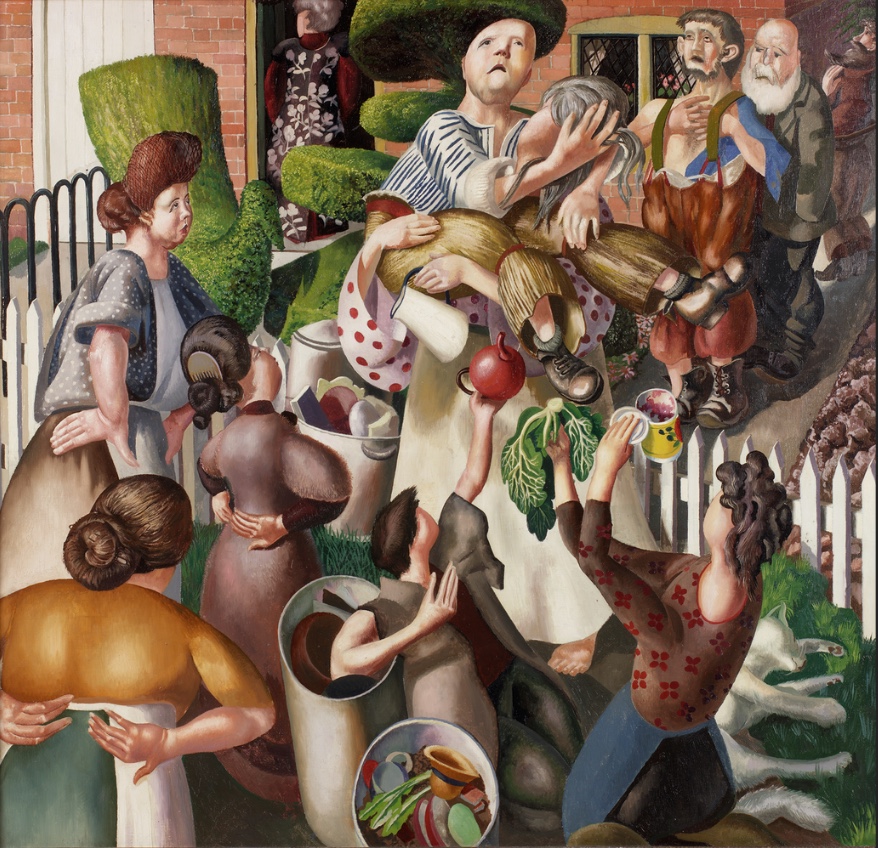
  The Lovers (The Dustman)  (1934)
Sir Stanley Spencer

A “dustman” in England is what Americans call a “garbageman,” and Stanley Spencer loved to see the “dustbins” set out every Tuesday morning in the streets of  his beloved Cookham. In  the painting he is himself a dustman with his trousers tied up tightly just below the knee — to prevent the vermin from climbing up inside them! Like a grown-up difficult child he is in the arms of his wife who is holding some left-over milk for him while he twists her thick grey hair in his fingers — which  he so loved to do! The other women are offering him bits of sacred garbage too: a broken teapot, some cabbage leaves, an empty jam tin…

The painting was submitted by the artist to the Royal Academy for the 1935 Summer Exhibition and was rejected. As a result, Stanley Spencer, already a revered painter at 45, resigned from the Academy.

[N.B. I have to show you the whole unpublished poem because the entire thread is about how  failure can also be a kind of forgiveness… (Oct. 17th, 2026 )


…………GRAVITY’S RAINBOW:
…………SUNDAY IN THE PARK WITH SIR STANLEY

………………..O rejoice in the women,
………………..And the white perfect ducks
………………..With their fashionable heads in the mud,
………………..How they tether themselves down
………………..With pegs in the ground
………………..So they won’t float up in the air,
………………..The feathery dry air that is brighter than gold
………………..But stays unredeemed on the shelf.

………………..For the ducks like the women
………………..Turn weight upside down
………………..By the water on Sunday to stay down,
………………..Not to be better, or up nearer the sun
………………..With the buskers, fine philharmonic
………………..Conductors, preachers, teachers,
………………..Invalids in chariots, toddlers and clowns —
………………..Ah those sweet little flippers that tickle the air,
………………..As pliant as play-dough or beeswax,
………………..Useless as paperweight slippers,
………………..Ballast for butterflies, barbells for kittens —
………………..Perfect as the lead in the magician’s tight furnace
………………..Or the sticky brown muck in God’s oven.

………………..“O the big wide basket of my body,”
………………..The duck woman cries,
………………..“O the piles of starched linen, the fillips,
………………..The white cotton aprons and tea-towels
………………..Folded so nicely in my trembling arms,
………………..Down on my knees by the pool!

………………..“Take this fine little turn-up,
………………..For example,” she says,
………………..“Do you see how it’s paddled and done?
………………..“The masterful curl at the end of the tail,
………………..How the bottom turns upward as if at a ball,
………………..The crinoline, the petticoats,
………………..The old-fashioned drawers that kick highest of all —
………………..And O how they flutter with each do-si-do,
………………..And how the heart goes — can’t you feel it?
………………..And aren’t it worth the applause?”

……………….. “Come on in then, come on in!”
………………..The duck-caller cries,
………………..And when she comes in on his arm
………………..To waddle like a lover on the velvety floor,
………………..Or soon to be mother,
………………..Which is very good too,
………………..How he dips by the water for a nod or a snooze
………………..Any day in the park, old poet by the pool —
………………..Takes his nap on a folding green chair and the paper,
………………..A moist royal nap amongst women,
………………..Head-over-heels in God’s pool.

…………………………Christopher Woodman
……………………………. from GALILEO’S SECRET: Two Decades of
……………………………..poems under House Arrest. [unpublished]”

NOTE: “Gravity’s Rainbow” from the very end of GALILEO’S SECRET, has in itself a considerable bibliography just waiting to be discovered by some ardent young academic a few years after Christopher Woodman’s death. “And the guy never got published,” the lucky student  may recount breathlessly to his friends over his latte at Starbucks, “so  nobody’s ever done him!”

“I can’t wait!” says Christopher.”

…………………THE DISCUSSION CONTINUES IN THE COMMENTS

“O FOOL OF EARTH!” A Haiku by Samson illuminated by Julija with Caravaggio, T.E.Lawrence & an encore by our Christy himself.

O Fool of Earth 450

……………………………………………………………………November 21st, 2017

A first draft of an illuminated haiku by a very special and gifted new friend, a Russian speaking Latvian calligrapher who goes by the single name of Julija. And there’s going to be lots more of her, including an illumination of the haiku in the previous post. At the moment her version of “Stumped like this” is lying on her scriptorium desk on the island of Bali, and I just read that the famous volcano Mt. Agung is going off so there may be a delay.

Just a few weeks ago, Julija and I started working together on a project to illuminate a series of what I call “relics” in my latest book called La Croix Ma Fille. And just to lay this new card on the table from the start, should La Croix Ma Fille find a publisher it might now include Julija’s work. Because what she is doing has inspired me so — lifted my spirits, confirmed my hunches, and given me the courage to believe that, even at just a few days short of 78, this author might still manage to publish the book!

I’ve had the idea for years — that I might assemble a book that would include some poems that I didn’t write myself but were “found.” So La Croix Ma Fille has a Foreword entitled “Three Relics Found Amongst the Ruins, Thought to be Samson’s,” the last poem of which is the haiku called “O Fool of Earth” — which, if you please, was written not by me but by the “front-line saint” called Samson, a Justice League enforcer if there ever was one. Because he’s God’s own body-guard, bouncer, and batman — yet he’s also humanity’s fool like the shy inventor, Bruce Wayne, which means not unlike me and perhaps even a bit like you. And don’t forget that these jottings were discovered “in the ruins” sometime after Samson pulled the temple down about his ears — “So the dead which he slew at his death were more than they which he slew in his life,” as the Bible puts it. And if that doesn’t sum up our own well-meaning but tragic interventions at home and abroad, what does, and I mean both on the personal and national levels?

Here is the “relic” as it appears in my typed m.s. in 12 point Lucida Calligraphy — that’s as far as I dare to go for open submissions, but I’d love to see what a good book designer could do with the fonts, colors and spacing . It’s a ‘Haiku’ as well as a ‘Relic,’ of course, so there’s that too to take into consideration.

O Fool of Earth - Relic

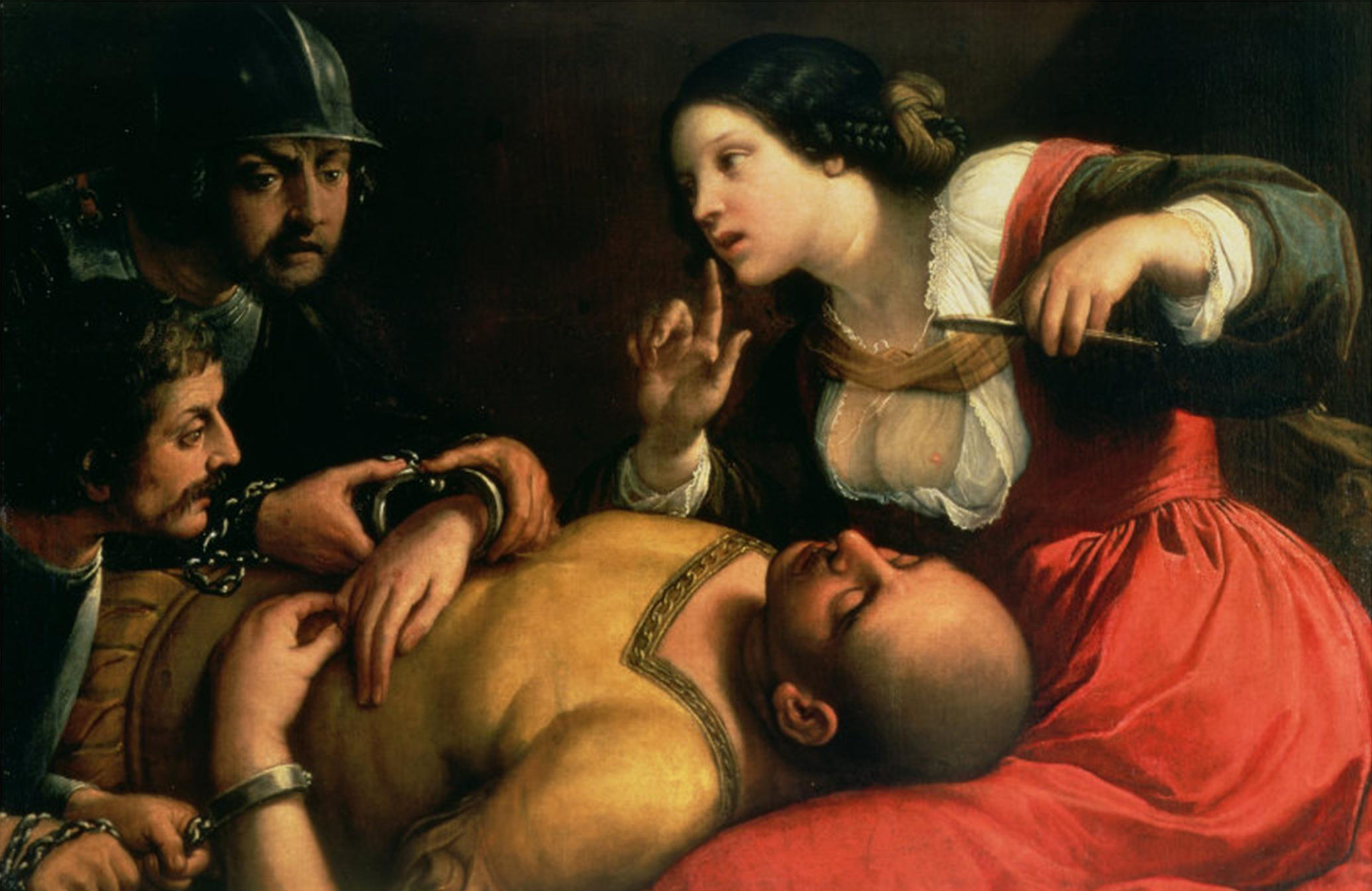
Julija’s version of the same poem at the top of the page is an early sketch with the script partly in black-letter and partly cyrillic, a fusion which creates an ageless sort of sacred cypher, which I love. Because the reader mustn’t forget that the original was transcribed in long-hand by a prophet in a most challenging position — trussed up between pillars with his God on the one hand and his girlfriend on the other (my imagination still goes to  Caravaggio*  for that, the saint’s bare head, her lap, the nipple, and God flaring up all over the place…).

………………

*Note: CARAVAGGIO! or How the Samson of Painters Paints Samson.
……………………………………………………………………..November 25th, 2017

It’s the prophet himself who wrote this little poem so forthrightly, of course, and by my way of thinking it’s the weakness of Samson that demonstrates his ‘chosen’ status more than his brute strength ever did. That’s why I think Samson was granted even more divine strength for that one last shove, and why the effects of it were even more cataclysmic than what he managed to do with the jawbone of the ass. And that’s how Caravaggio painted him as well, didn’t he? Doesn’t his shaved Samson reveal a prophet who is even more powerful sexually than he was before, his smooth skin, his feminine curves in silk and his hands just like her’s? And don’t the lovers fit together just about perfectly? And doesn’t everybody inside and outside the painting know just what that means? (Click more than once to see that even better.)

What also makes this haiku holy is the simplicity of its vocabulary: “wise,” “heart,” “love,” “girl’s,” “flares up,” and “burns.” Had someone like me written the poem you’d think it was by a middle-school student trying to make his creative writing teacher happy, whereas the author is actually an ancient prophet who is just about to discover his true strength by acknowledging that he has not only lost it but abused it. He admits, moreover, that his heart is not “wise,” and whereas the girl’s heart in the poem just “flares up,” his goes on burning and burning, a self-destructive and at the same time self-affirming conflagration not unlike Caravaggio’s. And it’s not demeaning for him to use the word “girl” either — indeed, he’s mocking himself, not women, exposing his fatal attraction to fantasy lovers as opposed to real or ‘other’ persons, and that’s a man-problem that no amount of man-splaining can ever cover up. Samson may be a saint but he knows he’s also a fraud ** — which is precisely what makes this humble scrap of a relic-poem so precious, and why any human being might think to fold it up carefully and place it in a small reliquary on a string about the neck, a talisman to keep from being undone by gently, humorously, respectfully turning oneself away from the self-serving self to behold. And “turns” is just the right word to describe whatever that is, I feel sure, though I haven’t a clue what that is myself.

**NOTE: The flawed saint I admire above all, and the one I never stop thinking and writing about, is T.E. Lawrence, and in a sense all of the above is about him. While actually on the road to Damascus at the very end of the Arab Revolt in 1918, [and with the Morte Darthur in his camel’s saddle bag, dear Jūlija and Romain], Lawrence realized that “all established reputations were founded, like myself, on fraud.” He removed himself from public life altogether shortly after representing King Faisal at the Treaty of Versailles in 1919, the outcome of which broke his heart as well as the whole of the Middle East. He died in 1935 under the name of T.E.Shaw, an ordinary mechanic in the Airforce. It was just a local motorcycle accident on a small country lane, but his funeral entourage a few days later included everybody from Bernard Shaw and E.M.Forster to Winston Churchill, and many born like myself too late are still there.

……
ONE LAST FINAL ACT AND DEPARTURE

By way of an encore to all these final acts and departures I’d like to bring in for one last bow another Irishman, J.M.Synge’s almighty wastrel/minstrel hero from “The Playboy of the Western World.” For it’s “our Christy himself,” that genius liar, lover and logos, who makes such an utter fool of himself that he can turn the tables on the whole world, and scold all the Fools of Earth in one hearty go as if he were some Old Testament prophet: “Shut your yelling, for if you’re after making a mighty man of me this day by the power of a lie, you’re setting me now to think if it’s a poor thing to be lonesome, it’s worse, maybe, go mixing with the fools of earth!”

Which should bring this to a close, I think — dear friends.

Christopher

ONE FOR SORROW, TWO FOR JOY

Piero de la Farncesca 475 Piero della Francesca, Nativity (1475)(click on it to see the birds better)

……………………………………………..~

……………………..POST HOC, PROPTER ERGO HOC

………………………..“Two magpies,” she wrote him
………………………………….on shore again in February.

………………………..He propped them up above
………………………………….the herb jars in the galley

………………………..All that winter while she
………………………………….traveled overland in Africa—

………………………..Others hung there too, almost
………………………………….a dozen as the days lengthened

………………………..And the bright green shoots
………………………………….shone like spring in porthole pots.

………………………..He lay more naked in his letters then
………………………………….but the light-sick moths powdered

……………………….His thighs, made his eyes
………………………………….dapple and water as if he missed her.

………………………..Then she wrote again about
………………………………….small birds that migrate pole to pole

………………………..And told him he really ought
………………………………….to have more Arctic dreams.

………………………..It was then he began to notice
…………………………………the way the sheets twisted oh so

………………………..Tight like water-wings about him.
………………………………….He wrote her twice to Porto Ferraio

………………………..But the letters came back
………………………………….to an empty berth and bits

………………………..Of white silk on the bulwarks
………………………………….as if he’d undressed or cracked

………………………..In the terrible rush of the hatch—
………………………………….the brightness of a sheltered reach

………………………..Perhaps, the ease with which
………………………………….mayflies rise on the silvery stream.

…………………………………………………..~

This is a very small poem in a very small style, indeed as bare and simple as a Piero della Francesca painting, and as dependent on faith. That means your faith, the faith you have in yourself, the viewer, not in Jesus or Mary or anything like that but just in how much faith you are able to bring to whatever you see without rhyme or reason, like that tiny little bird on the left, or the big one on the stable roof for that matter, which is unmistakably a magpie. How still can you rest as you view two birds like that, for example, how long can you hold your gaze without blinking, without starting all over again to define what you see in relation to who you are, where you stand, what you expect, and what you know about me? Can you do that? Can you rest in uncertainties when you don’t even know who a poem is by or what it’s getting at? Can you trust yourself, in other words, and not just rush in to either explain it away, or appropriately file it ditto?

Or what if a friend sent you this poem because he or she wanted you to have it. Would you hold back the joy or the sorrow?

………THE COMMENTS THAT FOLLOW DEVELOP THE THREAD

CONFESSIONS OF AN OPIUM EATER: The New Critical Habit and How I Broke It.

As someone trained in the 60s at Yale and Cambridge who caught the bug from W.K.Wimsatt, sipped sherry with I.A.Richards and E.M. Forster on the same couch at Kings, shared a bag lunch with F.R.Leavis in a cold brick corner of some unrecorded quadrangle at Darwin, and suffered a nervous breakdown when a close disciple of Wittgenstein played with his head and his wife somewhere down the Huntington Road toward Girton, mostly on a bicycle, he had the New Criticism in his blood — and it’s a rush, I tell you.

And that’s a major part of the problem for any New Critic, to resist the thrill of using the gift of the academic gab as if it were a divine right — and I had a lot of that sort of chutzpah too, which I’ve now partly outgrown and partly forgotten. Indeed, that gift has bedevilled me both as a teacher and a poet all my life — because I so loved being a Guardian of the Poetry Threshold, I got so high on it, so vatic and blissfully feathered, I was not to be trusted on the ground at all. And even in my twilight years here on my other planet, I can still hold forth for hours and hours on a text, and the few people that somehow find their way to my table in Chiang Mai and ask the wrong question, e.g. anything to do with poetry, are still in mortal danger.

The danger is the way we New Critics deliver the message that only specially trained people can get the full meaning out of poetry, and even worse, that poetry that’s good is difficult. And, of course, the assumption that we cannot navigate it without a highly trained pilot in the wheel-house!

New Critics have become heavy pushers of that line, and far from increasing the popularity of poetry, their critical ‘gifts’ have crippled those who would like to hear about it just as much as those who would like to write it. For just like heroin, the effects of the New Criticism are as irresistible as they are destructive, and we’ve all ended up hooked on a kind of poetry that simply can never deliver enough. Indeed, the habit gets bigger and bigger even as we get smaller and smaller and more and more isolated from the world of real people down below.

Enter American poetry today. Enter the New Critical Angel.

Angels? Well, Kierkegaard can tell you just how dangerous “great moments” can be, and how disastrously misleading, but there’s another picture that works for me too. In the well-known Tibetan mandala, ‘The Wheel of Life,’ the angels at the very top are either blissfully at ease or blissfully exerting power. At the very bottom are the ghosts in hell, thirsty, hungry, endlessly tormented, abject victims of their own ignorance. Human beings are exquisitely poised between the two extremes and, the Buddha says, that’s a better place to be than even among the angels — because humans are the only beings that have any real hope of seeing things as they are, and thus achieving freedom from self-serving prejudice. And why? Ghosts suffer, angels live in bliss, but only human beings know both at once. When at last the heavens begin to change after countless aeons, and the slightest crack appears in the firmament, which inevitably it does, says the Buddha, an angel is unable to adapt. An angel’s attachment to bliss, permanence and control is so insidious it falls headlong into the very deepest hell at the first hint of dissatisfaction. Even an animal, it is said, is better off at that moment than an angel.

Instructional, and the curse of all inflation.

What I did about the potential Angel in myself, the Poet-written-Big in my nature, was truly radical. I simply placed a moratorium upon myself as a writer, and from my teen years in the 1950s until I felt at last safe enough to try again in the ’90s, I just didn’t write poetry at all, or at least I just wrote love poems and gave them away. Because I always knew secretly I was a poet, but a poet who couldn’t be trusted to write poetry as it should be written, with restraint, patience and integrity. Like T.E.Lawrence on the road to Damascus in 1918, I realized that “all established reputations were founded, like myself, on fraud,” and in my own humble way I wanted to avoid that pitfall. Even though I was very young and not remotely anything special, just living in a special time and place, I knew I had to be careful. And in the end I did manage to stay me, and not become just another fiddling angel. I arrested my development, went into artistic hibernation, and emerged 30 years later to publish my first poem at 52 without any established reputation at all to get in the way, or any schtick or obfuscation.

Here’s a poem about all this — it’s still a ‘new critical’ type poem, for sure, but I don’t think I’ve ever said it better. And there is room for this type of poem on Parnassus too, it’s just a lot harder to keep your head at such a heady level and, of course, to keep the hat off.

………………….SAMSON BETWEEN THE PILLARS,
………………….SAUL AND LAWRENCE ON THE ROAD
.
………………………….There was knocking but
………………………….no door into that heroic
………………………….world but first
………………………………………………..bowing out of it,
………………………….deferring gracefully to those
………………………….small private abstentions
………………………….that had murmured all
………………………….along just behind the
………………………….uncompromising hard
………………………………………………….god’s brilliance.

…………………………Like all things likely shorn
…………………………undressed ears can hear
………………………….the faintest abdication
…………………………………………………………..knocking.

………………………….Each white petal’s fall or
………………………….slightest finger’s white
…………………………………………………….print in soot,
………………………….every clean track or dry
………………………….tear knocks too against
…………………………………………………….that solitude.

………………………….Even the infinitesimal shock
………………………….of a single naked
……………………………………………………….snow-flake
………………………….slipping through some
………………………….daedalian avenue before
………………………..aall that slicked-back tar
………………………….can even wink at such
………………………….quick celestial skin
……………………………………………………is knocking—
………………………….just as veiled eyes seeing
………………………….too many fine things done
………………………….for the good in Damascus
………………………….turn toward whatever
………………………….violence or private wailing
……………………………………………………..wall closing
………………………….even as the bluntest flint
………………………….tapping, tapping opens.

………………………………….from LA-CROIX-MA-FILLE:
…………………………………………Hexes, Ruins, Riddles & Relics.

………………………………………………….(unpublished)

NOTE: In the final days of his Arab campaign in 1918, and while actually on the road to Damascus, T.E. Lawrence realized “all established reputations were founded like myself on fraud.” He changed his name, enlisted initially in the Tank Corp and then the RAF as an ordinary mechanic, and died on a motorcycle on a small country lane in 1935. Having tried his best to expunge himself while still alive, everybody walked behind his casket to the local graveyard including Winston Churchill, Charlotte Shaw and her husband, George Bernard, and E.M.Forster.

Christopher Woodman


……….+………+………+………+………+………+………+………+………+………+………+………+………+………+………+………..+………+………+………

If you are unsure where to go next on the Site, you can return to A COMPLETE DIRECTORY.

A great many of the early articles in the COWPATTY ARCHIVE are not listed in the Index on the left — there just wasn’t enough room for them all. To access this earlier material, you can enter the site with the URL: https://cowpattyhammer.wordpress.com. and then scroll back toward October 2009 where it all began. But don’t forget to click on “OLDER ENTRIES” at the end of each section.

You can also click on the small ARCHIVES window at the bottom  of the left hand Index and scroll down to the very earliest DATES or the CATEGORIES . The latter may be able to direct you even more specifically to what interests you.

You can now move on to the next thread, A HAPPY CHRISTMAS TO ALL MEN AND WOMEN BLESSED BY WINGS IN A SIMILAR FIX