Gilding the Pieces: LA-CROIX-MA-FILLE.

Fan Tail 450
The old Impington Windmill at Histon, Cambs, 1967.

Histon is the small village near Cambridge where Christopher Woodman began to restore an old windmill in the 1960s. The ‘fan-tail’ which you see here drives a series of cogs and shafts that turn the whole top of the mill so the wind-blades always face the wind. This meant that when Christopher Woodman looked out of his window from the Miller’s Cottage each morning, having completed that part of the restoration, he was never quite sure where he was as the world changed all its coordinates when the wind shifted directions in the night.

.
PARTINGS & RESTORATIONS

…………………………………………………..updated May 12th, 2022
To start with, I have very few friends who read poetry and even fewer who read the poetry I write. This is partly because at two very important junctures in my life I quit poetry altogether, and as a poet I have no past.

The first time I quit was in my teens when I stopped writing because I knew my poetry was fake. Even at sixteen I was aware that I wrote poetry because I wanted to be a poet, and would cobble together anything and call it a poem for that reason. CW Yearbook 1957Indeed, I was aware that I was putting on a mask in order to hide my own struggle with myself, not to express it — I couldn’t tell anybody that but knew it myself. That’s one of the reasons I’m still so interested in W.B.Yeats who was an out-of-touch adolescent with similar obsessions all his life. On the other hand, right from the start Yeats built on an ancient mythology that had everything to say in itself however much he fudged it, and of course he was also a genius in so many other ways. I posed as Yeats did but with a great deal less skill and with no effective schtick of my own at all. I pretended to be Shelley, for example, and even nourished the fantasy that my boy’s boarding school was the school that imprisoned 19 year old Percy Bysshe’s 16 year old Harriet! But all the same I did get a superb education there and, perhaps even more importantly, the experience of waking up among the magical New Hampshire lakes and forests for five of my most sensitive years.

I also arrived with a beautiful soprano voice, and from the age of 11 sang solos in the St. Paul’s School boy’s choir, Handel to Mendelssohn. I did it for that long because my voice remained clear as a bell until I was all of 15, no less. And of course I was just getting ready to quit poetry at the same time that my voice was finally changing, and little did I realize what all that would mean for the latter part of my life!

To finish up the First Parting, then, I fell in love with the girl in the red silk dress at 17, married her at 20, and had my first child as a sophomore at Columbia in 1960, just 5 days after I turned 21. I loved my young wife to distraction too but lost her not so long after I married her, just one single fraught decade out of 8 of them — and lost her in much the same way as both the hero and the author lost Yvonne de Galais in Le Grand Meaulnes, that most important of all tropes.

At a séance in New Haven, Conn., 1962.

It was thus that women trumped poetry in my life, and in a sense still do. But I’m not in any way a threat to anybody, not even to myself, nor have I ever been ‘any of the above’ what is more promiscuous. On the contrary, I’ve been much too fond of my wives even when the marriages failed, and they were long ones, an inspired 10+ years each. That always made it especially hard to let them go and, like Alain-Fournier, to my detriment I didn’t.

Women have always been it in my poetry as well — as it was for the Troubadors, for Dante and Petrarch, for Goethe and Coleridge to John Fowles and his mentor, Alain-Fournier. On the other hand, this pedigree has had less to do with my personal relationships with the women I have loved than with what might be called my ‘magical thinking.’ Indeed, it lies at the core of my inner life as a seriously engaged Buddhist/Christian/Animist who remains both an undeveloped enfant terrible and an old hurt soul to this day. As silly as all that may sound, I wouldn’t be me without any of it!

And just to mention that I’m now in the 30th year of a marriage with a very real, dynamic, professional woman, Homprang Chaleekanha, and if you want to know more about that sort of love relationship you should read the last of my 3 books, Fig Leaf Sutras: a Memoir in Poems, 1994-2024. I just hope you will be able to get hold of it soon. Indeed, it’s out there right now, fishing with the very brightest feathers and most succulent bait it can manage.)

The Second Parting was not with writing poetry but with studying the history of it as a graduate student at King’s College, Cambridge. C.S.Lewis accepted my research proposal based on the reading of Edmund Spenser’s The Faerie Queene I had developed under Professor Harry Berger at Yale, and C.S.Lewis was my Supervisor until he passed away leaving me just with the title of my thesis, “Polyphonic Narrative in Elizabethan Literature” — which remains to this day the origin of my style, my imagery, and my modus vivendi both as a poet and as a person.

That Second Parting happened just four years after my brother Tony’s accident in 1965, and was certainly hastened by it. In the interval I had won a Research Fellowship at Christ’s College and at the same time become Chairman of the Cambridge University Buddhist Society, a delicate balancing act if there ever was one. And what I did after that shocked everybody, even myself — I resigned my Fellowship at Christ’s, sold my beloved windmill in Histon, packed up my beautiful wife and by then 3 little girls, and went off to Scotland with a Tibetan Lama. But the really devastating event in that Second Parting was the moment when my beautiful wife, aka ‘the girl in the red silk dress,’ departed with another of the Lama’s disciples, and I found myself at 29 alone with 3 small children and a whole lot of relics already — memories, images, artifacts, whatever you want to call them — all of which are covered in the gold leaf that has always sanctified my turbulent, topsy-turvy past.

Indeed, “La-Croix-Ma-Fille!” used to be called “Gold Leaf on the Waters” but has now moved on to a title that’s more like life as mine actually turned out to be. And how I hope you will be able to get hold of my book in the very near future as it’s so winsome and so longs to be read. It’s out trolling at the moment too — you can click on the title, “LA-CROIX-MA-FiILLE!” to see what it’s doing right now.

……………………………..My fingers ache with so much crossing,
………………………………………………………..Christopher

RELOCATIONS & RECASTINGS


Tea break at the Old Windmill with Sophia & Delia in the sandpit.

Christopher Woodman restored the old ‘Impington Windmill’ in the village of Histon while living in the Miller’s Cottage at the base of the mill in the 1960s — those are wooden cog-wheels that he’s sitting on which he intended to restore as well. He had already rebuilt the whole fan-tail porch in hard wood and recovered the dome-like cap as well with lap-strake cedar. Fortunately there were blacksmiths in Cambridgeshire at the time who still knew how to find and/or recast the broken iron parts of the machinery just as his writing attempts to relocate and sometimes to recast the missing parts of himself and his life. Much of that was also involved in his 400pps Cambridge thesis, “Polyphonic Narrative in Elizabethan Literature,” which was not liked at all by any.

1910

This is an old photo of the ‘Impington Windmill’ in 1910 with young women in white bonnets picking strawberries for the Chivers jam factory in the nearby village. If you look closely you can see two figures standing on the fantail of the mill. There are also two horse-drawn wagons, and the overseer is wearing a suit and fine hat. This is very much the worlds of both Tess of the d’Urbervilles (1891) and Le Grand Meaulnes (1913), remnants of both of which were still there in rural England and France when Christopher Woodman arrived just 50 years later. The miller’s cottage where he lived with his wife and children is visible just to the left of the mill, indeed his third and youngest daughter, Antonia Unity, was born in the cottage in 1967.

1

THIS IS THE END OF THE THIRD SHORT PREFACE...


 ……..+………+………+………+………+………+………+……. ……..+………+………+………+………+………+………+…….+…….+…….
[To exit this Preface you can visit  LA CROIX MA FILLE! ,  the ***FIRST MAJOR THREAD*** on this particular theme.

[Alternatively you can go on to the   ***FIRST MAJOR THREAD*** in the Index:  FOR THOSE LIKE GALILEO WHO NO LONGER READ .

[You could also choose any other title from the Index in the left-hand Margin.]


IN PURSUIT OF THE STILL UNWEIGHED: Off the Record at Eighty.

…………………
I am on the side of angels and of dirt.”
…Sir Stanley Spencer (1891-1959)

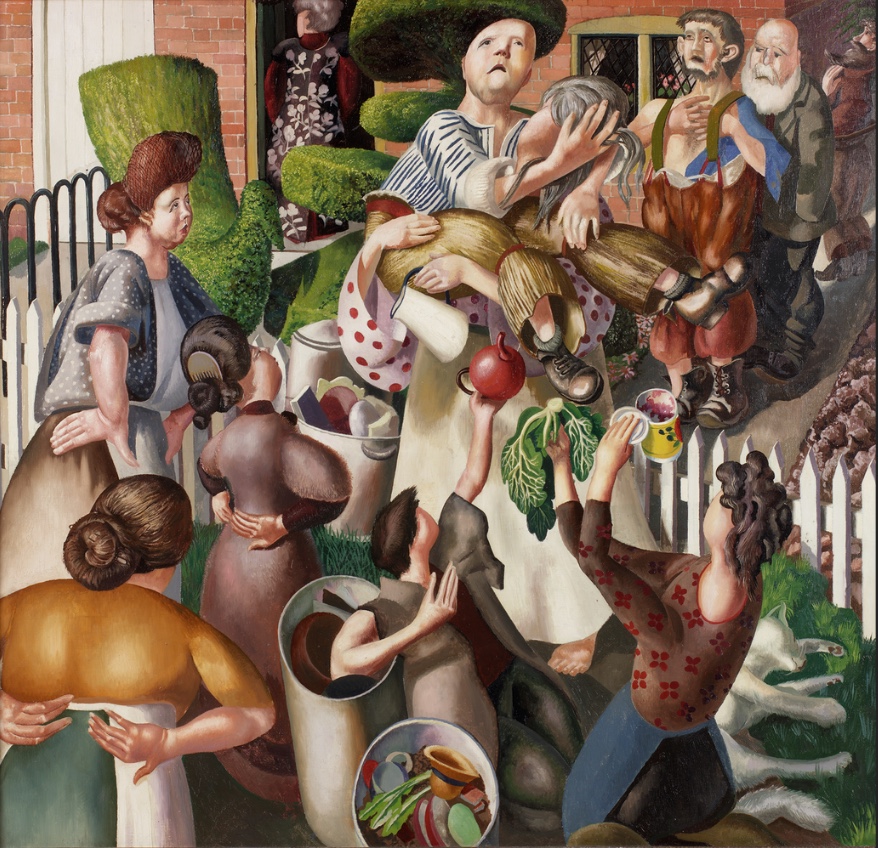
  The Lovers (The Dustman)  (1934)
Sir Stanley Spencer

A “dustman” in England is what Americans call a “garbageman,” and Stanley Spencer loved to see the “dustbins” set out every Tuesday morning in the streets of  his beloved Cookham. In  the painting he is himself a dustman with his trousers tied up tightly just below the knee — to prevent the vermin from climbing up inside them! Like a grown-up difficult child he is in the arms of his wife who is holding some left-over milk for him while he twists her thick grey hair in his fingers — which  he so loved to do! The other women are offering him bits of sacred garbage too: a broken teapot, some cabbage leaves, an empty jam tin…

The painting was submitted by the artist to the Royal Academy for the 1935 Summer Exhibition and was rejected. As a result, Stanley Spencer, already a revered painter at 45, resigned from the Academy.

[N.B. I have to show you the whole unpublished poem because the entire thread is about how  failure can also be a kind of forgiveness… (Oct. 17th, 2026 )


…………GRAVITY’S RAINBOW:
…………SUNDAY IN THE PARK WITH SIR STANLEY

………………..O rejoice in the women,
………………..And the white perfect ducks
………………..With their fashionable heads in the mud,
………………..How they tether themselves down
………………..With pegs in the ground
………………..So they won’t float up in the air,
………………..The feathery dry air that is brighter than gold
………………..But stays unredeemed on the shelf.

………………..For the ducks like the women
………………..Turn weight upside down
………………..By the water on Sunday to stay down,
………………..Not to be better, or up nearer the sun
………………..With the buskers, fine philharmonic
………………..Conductors, preachers, teachers,
………………..Invalids in chariots, toddlers and clowns —
………………..Ah those sweet little flippers that tickle the air,
………………..As pliant as play-dough or beeswax,
………………..Useless as paperweight slippers,
………………..Ballast for butterflies, barbells for kittens —
………………..Perfect as the lead in the magician’s tight furnace
………………..Or the sticky brown muck in God’s oven.

………………..“O the big wide basket of my body,”
………………..The duck woman cries,
………………..“O the piles of starched linen, the fillips,
………………..The white cotton aprons and tea-towels
………………..Folded so nicely in my trembling arms,
………………..Down on my knees by the pool!

………………..“Take this fine little turn-up,
………………..For example,” she says,
………………..“Do you see how it’s paddled and done?
………………..“The masterful curl at the end of the tail,
………………..How the bottom turns upward as if at a ball,
………………..The crinoline, the petticoats,
………………..The old-fashioned drawers that kick highest of all —
………………..And O how they flutter with each do-si-do,
………………..And how the heart goes — can’t you feel it?
………………..And aren’t it worth the applause?”

……………….. “Come on in then, come on in!”
………………..The duck-caller cries,
………………..And when she comes in on his arm
………………..To waddle like a lover on the velvety floor,
………………..Or soon to be mother,
………………..Which is very good too,
………………..How he dips by the water for a nod or a snooze
………………..Any day in the park, old poet by the pool —
………………..Takes his nap on a folding green chair and the paper,
………………..A moist royal nap amongst women,
………………..Head-over-heels in God’s pool.

…………………………Christopher Woodman
……………………………. from GALILEO’S SECRET: Two Decades of
……………………………..poems under House Arrest. [unpublished]”

NOTE: “Gravity’s Rainbow” from the very end of GALILEO’S SECRET, has in itself a considerable bibliography just waiting to be discovered by some ardent young academic a few years after Christopher Woodman’s death. “And the guy never got published,” the lucky student  may recount breathlessly to his friends over his latte at Starbucks, “so  nobody’s ever done him!”

“I can’t wait!” says Christopher.”

…………………THE DISCUSSION CONTINUES IN THE COMMENTS

WHY I WROTE HOW BAD IS THE DEVIL

I was born in 1939, the year Yeats died.

In the photo I’m in a derelict Hmong shaman’s house on Doi Pui. I’m 76, and the house is still up there with all its paraphernalia, even the hearth unswept and the log ladder with the notches cut in for climbing up to the sleeping platform.

No local person in their right mind would dare to enter such a formidable person’s dwelling place — unless they needed help, of course, and then they would fast, wash, and bow their way in — with offerings, an egg maybe, a small cupful of blood, a sprig of rosemary. But no fooling around, as I’m certainly not fooling around in the photo.

Look at my stick. Look at my bent body.

Indeed, that’s why I write into dangerous places like How Bad is the Devil — to enter a realm nobody in their right mind would venture into. ‘Women,’ after all. foemina!

That’s important for me to say as the reward for the effort I put in everyday. It’s the strength to go on in such a way even with so little encouragement, even from my wife, I mean, a strength which is also a certain softness that inspires and protects me.

My wife Homprang often asks me how someone with so many degrees can be so stupid, and I always reply the same way, that unlike me she’s a genius. Which she really is — because reading and writing so little has given her a distinct advantage over me when it comes to sharpness and sanity. Because of course she can see ghosts and things like that which is a great advantage because they terrify her and make her refrain from doing or saying anything stupid or risky. On this particular day, for example, she wouldn’t even peak in the door of this house, and the photo was taken by a foolish student who didn’t know anything…

And I’m just the opposite, of course — I’m a bit soft in the head from reading and writing too much. It’s my rarefied education that has made me so fearless as well as foolish, a fact that makes Homprang even more impatient — because just imagine what she might have done had she had an education like mine instead of leaving school at eleven? I mean, she could have made up ghosts and spirits like I do instead of being careful never to look in their direction what is more to mention their names.

On the other hand, isn’t it also a certain softness in the head which makes us love and admire a great poet like William Butler Yeats so much, that he could have worshiped Maud Gunn like that for so long, for example, and then proposed to Iseult? Or sat up and read what his very young wife George wrote down restless beside him in bed on their honeymoon, as if she were Ishtar or the Angel Gabriel descended on the Ashdown Forest Hotel? And never even to have suspected she might have been making it up — as in a sense she didn’t, both of them being in the softness way over their heads? And to have actually believed in “The Circus Animal’s Desertion” too even when he was always so nicely put up in Anglo-Irish country houses right to the end, an emperor with a mechanical bird for eternity in a gilded cage?

Or Eliot in his own foul rag and bone shop of the heart down-and-out in Harvard and Paris?

…………………………………Between the conception
…………………………………And the creation
…………………………………Between the emotion
…………………………………And the response
…………………………………Falls the Shadow.

And how we love the really great ones for being soft in the head like that, neurasthenic even, connecting nothing with nothing. How they expose us and redeem us, and make us whole.…………………………………<…………………………………In an Emergency.

~

I lived for 10 years in Coleman’s Hatch on the Ashdown Forest just down the road from the Pooh Bridge in one direction and the cottage where Pound wintered with Yeats in 1913 in the other, and I walked by the Ashdown Forest Hotel everyday on my way to teach school with my children, and drank at the Hatch in the evening. That was back in the ’70s.

~

What’s important is something way out there, that’s the point, and I mean having the courage to do whatever it is all by yourself regardless and always in a sense upstairs alone in your room late at night. Because there’s no other activity that counts one iota but being alone with a loaded gun and a delicate body.

…………………..Much Madness is divinest Sense —
…………………..To a discerning Eye —
…………………..Much sense — the starkest Madness —
…………………..’Tis the Majority
…………………..In this, as all, prevail –
…………………..Assent – and you are sane –
…………………..Demur – you’re straightway dangerous –
…………………..And handled with a Chain –

And that’s how bad the devil is, not knowing your place in the grown-up world, not just lying down and being quiet like the big dog Sam. Being soft in the head is like being Eve in God’s grown-up Garden, I’d say, like not only rejecting Heaven but being in cahoots with the Devil in a serious effort to rewrite Paradise. “Unless we become as Rogues we cannot enter the Kingdom of Heaven,” Emily Dickinson wrote to a friend at age 50, and I’d say courage like that coupled with a delicate body and a diamond mind is heroic!

Speaking as a poet I say that, because in fact I know almost nothing about “diamond minds” or “heroic” but just what I write.

Which is why I write as well, as if my desk were underground in Lascaux — as if the hunt depended on my depiction of the beauty and grace of the animals as well as my reverence for them. And even the sun rising.

~

Emily Dickinson’s named her huge black and white Newfoundland ‘Carlo’ after St John River’s old pointer and not after Mr Rochester’s huge black and white Newfoundland called ‘Pilot.’

With that in mind, can you imagine Emily Dickinson out for a walk on the treacherous, ice-bound cart-road to Hay being rescued and steadied by Jane Eyre as if she were the one who was mounted? The clatter of the hooves and the crash? The neat little boots and the hot breath of the gytrash on your neck? And is that why you name your dog ‘Carlo’ instead, to reject the tall, perfect, god-like ‘Master’ on the straight and narrow path? For the Rogue himself do you name him, tumbling on the causeway at your feet?

And can you see then how the truth is more important than the facts? Can you imagine what ‘Pilot’ was like before the Wright brothers put that neat blue-serge suit on him and made him a captain at 35,000 feet? Can you rather hear the crash of the sea as the earlier ‘Pilot’ guides you over the bar to land-locked Florence and on up the hillside to La Gioiella? Can you go somewhere you can never be but you have to arrive at — where everything that has ever happened happens to you for the first time alone in your room upstairs?

Here’s how I say that upstairs alone in my own delicate body.

…………………..“Yet still it moves!” the old beard raves,
…………………..The moon girdling a softer quarter —
…………………..The impossible return,
…………………..Ocean fins quickening the landlocked water.

………………………………………..from GALILEO’S SECRET: Two Decades
………………………………………………..of Poems Under House Arrest
……………………………………………………….(unpublished)

Christopher Woodman

THIS THREAD IS CONTINUED IN THE COMMENTS THAT FOLLOW.