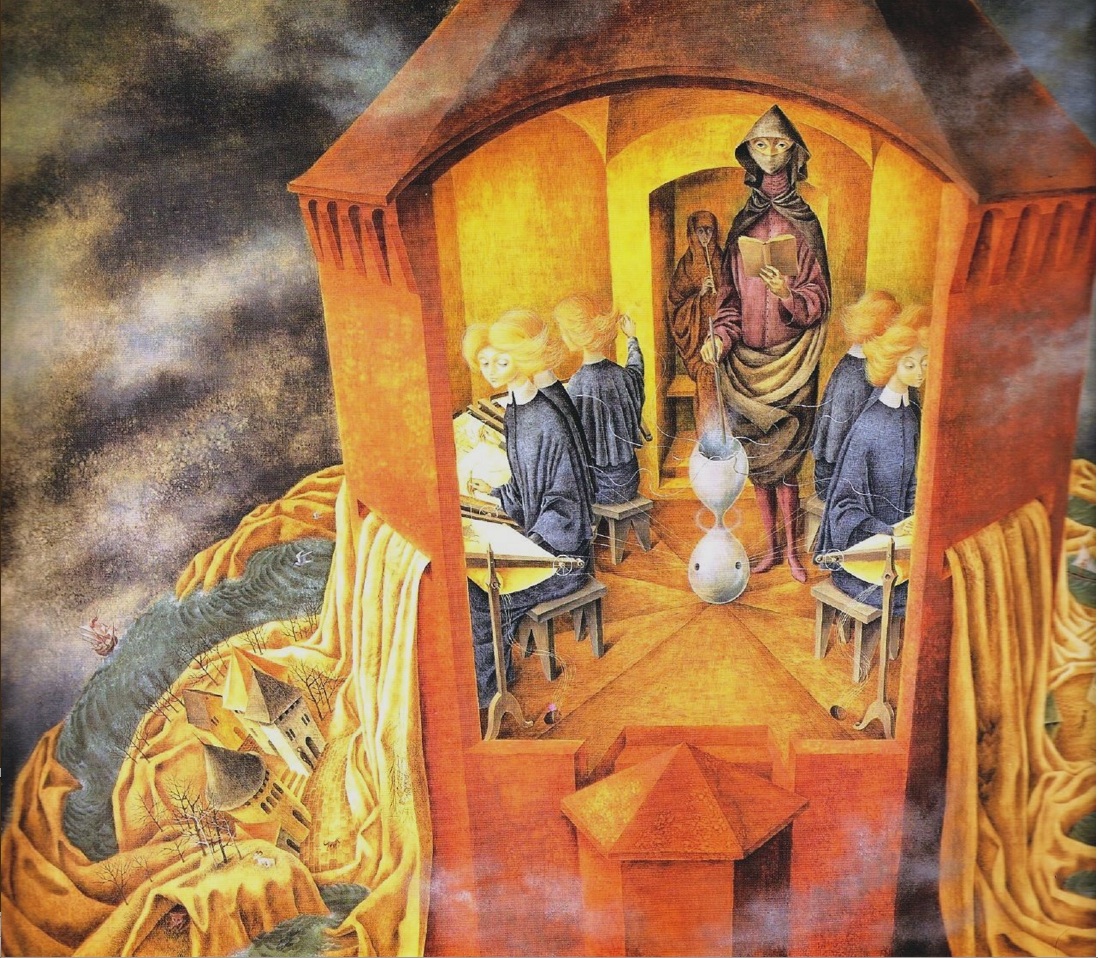
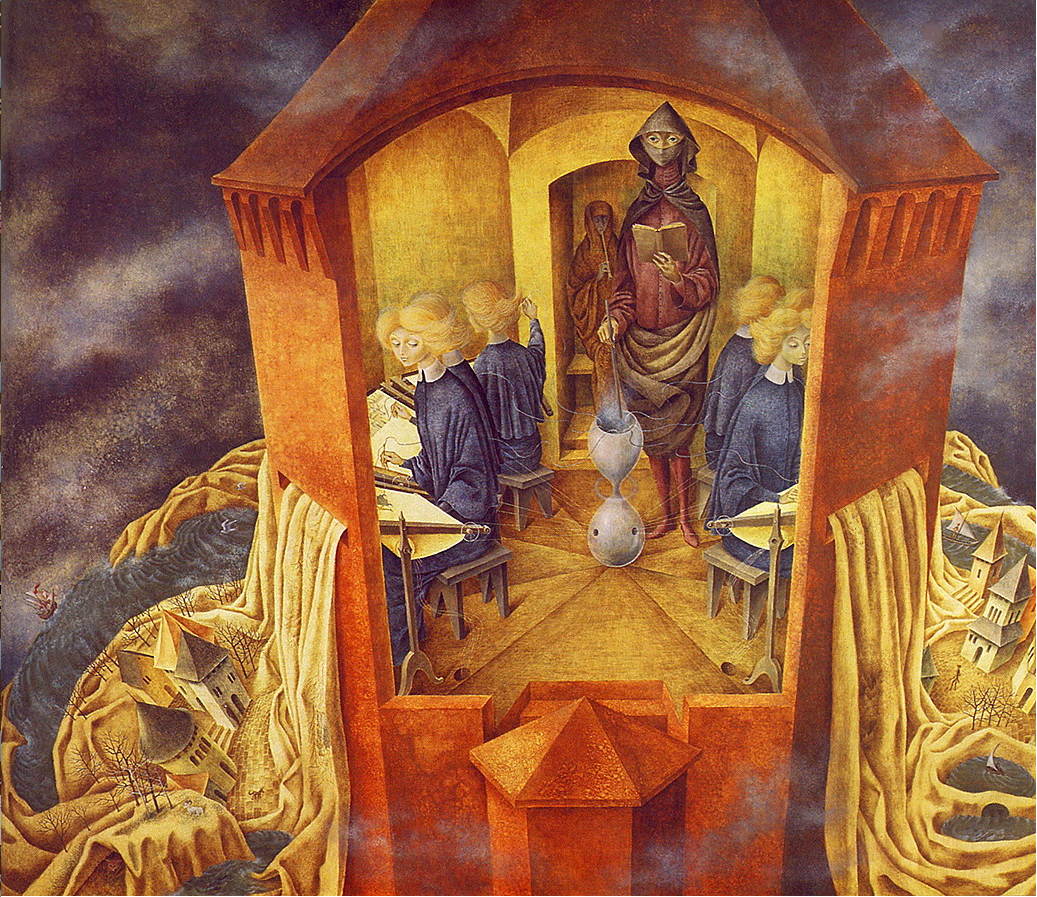
 “Bordando el Manto Terrestre” [ Embroidering the Earth’s Mantle ] (1961) by Remedios Varo.
The Cowpattyhammer management apologizes for having closed “Make It New!” so abruptly.
One of the casualties was that we never got a chance to look at this painting by the Spanish-Mexican painter and anarchist, Remedios Varo. The title means “Embroidering the Earth’s Mantle,” and the imagery is probably the closest we got to the “secret” that was such an important part of the discussion. My own feeling is that with the exception of the sculpture of the tall Aborigine woman and her daughter that introduced the previous thread, this extraordinary painting was probably the most relevant.
You can click here to look at the painting in more detail. Once you have moved in, the definition of the graphic is quite high so you can zoom in as much as you like. Indeed, I’d be very interested to hear what you see.
In addition, if there are any matters arising from the previous thread do feel free to comment below — the management is very grateful to the increasing numbers of people who visited the site in the last weeks of the discussion, and would be very pleased to have more feedback.
Christopher Woodman
………THE COMMENTS THAT FOLLOW DEVELOP THE THREAD


Christopher Woodman said,
February 11, 2014 at 5:13 pm
As we’ve still got one foot (and a big muddy one) back in the previous discussion, I’ll drag in a bit more dirt with one of my own.
At the very end Dawn Potter said:
I met Dawn Potter first on FOETRY way back in 2007, I think — she was just an occasional visitor while I was a regular, but whenever she came in the earth trembled, she was such a fierce breath of fresh air from the Maine woods. I remember very well the day when one debater had the temerity to say she needed to be “de-educated,” and that person I suspect still has some singed places on his head and perhaps some deeper damage elsewhere. I was very struck by Dawn’s strength and passion at the time and have been a great admirer of her ever since, even when she flames me. But still I can’t say, I’m afraid, that I always agree with her.
By way of an answer to her here I’m going to ask Leonardo da Vinci to come into my corner:
Of course they’re both right depending, as we were both right on the previous thread, she about the primacy of craft, me about the primacy of meaning. What was wrong was the rivalry and the anger, and all that’s about something much deeper, I think. And I don’t mean personal, I mean in the nature of things, even when they’re woven in as fantastical a way as they are by Remedios Varo, a woman, take note, in “Embroidering the Earth’s Mantle.”
But I still have to drag in a bit more of the past, I’m afraid. The first time I encountered Remedios Varo was in a discussion on FOETRY too, a site which had a far more active intellectual life than many of its critics realized mainly because they never bothered to go there. Dawn Potter did, and much to her credit. In addition, the quote from Leonardo da Vinci came from the infancy of the very same blog where we are now at a time when it was called ‘Scarriet’ — and the quote is even now part of the Cowpattyhammer/Scarriet joint archive.
And the relevance of all this to “Bordando el Manto Terrestre?”
Wraps. Packaging. Have a look and see.
Christopher
Christopher Woodman said,
February 12, 2014 at 10:27 am
WHAT I SEE FIRST
1.) I see warm, vibrant oranges and yellows tinged with brown that deepen toward the edges into shades of warm silt, all of it surrounded by damp swirling greys and amorphous smudges not yet differentiated into colors.
.) I see a high medieval-type tower with a chamber at the very top with six beautiful young women with golden hair sitting on simple wooden stools with drafting tables before them. Five of the women are busily drawing or designing something while the sixth is raising her right hand with something in it.
3.) I see what is probably a woman in a niche at the back. She is robed like a nun or a devotee of some sort and is playing a pipe. The figure’s quiet, reflective music feels like it is filling and perhaps even creating the space.
4.) I see a very tall, very thin figure standing in a commanding position in the center. The figure is robed like a nun or perhaps a priestess or even a priest with a conical hat and a tight-fitting inner garment that goes all the way from the toes to the chin. The figure is looking straight out but without seeing anything, as if he or she were concentrating hard or perhaps even visualizing something. There is an open book in the left hand as if the figure had been following instructions or interpreting something in it just before looking up. In the right hand the figure holds a stick or a wand of some sort which seems to be stirring something in a very odd, hour-glass-shaped pot just in front. Indeed, the pot seems to be turning too – there’s a circular vector ring around it that would suggest that. A very striking detail is that the figure’s face is veiled with only just the large, far-seeing eyes looking out. A less obvious but perhaps even more significant detail is that the figure’s outer robe is drawn in about the knees so the shape becomes like a calyx, vulva or shell. The figure is so thin, tall and fey yet the robe’s shape is female and full.
Christopher
Christopher Woodman said,
February 13, 2014 at 9:45 am
Building up to WHAT I SEE next – and hopefully you are thinking about that too.
There’s a question that has been on my mind for some years — not to be dramatic but that’s true, I actually mean some years!
I live in a world that is indescribably beautiful in everything it does except it’s art – indeed, in a sense it has no art, only craft. Thai children are brought up with the strict injunction that what you think or you want doesn’t matter, it’s what other people want that’s important, and your elders in particular. Of course your ‘ancestors’ count very highly among your elders, so it’s a very ‘traditional’ society in the sense that everything made in the present is modeled on and judged by the way things were made in the past. The perfect copy is the perfect product.
Indeed, to be perfect in South East Asia you must learn to copy perfectly, and Thais like the Burmese, Laotians, Phillippinos and Indonesians do so in the most astonishing ways. For a local example, there’s a well known restaurant on the Ping River called The Gallery (you can go there!) which is always full because it has a very famous guitarist who plays every evening all by himself alone with his guitar. And what’s so special about that? Well, he’s playing perfect Eric Clapton, that’s what, and has been doing so for the whole 19 years I’ve been in Chiang Mai! And there are 3 or 4 other guitarists floating around the bars who play perfect Doc Watson too, and I mean that blind man’s astonishment, finger-picking miracles, which any number of Thai musicians make look easy. And as well there are some really top quality Bluegrass groups around – the musicians have long black hair tied back in pony tails with leather fringes everywhere and bandanas and mustaches and you could swear they were Indians, because of course Indians play Bluegrass! Five strings of course, the electric pace, the laid-back drawl. Perfect, and thrilling.
The Wats (temples) are hives of activity as Thais believe that if you give money to the Wat you will get a better next life – i.e. higher up and richer. Most of the money is spent on building, and the Thais are still building extravagant golden peaked visions everywhere, and there are 10s of 1000s of craftsmen who can still carve teak in exactly the same way, sculpt stucco, do wrought iron work, cast bronze Buddhas, glaze and lay tiles, all in exactly the same way as the past. Indeed, when a new building is finished you’d have to have a really practiced eye to know it was new at all. And more even than that, when one of the really old buildings, giant Buddhas or chedis starts to cumble, and I mean ancient classical works 500 or 600 years old, or even more, they don’t call in the Department of Fine Arts to preserve it, they rebuild it so it’s exactly the same but all perfect and new. For a Thai you preserve your heritage not through preservation of ruins but through demolition and perfect recreation!
I’m sure you can see where this goes. For such a gifted people, why have they no interest in self-expression what is more in what we call ‘meaning?’ Why is it all recreation accomplished by craftsmen scrupulously trained in all the old skills? For example, there is a big new Modern Art Gallery attached to Chiang Mai University, but there is no Thai modern art at all to put in it. Oh, there are many Thais copying primitive vegetation with tigers like Henri Rousseau, silk screens like Andy Warhol, and distortions like Frances Bacon, etc. etc., but there is not one piece out there that you would stop and wonder at, what is more want to commune with because it’s so vital, original and challenging. There are very well known “National Artists” who paint celebrated murals in temples like the famous one at Doi Saket, for example, but to a cynic they still look like covers for Acid Rock albums or airbrush fantasy art. Same thing with poetry, same thing with design, same thing with pottery, weaving, clothes and of course music. All traditional and executed with precision but nothing that could be described in Western terms as ‘art.’
I know the question you will ask – what do I mean? So what is art as opposed to craft, then, and how do we define the difference?
Christopher
P.S. As a footnote to that, I would say it’s how we know the difference between Remedios Varo and Salvador Dali, for example. By and large I’m not very interested in ‘Surrealist Art’ which usually feels to me like a waste of talent regardless of how astonishing, fanciful, shocking or ‘magical’ the execution may be. Fooling around with technique. Genius icing on an inedible cake. Bland white cake supporting an extreme exhibition of magical skills. Art for art’s sake, could one say that?
Christopher.
Kay Baumgartner said,
February 14, 2014 at 4:30 am
Christopher, I’m fascinated by this culture-wide devotion in Thailand (and elsewhere in Southeast Asia) to reproduction that completely supplants originality. I have enormous respect for art restorers, but that’s an entirely separate critter from the destruction/recreation cycle you describe. Would Kali approve, I wonder? I’m not well versed enough in her lore to know whether she improved on the original when she was in creative mode, or simply remade everything precisely as before.
I’m truly astounded, though, that (apparently) no one who’s been educated abroad has understood the profound spiritual and emotional gifts available to the artist specifically through actual creation, or contemplated the inspired source creators of this traditional art and architecture — which had to be original once. I’d love for you to expand on your own observation, and/or any scholarly investigation into this phenomenon.
As for surrealists, I have to disagree with your assessment, at least in terms of my personal response to them. Dali, e.g., often speaks to deep id wells of dream stuff in me. Likewise Magritte. It’s true that their photorealist facility was sometimes off-putting to me initially, but the more time I spent with a specific painting, the more I appreciated that the hyper-real vividness of the imagery actually, counterintuitively at first, contributed to the hallucinatory quality of the work — its capacity to transport me out of my verbal/analytical, left-brain orientation into what I imagine a guided peyote-assisted vision quest might look (and feel) like. Immensely liberating when the connection happens. Yes, Dali in particular was a shameless showman — an early performance artist, maybe — but whatever his motives or intention toward the viewer, the result (for me) was far from merely dazzling.
Kay Baumgartner said,
February 14, 2014 at 5:13 am
Total agreement, Bill. I’ve sung him all my life; I never, ever get tired of his stuff. The Oscar Wilde of songwriters; epigrams everywhere you turn. In a later era, he could’ve made a mint on literary T-shirts. (And a good thing, too; for musicians, it’s all about the merch these days.)
Christopher Woodman said,
February 14, 2014 at 9:33 am
Thanks for that very positive response, Kay – what I said was actually quite hard to write because I have such high regard for the people where I live and wanted to say something critical about their culture without insulting my friends. That’s why I used the word “recreation” instead of “reproduction,” though exactly what the distinction is there I’m not quite sure – I’d be interested to hear what you feel about that. I felt that “Recreation in Thai culture” was a topic that could be discussed as a critical issue without it having to feel like a criticism. Because what I’m really interested in is why we in the West feel that the oldness of a thing gives it special value, and why we go to such lengths to preserve ruins – which, in a sense, is equally an obsession as remaking everything new. Yet at the same time we follow the injunction, “Make it new” in almost everything we do, so much so, in fact, that we are willing to give the benefit of the doubt to a messy, confused and sometimes even counterfeit concoction as a “work of art,” even when it’s simply fulfilling the injunction to be “original” and nothing much else. It’s original, alright, indeed it’s trying so hard to be ahead it hasn’t even gotten out of the blocks!
That’s hard to say, but it’s one of the directions I thought this thread might go.
I like your idea of a “destruction/recreation cycle,” and you made my day with your beautifully expressed observation about Kali, “whether she improved on the original when she was in creative mode, or simply remade everything precisely as before.”
I’m not well-versed in Kali lore either, Kay, though at 74 I live totally under her sway as my own body is loved so passionately by her day and night. Indeed, what I have been trying to do in these last two threads is not “research” such topics in a “scholarly investigation,” as you put it, but rather revisit them in living words as if they were right there before my eyes, fresh and new– as if I could just see them like a Kalahari Bushman!
As I say in my poem in the previous thread, the one which drew so much flak, alas, we human lovers of knowledge must also respect what is hidden (“dark,” “secret wraps,” “furtive,” silt-lapped,” “draped” etc. etc.), for there is a dynamic in the tension between what we know and what we don’t know that makes us human just as much as our higher knowledge makes us like gods. Knowledge sucks us upward like the sun does the orchard’s sap, says the poem, but there is an equal genius in what we experience in both our minds and bodies as “weight.” If you haven’t visited that thread, you can click here and scroll down a bit to find the discussion.
Forgive me the nutshell, all those of you that are still left after the debacle at the end of “Make It New,” forgive me and listen once more if you can, and stretch! Both as an old man who has never grown up and as a poet, I’m convinced there is a “spirit” or “djinn” in Things that if rubbed by the artist in the right way, or embraced, or loved, or even just desired, can reward all those who have eyes to see and ears to hear with the greatest of all treasures, wholeness. For it’s human beings alone that are whole, not angels or demons, and our ignorance is part of the nature of things, as is decomposition. Which is another reason why Kali is so important, as much as I’d rather stay young!
I hope you’ll forgive me for not responding immediately to what you say about Surrealism, Kay. I won’t forget and I’m sure you won’t either, and when we get there those observations will be important I feel sure.
Christopher
………….
[Added 5 minutes later:]
……. THE UNWITHERED GARLAND
……….. Her grace is not of any part,
……….. But selfhood’s self, its very motion,
……….. The mortal dream surprised by art
……….. More effortless than wind or ocean,
……….. All spirit flowing out to burn
……….. The essence of its contradiction,
……….. And give more light the more it turn.
……….. Things are not only what they are:
……….. They pass beyond themselves to learn
……….. The tears of the particular.
……….. If she go ranging out of sight
……….. To suffer on a distant star
……….. Her wounding by the infinite,
……….. It is in answer to her law.
……….. Who had of her the world’s delight
……….. And loved her for her sacred flaw
……….. Loves her not less beyond his reach,
……….. Still with the wonder that he saw
……….. Alive. Perfectly to pray,
……….. As the Fathers of the Desert teach,
……….. He does not even try to pray.
…………………………………… Stanley Kunitz
Christopher Woodman said,
February 15, 2014 at 10:05 am
“The unwithered garland?”
“Unwithered” is the word that untethers this poem from time and decomposition, and “garland” is not far behind in its elevation and praise. Indeed, if there ever was one, this is a poem that sanctifies earth’s godliest yearnings.
A garland crowns the head with laurel or the like all over the world, just as where I live it encircles your neck with fresh jasmine buds so fragrant you walk around in a trance for the whole day long. But it’s gather ye rosebuds while ye may like everything else, and jasmine moves on very quickly, indeed just one day later the smooth white flesh of the blossoms is worn to old brown skin and the odor is stale. Every altar in Thailand has the remnants of such withered garlands as jasmine necklaces are draped over the images when asking for blessings, and the feeling is that whatever is offered to a god or a deity becomes part of its spiritual environment, and like those Spirit Houses I showed you in the last thread, they’re never cleaned up. That’s the way the spirits like it, that’s the way the spirits live, after all. And as to me personally, all I have to do is change the word from “spirits” to “spirit” because I can’t see ghosts, ‘phi,’ or elementals at all as my neighbors do all the time. On the other hand, when I rub this poem, the djinn in it allows me a very real glimpse of “Her,” and that’s what I read, write and live for.
This is Homprang’s personal shrine. You can see Ganesha directly below the large bronze Buddha which presides over his head. There’s also a delicate, white glazed Kwan Im on the right – a gift from Bill who just left the gift of the Dali below. Both images are still decked with what was fresh white jasmine just a few days before – you’ll see how it’s withered. Hopefully you can see too how what they celebrate is forever and has no problem encompassing decomposition too.
I just wish you could see how wrong it is to delve too fiercely into that mystery, how you can love it but you can never grab it what is more hold it in your arms or understand it, ye gods of white sexual fury, ye cruel suitors who would take what doesn’t belong to you over.
Christopher
A NOTE ALMOST A DAY LATER: Please forgive the dislocations and readjustments my prose goes through in trying to say what I mean, very often leaving dangling words and misconstructions in it’s wake. It’s like writing a poem — who knows when it’s ever completed? (And is even that o.k.?)
One wonders how Herman Melville ever got Moby Dick done through all that pentameter in prose…
wfkammann said,
February 19, 2014 at 12:48 am
Ganesh
Galileo was secretly a Hindu: is that it?
Or did he just lift the boys’ skirts to check the pendulum to see what time it was?
wfkammann said,
February 19, 2014 at 7:34 am
wfkammann said,
February 19, 2014 at 7:39 am
wfkammann said,
February 19, 2014 at 7:46 am
http://www.youtube.com/watch?v=nihqt3Ct2KU
………………
………………
Christopher Woodman said,
February 19, 2014 at 10:24 am
Thank you so much for all those readings, Bill — I’d never heard any of them.
I’m in tears as I’ve been under the shadow/blessing of all three of them so much of my life, even as a youngish man — though I didn’t understand any of them very well until I got to be where I am now at 74. Also, being a failed poet is a great help because all you can do is read to yourself your own work in a similar way, and listen, over and over again.
Here’s one of my favorites written in direct response to “King of the River” just a few years ago. You’ll just have to read it quietly to yourselves as all I have is this small space to show you.
………………
………………
Christopher
………………
wfkammann said,
February 19, 2014 at 11:33 pm
Half the Truth
by Jack Gilbert
The birds do not sing in these mornings. The skies
are white all day. The Canadian geese fly over
high up in the moonlight with the lonely sound
of their discontent. Going south. Now the rains
and soon the snow. The black trees are leafless,
the flowers gone. Only cabbages are left
in the bedraggled garden. Truth becomes visible,
the architecture of the soul begins to show through.
God has put off his panoply and is at home with us.
We are returned to what lay beneath the beauty.
We have resumed our lives. There is no hurry now.
We make love without rushing and find ourselves
afterward with someone we know well. Time to be
what we are getting ready to be next. This loving,
this relishing, our gladness, this being puts down
roots and comes back again year after year.
Christopher Woodman said,
February 20, 2014 at 9:32 am
The Next Step: Entering The Haunted House
………………
I’ve been interested in Emily Dickinson’s “haunted house” remark for many years, and like everything Emily Dickinson said or wrote it’s endlessly fertile. Like most writers, I think, her words have brought me right to the very edge of the questions I’ve been been trying to ask the universe all my life, and oddly enough one of those moments came up quite recently in a discussion with my friend, Dawn Potter. You can click here to read Dawn Potter’s poem and what we said about it — and if you thought we weren’t the close friends that we are, you can check that out too.
I think this little exchange is as good an introduction to “haunting” in poetry as I could come up with, and as Dawn is partly responsible for this present discussion, I’m sure she won’t mind if I draw your attention to it. Dawn’s poetry is also so different from my own it might help us to apply these ideas in a wider context — my poetry and her’s are night and day, needless to say, as are Jack Gilbert’s and Stanley Kunitz’s, or Dawn Potter’s and Emily Dickinson’s.
But before we begin, here’s a shape-shifter:
The event that follows, and I mean the whole installation including the flags, appeared beside a road near our house quite recently, but when I asked my wife what it was she wouldn’t tell me and just said I shouldn’t even look at it, it was so dark. She said I should keep to the little hex signs in the new rice which depict Mae Pho Sop, whose name loosely translates as ‘Mother Demeter.’ She said I would understand Mae Pho Sop better and therefore be at less risk — even though men are forbidden entry to the Jung Kaew (rice barn) because she sits on top of the shimmering pile of new grain stark naked, and no man has ever recovered from that. That’s why in Thai culture only women climb up to collect the rice from the barn before the next meal or next planting.
50 years ago I saw farmers in Sussex, the Cotswolds and Brittany weave newly harvested sheaves of wheat and barley into “Corn Dollies,” as they’re still called in craftshops and county fairs in the U.K. (“corn” = grain in the U.K.). Equally abstract as the above, they are invested with exactly the same function and power in rural areas of Europe even today, and I strongly suspect among Native Americans throughout the Western Hemisphere.
Also I should mention that I’m just now going out into the rice to see if I can photograph Mae Pho Sop for you — if you look at the introductory photo to this post you can see my green bicycle and I’m already over that bamboo bridge on the edge of the rice which is just behind me. If you don’t hear more from me it will be because I got zapped.
Christopher
………………
Christopher Woodman said,
February 21, 2014 at 7:16 am
I went out into the paddies and called, and even though she’d obviously had a bad hair-day she came. Click on her and see (give her a bit of time to appear as she’s very big!).
………..
wfkammann said,
February 24, 2014 at 10:54 pm
This hymn from the funeral of Princess Diana is a way to link together the remarks above. Jesus was called “The Good Shepherd:” The fellow who said “Love your enemies.”
http://www.youtube.com/watch?v=iu83WQdQ7-Y
The King of love my Shepherd is,
Whose goodness faileth never,
I nothing lack if I am His
And He is mine forever.
Where streams of living water flow
My ransomed soul He leadeth,
And where the verdant pastures grow,
With food celestial feedeth.
Perverse and foolish oft I strayed,
But yet in love He sought me,
And on His shoulder gently laid,
And home, rejoicing, brought me.
In death’s dark vale I fear no ill
With Thee, dear Lord, beside me;
Thy rod and staff my comfort still,
Thy cross before to guide me.
Thou spread’st a table in my sight;
Thy unction grace bestoweth;
And O what transport of delight
From Thy pure chalice floweth!
And so through all the length of days
Thy goodness faileth never;
Good Shepherd, may I sing Thy praise
Within Thy house forever.
omino23 said,
February 25, 2014 at 11:54 pm
Sometimes designers or programmers of video games include what is referred to as an “Easter Egg” in the game. This “egg” is usually hidden or only accessible through an either tedious or highly convoluted process well outside of the regular game activities.
An example of these hidden delights might be if you go to http://www.google.com and type in the search box “Do a barrel roll” you will see the whole browser screen turn 360 degrees. This is a reference to the hugely popular classic “Starfox” produced by Nintendo in 1993. It is put in there to appeal to folks who grew up during the 80’s and who find themselves somewhere in their 30s now.
One might argue that poetry often features many of these “Easter eggs”, that reference or evoke the whole range of human thought and feeling. I agree that annotations explaining away every little thing remove much of the mystery, it is one thing to beat a difficult game without any hints, another entirely to read the strategy guide and use a cheating code to “lift up the clothes” as you put it.
Some Easter eggs remained secret and were hidden so well that they never came to light at all or were known only to the programmers and developers of the game. Some of these are simply messages in the code that a regular player would never be able to access. I am sure there are many that we do not know about and never will.
So I beg to leave us poor unfortunates who are ignorant and blind a bread crumb trail in your poems so that we might also “Do a barrel roll” with you. But don’t of course just tell us “up up down down left right left right B A start” lets you start with 30 extra lives, we want the full experience.
Christopher Woodman said,
February 26, 2014 at 7:57 am
That’s very exciting, Omino — particularly as I’m possibly the only computer literate person left on earth who has never played a computer game. On the other hand, I have developed a degree of intimacy with programming through managing this blog and more so even as the designer of http://www.homprang.com. Both are very simple compared to the level of what you call “the strategy guide” employed by highly trained programmers, for example, but I have managed to learn quite a lot of html code all the same and have been stunned by the extraordinary, indeed miraculous existential dislocate between the instructions I write in code and the result I experience through my eye on the screen, and above all how I can hide things under “the dark secret wraps” in the process. Indeed, I can see precisely the parallel to the “mystery” I’m arguing for when I rail against “lifting the clothes,” and it’s mind-blowing to me that somebody not only got what I was trying to say but found a parallel that for a moment made it look easy! And that’s truly exciting for me — that there is somebody out there who understands what I’m talking about. That’s a shot in the arm “beyond belief,” which is precisely what I’m talking about as well.
nd you write so clearly about it too, Omino – what an extraordinary gift to be able to write like that, and specifically a gift to me, Lung Kip, so out of the loop. That’s what I’m called here where I live — “Lung” means any man older than your parents and “Kip” is my childhood nickname which my Thai family use because they can’t say “Christopher.” At Chiang Mai University I was “Ajarn Christopher,” which means “Professor Christopher,” of course, but literally it means “Revered Master Christopher.” At home I’m just this bumbling old guy, “Lung Kip,” and the secret’s right in there too, make no mistake about it, like something out of King Arthur.
I’ll be back to you soon with a response to your final paragraph but I’m too busy waiting on the table in ordinary time to respond to you now. But I might just add that being a servant helps when it comes to the wraps, just as servants are so often the only ones who get to see her truly naked.
Christopher
NOTE ADDED LATER: Omino 23’s previous comment was a quote from Frank Herbert’s “God Emperor of Dune” on the same theme, and I remember it well as he was already thinking toward where we are now. You can look at it here, and you might be interested in my response at the time as well.
Christopher Woodman said,
February 27, 2014 at 10:19 am
So now I’ve got to take this bull by the horns and see if, like Europa, I can ride it.
What I found so exciting about Omino 23’s “Easter Egg” comment was that someone had actually been able to read my own parable for what it was and then reply with another, very different parable equally fertile. Because, of course, my example of someone proving the existence of God in our times with an irrefutable “machine or tool” was just that, a tall-tale or sci-fi fable, and it was supposed to illustrate how difficult it would have been for Galileo as well to have proven that God did not, in fact, place the earth at the center of things as described in Genesis. Of course, Galileo did invent a “machine or tool” that proved irrefutably that the sun was at the center of the universe, as we say, not the earth as in God’s well-publicized plan in The Bible, and that in the process he undermined the whole world-order of his time. Indeed, Galileo was able not only to think the unthinkable, as I call it, but came up with a machine that would allow any old person in the street to see he was right with their own eyes, as we say.
And what a terrible and frightening thing to have done, particularly when, as I feel sure, Galileo revered The Holy Bible as much as anyone of his time and would never have wished to belittle what is more destroy God’s Creation – a terrible predicament for a man of such genius, and of course a predicament which Galileo had 8 years to live with without the distraction of any more scientific research. That’s my point, and although I have no special genius and can’t think much beyond my own nose when it come to science, I can make things up like a Magus – or like Omino 23 has suggested, a Designer or Programmer of Video Games! And I don’t mind the parallel at all as I know I’m not a Magus, or indeed anything special. But I do know that as an ordinary human being I have a hunch there’s a secret in or out there, as the case may be, and that poetry is a way I can approach it. That video games would help me to approach that riddle is no problem for me at all.
And think about this. I fleshed out my parable about my own “machine or tool” so completely that at least one reader assumed I believed in it, whereas I was just fiddling around with language to create a theory that sounded pretty plausible with a god called “God” in a “Dimension” that was dimensionless and was therefore in a position to create our own dimensions while still exisiting on His Dimensionless Plane. And I would add now that that really does sound a lot like an “Easter Egg” – or maybe just being dead.
What I must deal with next are Omino 23’s well-expressed reservations about what I’m doing, and I will – and I don’t mean to refute them but to open them up a bit more and hope he will come back to discuss them.
But before I go now I’d like to leave you with that extraordinary final image on the beach from Carl Sagan’s story called “Contact” made into the wonderful film by Robert Zemeckis and starring Jodie Foster. I’m not going to say anything about it because if you haven’t seen it I’d like you to go there on your own. It too is just a parable, but isn’t it fascinating that we have to go to a place like that to begin to think like Galileo in exile?
Christopher
Christopher Woodman said,
February 27, 2014 at 11:30 am
I don’t really like to leave a little tag hanging at the end of a comment, particularly when it’s by a poet I admire as much as Carl Phillips.
I’m referring to those 3 lines from the end of “Leda, After the Swan.”
What I like so much is the idea that a celestial rape (bad trip, or even a good one? nervous breakdown? brush with death, psychotic trauma or visionary collapse and/or transformation???) is so much huger and more cataclysmic than the event one remembers. Indeed, there are just hunches left over — like a “barely defined/ shoulder, whose feathers/ came away in my hands” (that’s Carl Phillips at his best!). And of course all that bruising and stitching (Troy burning and/or your own body when you’re the victim of a rape — terrible). And then one wakes up to what one knows in this world, including one’s own inexpressible loneliness and incomprehension. And yet? And yet?
In relation to that deepest of all human feelings I’d like to draw your attention to a comment in the previous thread that might be helpful:
Christopher
omino23 said,
February 28, 2014 at 2:20 am
Was just reading about the Catholic priest/physicist/astronomer, Georges Lemaître, and was struck by his work and what you mention above about revolutionary changes in human understand and cosmology.
While the work of Galileo hundreds of years ago lends itself well to this discussion consider also that in the 1930s Lemaître proposed a “primordial atom” or “cosmic egg exploding at the moment of creation” that would lay the foundation of the big bang theory and our “scientific” creation myth.
When Pope Pius XII saw this theory as scientific proof of the Catholic faith Lemaître responded:
“As far as I can see, such a theory remains entirely outside any metaphysical or religious question. It leaves the materialist free to deny any transcendental Being… For the believer, it removes any attempt at familiarity with God… It is consonant with Isaiah speaking of the hidden God, hidden even in the beginning of the universe.”
You can read the article, “Georges Lemaître, Father of the Big Bang,” here.
And there’s always this from “Jurassic Park.”
………………
Christopher Woodman said,
February 28, 2014 at 5:30 am
Thanks for that, Omino – both snippets are wonderful.
I’ve never suggested that anything I say here is new or “revolutionary,” indeed I have the feeling that my clumsy fumbling with all these “secrets” and “hunches” is because my mental faculties are in some ways less developed than the minds of people in the past.
Here where I live in Northern Thailand I can sense that every day. My old mother-in-law can’t even write her own name, for example, what is more read a road sign or the instructions on a label, but she knows things I don’t know and never will. Indeed I know so little about the things she knows and sense so little of what she experiences that I don’t even know what those things are! Like the Sea Gypsy people who live on the west coast of Thailand adjoining the Andaman Sea who were able to flee to high ground before the Tsunami hit in 2004. Apparently they listened to the animals, in particular to the elephants that they keep just for that purpose. All our sort of people on the beach didn’t know the Tsunami was coming and perished. And a footnote to all that is that the Sea Gypsy people don’t even know what a Tsunami is in our terms — for them it’s a very powerful spirit with a life of its own and they know how to live with it.
I have the feeling my mind is less developed in some ways probably because it’s more developed in others. My mother-in-law, who lives with us and chews betel all day long, hasn’t a clue what I’m doing, and often makes little jokes at my expense (they’re always loving, but nevertheless). Above all she finds my office stuffed with books and papers hilarious, and also the way I sit there for hours at my desk doing absolutely nothing worthwhile – while she’s weaving the most beautiful baskets you’ve ever seen and gathering plants to dry for medicine. She also has no existential problems, and no questions about this life what is more about the next.
Educators all through South East Asia are stumped about how to develop a taste for reading among young people, very aware that until they do the level of education will remain poor. The problem is that although there is a high rate of minimal literacy in the region, there is no natural appetite for reading, even among the educated – even my colleagues at CMU with PhDs from abroad had very few books in their offices, even when they were teaching literature! And there wasn’t even a Common Room with all those current periodicals we so love and take for granted, indeed one of the primary perks of being an academic in the west, isn’t it? My Thai colleagues just weren’t interested in reading at all, just laughing and eating together, which they did all day.
In general the cultures in the region are intensely communal, and from a very young age children are taught to keep their eyes up and stay constantly engaged with others. As they sit for everything on a mat on the floor in a circle, they stay in touch with everybody all the time at eye level, not just with the person across the table as we do, or in the next chair. Traditionally there is simply no place in the dwelling to put your head down either, even for children to do there homework, which as a result many, many simply don’t, compounding the education problem. Because of course when people do start to turn inward intellectually they will lose so much of the genius which enabled them to inherit the earth in the first place. And what an irony that is.
The sort of questions I’m dealing with in my poetry are only of interest to those who have lost the earth, in a sense, and are already off space-traveling – which I am. And I’m not talking videos and computer games, I’m talking about thinking.
My feeling is that most occult theories today, Theosophical, Anthroposophical, New Age Theological like Georges Lemaître, and there are many, and the numerous other old-style New Thinkers all the way from Ouspensky to Ron Hubbard and Osho, are grasping at straws. They all assume that there are spiritual certainties from the past that can simply be grafted on to present science to create what Rudolf Steiner called in one of his most influential books, Spiritual Science. My own feeling is that what we really need to do is more like what is suggested in the title of one of Trungpa Rimpoche’s books, Cutting Through Spiritual Materialism — and I mean more in the title than in the content (though it’s excellent, and very influential too, it’s not about what I mean).
Which is also what I hope we’re doing here, Omino, and I thank you for your contribution which has really helped to free things up — I was beginning to feel very much alone. On the other hand, I’m not going to be interested in “spiritual science” of any sort unless it’s expressed in some sort of “poetry,” which is usually going to mean parable or metaphor. Like your games, for example, or “Contact.” And by “poetry” I also mean, needless to say, painting, music, dance, theatre, sport and just plain play like chess, blind-man’s-bluff, crosswords, Sudoku, scuba-diving, knitting, wood-carving and weaving.
Or this — if you can a.) take it seriously, b.) find it delightfully wacky, and c.) read it as poetry all at once. Indeed, if you get stuck in any one of those ways of approaching it you’ll have lost the celestial thread, which is why good poems are so often as confusing as they are endlessly suggesting new meanings.
Christopher
ADDED A BIT LATER: also gardening, hiking, meditation, bird-watching, going to church, sailing, bicycling, fishing, and above all living in a culture which you don’t understand at all for 20 years, being in prison, and getting old.
Christopher Woodman said,
March 1, 2014 at 7:32 am
A bit more on your “Easter Egg” analogy, Omino — I promised I would try to reply to your reservations about my poetry as well.
Have a look at this. You’ll see my bicycle propped up against the fence so I could look more closely at the thing that had just appeared by the roadside. I had to wait a moment so a farmer on another bicycle could go by — you’ll see him in the distance.
This is a very private and probably dangerous apparition, and I didn’t want him to see me peeking. You can click on it to see what I saw more clearly — I don’t know whether the fighting cock was part of the show or not, but there he is.
It seems to me that there’s a big difference between things that are hidden in order to be difficult and things that are difficult because they are by nature difficult or, even harder to accept, perhaps, because they require human perceptions that not everybody is born with but which any human being can develop in time.
With regard to the former, “things that are hidden in order to be difficult,” everybody should be on the same playing field for that and essentially playing by the same rules — like in a treasure hunt at a summer camp. The camp counselors have constructed a course of discovery based on clues the campers have to decipher, and it’s to everybody’s advantage that a.) the clues actually mean something and b.) if you do crack the code there is, in fact, a treasure to be had at the end. I remember one summer about 1950 that my team of very young campers had to dive for the treasure which was sealed in a large glass jar tethered to a stone at the bottom of the lake. When we realized the clue meant it was underwater all we had to do was establish the spot in relation to a dock, the peak of Mt. Monadnock, and a big tree, all of which we knew well. It was thrilling but doable, and the treasure was the ultimate that summer — Mars Bars!
The Easter Egg in Computer Games is, as you say, “usually hidden or only accessible through an either tedious or highly convoluted process well outside of the regular game activities.” With regard to poetry such a game would bore me, as it’s all just tricks. And such a gamer is hardly going to be sexy as a poet, I’d say, so my image of “lifting the skirt” would very likely lead to a not very pleasant sight. I mean, what does hiding something in a code that nobody can crack and which reveals something that is otherwise un-noteworthy add to the sum of things? Not much for me.
If you think that image through a bit, I think you’ll see that on an existential level this is not a parallel when it comes to a genuine struggle to understand life through poetry – i.e. the intolerable wrestle with love, grief, loss, time, death, surrender, hope and wonder, all with just ordinary, everyday, humdrum words.
Your suggestion that I might be persuaded to leave “a bread crumb trail” for my readers implies that I wouldn’t do that unless I had to. It implies that I’m writing about things that anybody could understand if just expressed more clearly. My point is that at a certain point in the exploration of things you realize you’re way in over your head yourself, as I feel sure Galileo did. And the next step is not deliberate obfuscation but something else entirely, a bowing down, a yielding up, an admission of both ignorance and impotence, and if one is patient the arrival of something that’s not really but almost like prayer at the point of surrender. And my argument is that it’s the job of a poet to try to get there and, furthermore, that this is unlikely to happen if the poet just provides a comprehensible answer for the sake of clarity. That would be, as I’ve said a number of times, just algebra – the lowest common denominator without any wings and going nowhere you haven’t already been.
So that’s the easy part done now, talking in code that we both know. It’s much harder to talk about how we talk about things we don’t know how to talk about, and why “stripping away the dark secret wraps,” as I called it in my introductory poem to Galileo’s Secret, is unlikely to take a poet deeper into things which are by nature hidden. That’s a lot harder to say.
Christopher
Christopher Woodman said,
March 3, 2014 at 11:29 am
Be careful — this is a haunted house, a real one. Indeed, I’ve been keeping a watchful eye on it for 15 years now and little by little it’s become this, and if you dare you can just keep clicking and clicking, as we say, and eventually you’ll catch a glimpse of the ghost in the machine as Arthur Koestler called it. Indeed, if you hang in there you’ll eventually see yourself as in a mirror and realize that’s all you’ve ever seen, or will.
But be careful even more so on this next one, be truly careful. If you just say to yourself “Halloween” or “Funny Noises,” or “Dungeons and Dragons” more likely today, or even if you’re proud and know enough to say “All Hallows Eve” or, let’s go for it even farther, losing faster: Totensonntag, Samhain, Hop-tu-Naa, Calan Gaeaf, Allantide — keep going with the sensible explanations and you’ll be farther and farther off the mark and more and more in danger. And the danger comes about because your monkey mind with all its well-informed words and dictionary definitions is all the time distancing you from your roots, and a rootless tree has no “silt-lapped limbs” to hold it down anymore and, more like a balloon than a tree, you’ll soon have lift-off. That may be how you want to be, up in the air, weightless with Yuri Gagarin, Neil Armstrong and the others, but there’s a big sacrifice in that. “All nature is a haunted house,” said Emily Dickinson, and by taking off (or “stripping off” as I call it in “In Praise of the Still Unweighed”), you’ll be left with just “Art” which is, as Emily Dickinson explained to her charming, handsome, brave and intelligent but obtuse friend, Thomas Wentworth Higginson, “a house that tries to be haunted.”
Which is why art comes after craft — we’ve talked about that a lot already. And in this craft-world where I live, the most valuable material is teak, a most extraordinary wood that not only has a most beautiful shade and texture but which never rots, isn’t damaged by insects, even termites, and is a hardwood yet’s as easy to carve as butter. That’s the true miracle of teak, how it yields to the chisel, adze or carving knife, as if its spirit participated in its own transformations into chests, ships, chairs and sacred images. A willing partner in man’s endless search for beauty as well as his desire to make things that can stand up to the ravages of time. That’s teak, an angel in wood.
Well, the above house is all teak, and the tragedy is that there’s no other source of teak for Thai carvers, cabinet makers, craftsmen and builders but old farm buildings to supply the most important raw material for Thai crafts. Because there is almost no living teak remaining in Thailand, all its great forests having been clear-cut in the 1920s and 30s by European “teak wallahs” who left Chiang Mai with a gymkhana club and polo but no trees. No trees at all, and indeed it’s illegal in Thailand today to cut a teak tree down, if you can find one, and if you want to grow one, and we have three small ones at home, you have to register them with the police. And of course they take 100 years to mature.
Yes, the only source of teak for ordinary Thai people is old farm houses like the one above, and they’re everywhere because as soon as Thais can afford it they want to sell the old wooden house and build a proper cement house like they see on TV, even with a chimney though it’s much too hot for a fire. At Baan Hom Samunphrai we don’t have the same reservations about the rural past, and indeed our whole place is constructed out of old farm houses we have bought in the neighborhood, taken apart stick by stick (there are no nails in the old ones), put in the back of our pickup truck, and reconstructed at home — if you look at our website you can see lots of photos of the houses we have reconstructed in this way.>/p>
I found the house above on my bicycle 15 years ago and rushed home to tell my wife because it’s only 3 or 4 miles from where we live, and the wood is excellent — still is. She came with me to look, thinking we would buy it, of course, but the moment that she saw it she turned her head away and took me home. “Don’t even look at it,” she said, “don’t ask or even think about it.” And she’s never mentioned the house again and I haven’t mentioned that I’m still delicately and sensitively watching it out of the corner of my eye either. I ride by perhaps once a week and pretend to look the other way but I’m not.
So dangerous is a house like this that no workman would ever lay his hands on it even if you dared to try to buy it. Yes, the monks could come but even then nobody would accept a stick if only because everybody else would look at you with such horror — how could you be so foolish? No, don’t even ask about it. Don’t even think.
And what if you needed the land for something else?
Take it to the Wat with 9 monks in attendance and stack it up in a corner. Nobody will look, don’t worry, and every stick will be there in the Wat forever.
Christopher
Another, not quite so dark but just as empty and unthinkable:
To Exit the present thread you can go to MAKE IT NEW. Alternatively you can choose another thread from the Index in the Left Hand Margin.
…………………
……..+………+………+………+………+………+………+…….
https://cowpattyhammer.wpcomstaging.com/2013/12/07/make-it-new/
Kay Baumgartner said,
March 5, 2014 at 9:06 am
Not wishing to interpose myself in this petit contretemps, which seems to me at a (very) casual glance to have antecedents of which I know bupkes, I will simply remark that this kind of humor (in which something vulgar is enveloped in the most refined giftwrap, so that the recognition of the core sentiment is typically on a slowish fuse) makes me very happy. (Kiss me, Wolfi!) Nothing to do with either the creator or the intended recipient; it’s simply the deliciously surprising baked-Alaska amalgam of cool structure with heat and goo. (Though of course the layers are reversed.)
I am completely over my head here as regards most of the high-flown output of two terribly erudite esthetes — so, with your kind permission, I’ll continue for the most part in my role as often bemused, but occasionally enlightened and entertained, observer. Quotidian demands preclude my participation in any meaningful way on a regular basis; I don’t get this kind of mental exercise often enough at this point to be able to contribute without prodigious (and likely hernia-inducing) heavy lifting. Too much like work! However, carry on, gentlemen; carry on. I’ll cheer from the sidelines.
Kay Baumgartner said,
March 5, 2014 at 9:07 am
Oops — intended that this should follow the Mozart canon. See? — can’t even get the logistics right!
Christopher Woodman said,
March 5, 2014 at 9:29 am
Firstly, what’s a haunted house? I’ve talked quite a lot about one or two now but you will notice I never said what one was. I have no idea if the houses I showed you were haunted because people died there or not — nobody would tell me, and I suspect nobody knows either. Indeed, as soon as you put a name on it it’s gone anyway — and if it’s not gone it’s got you!
I know of two other houses that are “haunted” but are definitely not haunted by the dead. I will tell you about them when I can.
Also Emily Dickinson used the word Nature, not the World. She also never said “ghosts” what is more “the dead” or even “spirits.” She simply said “haunted,” and we have to start there.
The whole thread is about “art is a house that tries to be haunted,” and if you look back you will see it really started “here”.
C.
wfkammann said,
March 6, 2014 at 10:33 am
And what do you say about Mozart? It’s really like pulling teeth.
wfkammann said,
March 7, 2014 at 11:32 am
It is NOT my assumption that haunted means possessed by spirits of the dead. I posted something by Mozart. I think it means spirit-filled and an “inspired” work of art would be similar. An uninspired work of art like Mozart’s joke can be talked about eternally but will never be filled with spirit. Some poetry is like that too.
Christopher Woodman said,
March 9, 2014 at 1:17 pm
NOTE TO THE ABOVE: The Emily Dickinson poem Bill quoted just above usually begins like the following — there are so many versions to her poems perhaps the one Bill found didn’t include it. But the image of water as “a neighbor from another world” is so similar to my idea of “ocean” as opposed to “landlocked” water I’d love to include those verses too, and as they elucidate the rest of the poem in such an important way I’ll go whole hog and give you it all again.
And just to say I’m so happy we have arrived where we are. My own feeling is that it has been worth the effort, and hope that some of you visitors will feel the same. The problem is that you have to be so ‘attentive’ to hold on to such perceptions — it’s as if you have to do a three day fast and several hundred prostrations before you can even start to read such poetry, and I mean every time anew!
C.
Christopher
…………………
……..+…….+…….+……..+……..+……..+……..+…….+…….+…….+…….+…….+…….+…….+…….+…….+…….+…….
To Exit BORDANDO EL MANTO TERRESTRE’ you can go on to MAKE IT NEW.
You can also decide to go back to the COMPLETE DIRECTORY or choose from the ***MAJOR THREADS*** that are listed in the left hand margin.]