Gilding the Pieces: LA-CROIX-MA-FILLE.

Fan Tail 450
The old Impington Windmill at Histon, Cambs, 1967.

Histon is the small village near Cambridge where Christopher Woodman began to restore an old windmill in the 1960s. The ‘fan-tail’ which you see here drives a series of cogs and shafts that turn the whole top of the mill so the wind-blades always face the wind. This meant that when Christopher Woodman looked out of his window from the Miller’s Cottage each morning, having completed that part of the restoration, he was never quite sure where he was as the world changed all its coordinates when the wind shifted directions in the night.

.
PARTINGS & RESTORATIONS

…………………………………………………..updated May 12th, 2022
To start with, I have very few friends who read poetry and even fewer who read the poetry I write. This is partly because at two very important junctures in my life I quit poetry altogether, and as a poet I have no past.

The first time I quit was in my teens when I stopped writing because I knew my poetry was fake. Even at sixteen I was aware that I wrote poetry because I wanted to be a poet, and would cobble together anything and call it a poem for that reason. CW Yearbook 1957Indeed, I was aware that I was putting on a mask in order to hide my own struggle with myself, not to express it — I couldn’t tell anybody that but knew it myself. That’s one of the reasons I’m still so interested in W.B.Yeats who was an out-of-touch adolescent with similar obsessions all his life. On the other hand, right from the start Yeats built on an ancient mythology that had everything to say in itself however much he fudged it, and of course he was also a genius in so many other ways. I posed as Yeats did but with a great deal less skill and with no effective schtick of my own at all. I pretended to be Shelley, for example, and even nourished the fantasy that my boy’s boarding school was the school that imprisoned 19 year old Percy Bysshe’s 16 year old Harriet! But all the same I did get a superb education there and, perhaps even more importantly, the experience of waking up among the magical New Hampshire lakes and forests for five of my most sensitive years.

I also arrived with a beautiful soprano voice, and from the age of 11 sang solos in the St. Paul’s School boy’s choir, Handel to Mendelssohn. I did it for that long because my voice remained clear as a bell until I was all of 15, no less. And of course I was just getting ready to quit poetry at the same time that my voice was finally changing, and little did I realize what all that would mean for the latter part of my life!

To finish up the First Parting, then, I fell in love with the girl in the red silk dress at 17, married her at 20, and had my first child as a sophomore at Columbia in 1960, just 5 days after I turned 21. I loved my young wife to distraction too but lost her not so long after I married her, just one single fraught decade out of 8 of them — and lost her in much the same way as both the hero and the author lost Yvonne de Galais in Le Grand Meaulnes, that most important of all tropes.

At a séance in New Haven, Conn., 1962.

It was thus that women trumped poetry in my life, and in a sense still do. But I’m not in any way a threat to anybody, not even to myself, nor have I ever been ‘any of the above’ what is more promiscuous. On the contrary, I’ve been much too fond of my wives even when the marriages failed, and they were long ones, an inspired 10+ years each. That always made it especially hard to let them go and, like Alain-Fournier, to my detriment I didn’t.

Women have always been it in my poetry as well — as it was for the Troubadors, for Dante and Petrarch, for Goethe and Coleridge to John Fowles and his mentor, Alain-Fournier. On the other hand, this pedigree has had less to do with my personal relationships with the women I have loved than with what might be called my ‘magical thinking.’ Indeed, it lies at the core of my inner life as a seriously engaged Buddhist/Christian/Animist who remains both an undeveloped enfant terrible and an old hurt soul to this day. As silly as all that may sound, I wouldn’t be me without any of it!

And just to mention that I’m now in the 30th year of a marriage with a very real, dynamic, professional woman, Homprang Chaleekanha, and if you want to know more about that sort of love relationship you should read the last of my 3 books, Fig Leaf Sutras: a Memoir in Poems, 1994-2024. I just hope you will be able to get hold of it soon. Indeed, it’s out there right now, fishing with the very brightest feathers and most succulent bait it can manage.)

The Second Parting was not with writing poetry but with studying the history of it as a graduate student at King’s College, Cambridge. C.S.Lewis accepted my research proposal based on the reading of Edmund Spenser’s The Faerie Queene I had developed under Professor Harry Berger at Yale, and C.S.Lewis was my Supervisor until he passed away leaving me just with the title of my thesis, “Polyphonic Narrative in Elizabethan Literature” — which remains to this day the origin of my style, my imagery, and my modus vivendi both as a poet and as a person.

That Second Parting happened just four years after my brother Tony’s accident in 1965, and was certainly hastened by it. In the interval I had won a Research Fellowship at Christ’s College and at the same time become Chairman of the Cambridge University Buddhist Society, a delicate balancing act if there ever was one. And what I did after that shocked everybody, even myself — I resigned my Fellowship at Christ’s, sold my beloved windmill in Histon, packed up my beautiful wife and by then 3 little girls, and went off to Scotland with a Tibetan Lama. But the really devastating event in that Second Parting was the moment when my beautiful wife, aka ‘the girl in the red silk dress,’ departed with another of the Lama’s disciples, and I found myself at 29 alone with 3 small children and a whole lot of relics already — memories, images, artifacts, whatever you want to call them — all of which are covered in the gold leaf that has always sanctified my turbulent, topsy-turvy past.

Indeed, “La-Croix-Ma-Fille!” used to be called “Gold Leaf on the Waters” but has now moved on to a title that’s more like life as mine actually turned out to be. And how I hope you will be able to get hold of my book in the very near future as it’s so winsome and so longs to be read. It’s out trolling at the moment too — you can click on the title, “LA-CROIX-MA-FiILLE!” to see what it’s doing right now.

……………………………..My fingers ache with so much crossing,
………………………………………………………..Christopher

RELOCATIONS & RECASTINGS


Tea break at the Old Windmill with Sophia & Delia in the sandpit.

Christopher Woodman restored the old ‘Impington Windmill’ in the village of Histon while living in the Miller’s Cottage at the base of the mill in the 1960s — those are wooden cog-wheels that he’s sitting on which he intended to restore as well. He had already rebuilt the whole fan-tail porch in hard wood and recovered the dome-like cap as well with lap-strake cedar. Fortunately there were blacksmiths in Cambridgeshire at the time who still knew how to find and/or recast the broken iron parts of the machinery just as his writing attempts to relocate and sometimes to recast the missing parts of himself and his life. Much of that was also involved in his 400pps Cambridge thesis, “Polyphonic Narrative in Elizabethan Literature,” which was not liked at all by any.

1910

This is an old photo of the ‘Impington Windmill’ in 1910 with young women in white bonnets picking strawberries for the Chivers jam factory in the nearby village. If you look closely you can see two figures standing on the fantail of the mill. There are also two horse-drawn wagons, and the overseer is wearing a suit and fine hat. This is very much the worlds of both Tess of the d’Urbervilles (1891) and Le Grand Meaulnes (1913), remnants of both of which were still there in rural England and France when Christopher Woodman arrived just 50 years later. The miller’s cottage where he lived with his wife and children is visible just to the left of the mill, indeed his third and youngest daughter, Antonia Unity, was born in the cottage in 1967.

1

THIS IS THE END OF THE THIRD SHORT PREFACE...


 ……..+………+………+………+………+………+………+……. ……..+………+………+………+………+………+………+…….+…….+…….
[To exit this Preface you can visit  LA CROIX MA FILLE! ,  the ***FIRST MAJOR THREAD*** on this particular theme.

[Alternatively you can go on to the   ***FIRST MAJOR THREAD*** in the Index:  FOR THOSE LIKE GALILEO WHO NO LONGER READ .

[You could also choose any other title from the Index in the left-hand Margin.]


On Living with GALILEO’S SECRET.

Wildfire #1 (AP Photo/Noah Berger – Las Vegas, Sept.9th, 2020)

What is really different about our times is what is happening to Time itself. Because we assume the quicker the better, and behave as if we were on top of a powerful rocket that would deliver us from all our problems as soon as it got up a bit more speed. And we really are living like that right now, even as the rockets underneath us are disintegrating in balls of fire, clouds of ash, pollution and pestilence.

We forget entirely that the rocket is a very primitive form of locomotion, indeed on the same tinker-toy scale as the internal combustion engine. Because the latter’s hot, noisy, smelly technology with its flashing lights, sirens and big boots has been with us for just a bit over two life-times, don’t forget, and is, like the steam engine before it, the ham-fisted fire-power-in-your-face that has poisoned the whole of our planet in just two centuries. The irony is that as a method of propulsion the rocket won’t get us very far into space anyway — why, even our own moon is a dangerous long shot in a fiery tin-can like that.

But there are other people who don’t want to go, unassimilated stragglers washed up on alien shores who remember and weep. For example this quite recent, Studs Terkel-type interviewee:

I ought to say right here that I take no particular position — I’m no more this or that, both of which some suspect I am and criticize me for it too, either for being it or for not really being it. I can just say that in the light of what we now call ‘light-years’ there is for me something more important than the Impermanence and Suffering of the Buddha or even, for that matter, the personal Sin and Redemption of Jesus.

That’s why the indigenous people up the road are so important to me, because Animists can tell me so much more about who I am right here right now without any of the higher stuff. When I look in the mirror these days it’s not an elevated sight either, because it’s one of their old wizened ‘good-fella’ faces that looks back at me now and tells me that nothing that really matters is ever outdated what is more undreamt. That’s what I’m about, that’s the gist of who I am and what I believe.

A single lifetime is the only thing worth having in the light-years of the multiverse we live in, that’s all. And to be honest, I never think about Heaven or Eternal Life, or pay much attention to what my New-Age friends call “Spiritual” like “Good Karma” and “Future Lives.” I’m concerned with something much simpler than all that, more fundamental, close, intimate and familiar, a living ‘hunch’ that can’t be taught but is there in the nature of things for anybody anywhere and on any level. And I certainly don’t mean anything like the genius theories of the scientists who are trying to get all the forces in the cosmos to come together at last and make sense out of everything. Making sense, I’m afraid, isn’t me at all.

Of course in the end even Einstein couldn’t manage to reconcile the beautiful Unified Field Theory with the messy Quantum Physics that is still bewitching all the sciences. With the most celebrated mind on earth, Albert Einstein worked tirelessly on one beautiful yet inexplicable hunch alone at home in Princeton for three decades, thinking and thinking but never publishing anything. And then he died. He was 76, and left no further Papers, just unforgettable glimpses of who he was as a person. Indeed, is there any human face more companionable and liberating than Albert Einstein’s the older he got?

Was he bitter that he couldn’t work it out in the end, do you think? Did he feel discouraged? humiliated? left behind?  Or was he at last, as I believe with all my heart and soul he must have been with a face like that, “like honey, like water?” * 

That’s what I want to say.

That’s what I want to say as well, more or less.

Because I’ve been thinking again about the life of another great one, our own little ‘Good-fella’ physicist, Stephen Hawking, who confronted Infinity so bravely in his twisted, space-age body while grappling with the dreaming underground at Cern and among the dishes at Socorro while at the same time grappling with two women in two marriages in the same body in a real bed on earth. Extraordinary, miraculous  —  altogether beyond belief!

……………………But superstition, like belief, must die,
……………………And what remains when disbelief has gone?
………………………………………………………..Philip Larkin, Church Going

And thinking much, much more as well about Galileo Galilei, about what must have occupied him, indeed obsessed him during those grievous last years side-lined at Il Gioiello — the world’s greatest scientist with no instruments to measure things with, or paper on which to write them down, or audience to give him feedback. I want to know, what did Galileo glimpse in his own private dreaming? Where did it go for him between the cracks of the very lonely empirical floor under his feet, a loneliness that must certainly have been deepened by the loss of his beloved daughter, Suor Maria Celeste, ‘Virginia,’ as he called her as a little girl, who died in her cell just two years after he was placed under house-arrest? Though she was 34 and a close neighbor in Arcetri, he scarcely saw her because she never came out of San Matteo — her father had put her there at just 13 because he had never married her mother and so the poor girl could never be married. Can you imagine? And on top of everything else? And there were still 6 more years to go for him with both her cloister and her grave just a bit higher up the Florentine slope over his head from where he lived.

And, finally,  what are we ever going to do about this little scene, or at least what is a poet as old as I am going to do about it?

James Cook  Aboriginal Elder and granddaughter

“Do you think that when the first white man arrived in Australia 250 years ago, a Native Australian would have had a problem showing him a ‘God-particle’ had he asked? I mean, had the white man been able to ask the venerable Elder and his perplexed young granddaughter that question — had the European had the expertise to navigate that sort of thinking, or the language to discuss it with a Master so skilled in the bright art of dreaming for 30,000 years?

“And of course, had the Good-Fella Grand Master been willing to betray such Truths by sharing them with such a big, crude, ignorant stranger, a nobody from nowhere who couldn’t read anything were it thrust straight in his face or passed right under his feet. (‘And those feet, grand-dad, did you see what he’d done to his feet?’)”


*..“Every individual … has to retain his way of thinking if he does not want to get lost in the maze of possibilities. However, nobody is sure of having taken the right road, me the least.”

74 year old Albert Einstein in a reply to an unknown, 20 year old amateur science-buff named John Moffat (May 25th, 1953).
John Moffat has become one of our most important  physicists and, seven decades after his letter to Albert Einstein, is still working on the same unresolved issue. His most recent  theory  is called  ‘
Inhomogeneous Cosmology.’


.

1

THE PAST CATCHING UP  WITH THE PRESENT.

Speaking as a very new old poet I have an important question.

How many Americans today can afford to live and at the same time learn and grow wings in myth-time, something which human beings do quite naturally in smaller, less competitive, more egalitarian communities? What does a contemporary American have to do to succeed in a creative activity, I want to know, and I’m asking the question quite specifically about Poetry, that most private and introspective of the arts — the writing, the publishing, and the business  of poetry among us? Precisely what does one have to do to succeed in poetry in America today?

“Succeed?” you ask?

“Be fulfilled” maybe. Or just “satisfied” in the sense of “sufficient,” the “having enough” feeling  that lies at the heart of communities NOT so in thrall to ownership.

Like bards singing the blues all over the world — resisting tyranny, celebrating love, living grief or just loosening limbs & tongues. In Anatolia, Namibia, Patagonia, Connemara, Turtle Mountain, Papua New Guinea, Sapmi, Bali, Broome (Rubibi), Mindanao, down on the Bayou, up in Peru. And with so little, sometimes even with nothing.

“Lazy” we call those peoples who only “work” when they have to — “undeveloped,” we say, “left behind.” James C. Scott calls what they do  “the art of NOT being governed.”

The richest country on earth, so far ahead and at the same time so far behind. Pray, what are we doing at home in the Land of the Free, crazed as we are with work, debt, and self-slaughter? Terrible word, but that’s why Shakespeare coined it!

.


..……..+………+………+………+………+………+………+…….……..+………+………+………+………+………+………+…….

You can now can move on to the third of the Prefaces:  GILDING THE PIECES:  for LA-CROIX-MA-FILLE.

Alternatively you can visit the first Major Thread  on GALILEO’S SECRET ,  FOR THOSE LIKE GALILEO WHO NO LONGER READ .

If you wish you can choose another Thread from the Index in the left-hand margin.


IN PURSUIT OF THE STILL UNWEIGHED: Off the Record at Eighty.

…………………
I am on the side of angels and of dirt.”
…Sir Stanley Spencer (1891-1959)

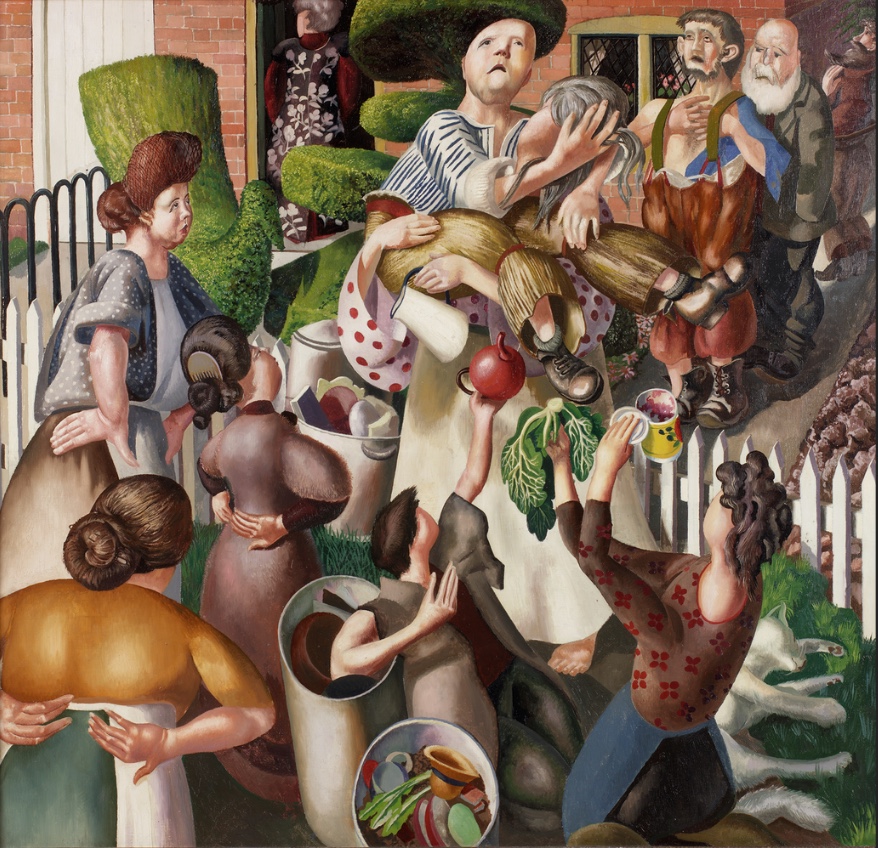
  The Lovers (The Dustman)  (1934)
Sir Stanley Spencer

A “dustman” in England is what Americans call a “garbageman,” and Stanley Spencer loved to see the “dustbins” set out every Tuesday morning in the streets of  his beloved Cookham. In  the painting he is himself a dustman with his trousers tied up tightly just below the knee — to prevent the vermin from climbing up inside them! Like a grown-up difficult child he is in the arms of his wife who is holding some left-over milk for him while he twists her thick grey hair in his fingers — which  he so loved to do! The other women are offering him bits of sacred garbage too: a broken teapot, some cabbage leaves, an empty jam tin…

The painting was submitted by the artist to the Royal Academy for the 1935 Summer Exhibition and was rejected. As a result, Stanley Spencer, already a revered painter at 45, resigned from the Academy.

[N.B. I have to show you the whole unpublished poem because the entire thread is about how  failure can also be a kind of forgiveness… (Oct. 17th, 2026 )


…………GRAVITY’S RAINBOW:
…………SUNDAY IN THE PARK WITH SIR STANLEY

………………..O rejoice in the women,
………………..And the white perfect ducks
………………..With their fashionable heads in the mud,
………………..How they tether themselves down
………………..With pegs in the ground
………………..So they won’t float up in the air,
………………..The feathery dry air that is brighter than gold
………………..But stays unredeemed on the shelf.

………………..For the ducks like the women
………………..Turn weight upside down
………………..By the water on Sunday to stay down,
………………..Not to be better, or up nearer the sun
………………..With the buskers, fine philharmonic
………………..Conductors, preachers, teachers,
………………..Invalids in chariots, toddlers and clowns —
………………..Ah those sweet little flippers that tickle the air,
………………..As pliant as play-dough or beeswax,
………………..Useless as paperweight slippers,
………………..Ballast for butterflies, barbells for kittens —
………………..Perfect as the lead in the magician’s tight furnace
………………..Or the sticky brown muck in God’s oven.

………………..“O the big wide basket of my body,”
………………..The duck woman cries,
………………..“O the piles of starched linen, the fillips,
………………..The white cotton aprons and tea-towels
………………..Folded so nicely in my trembling arms,
………………..Down on my knees by the pool!

………………..“Take this fine little turn-up,
………………..For example,” she says,
………………..“Do you see how it’s paddled and done?
………………..“The masterful curl at the end of the tail,
………………..How the bottom turns upward as if at a ball,
………………..The crinoline, the petticoats,
………………..The old-fashioned drawers that kick highest of all —
………………..And O how they flutter with each do-si-do,
………………..And how the heart goes — can’t you feel it?
………………..And aren’t it worth the applause?”

……………….. “Come on in then, come on in!”
………………..The duck-caller cries,
………………..And when she comes in on his arm
………………..To waddle like a lover on the velvety floor,
………………..Or soon to be mother,
………………..Which is very good too,
………………..How he dips by the water for a nod or a snooze
………………..Any day in the park, old poet by the pool —
………………..Takes his nap on a folding green chair and the paper,
………………..A moist royal nap amongst women,
………………..Head-over-heels in God’s pool.

…………………………Christopher Woodman
……………………………. from GALILEO’S SECRET: Two Decades of
……………………………..poems under House Arrest. [unpublished]”

NOTE: “Gravity’s Rainbow” from the very end of GALILEO’S SECRET, has in itself a considerable bibliography just waiting to be discovered by some ardent young academic a few years after Christopher Woodman’s death. “And the guy never got published,” the lucky student  may recount breathlessly to his friends over his latte at Starbucks, “so  nobody’s ever done him!”

“I can’t wait!” says Christopher.”

…………………THE DISCUSSION CONTINUES IN THE COMMENTS

WHY I WROTE HOW BAD IS THE DEVIL

I was born in 1939, the year Yeats died.

In the photo I’m in a derelict Hmong shaman’s house on Doi Pui. I’m 76, and the house is still up there with all its paraphernalia, even the hearth unswept and the log ladder with the notches cut in for climbing up to the sleeping platform.

No local person in their right mind would dare to enter such a formidable person’s dwelling place — unless they needed help, of course, and then they would fast, wash, and bow their way in — with offerings, an egg maybe, a small cupful of blood, a sprig of rosemary. But no fooling around, as I’m certainly not fooling around in the photo.

Look at my stick. Look at my bent body.

Indeed, that’s why I write into dangerous places like How Bad is the Devil — to enter a realm nobody in their right mind would venture into. ‘Women,’ after all. foemina!

That’s important for me to say as the reward for the effort I put in everyday. It’s the strength to go on in such a way even with so little encouragement, even from my wife, I mean, a strength which is also a certain softness that inspires and protects me.

My wife Homprang often asks me how someone with so many degrees can be so stupid, and I always reply the same way, that unlike me she’s a genius. Which she really is — because reading and writing so little has given her a distinct advantage over me when it comes to sharpness and sanity. Because of course she can see ghosts and things like that which is a great advantage because they terrify her and make her refrain from doing or saying anything stupid or risky. On this particular day, for example, she wouldn’t even peak in the door of this house, and the photo was taken by a foolish student who didn’t know anything…

And I’m just the opposite, of course — I’m a bit soft in the head from reading and writing too much. It’s my rarefied education that has made me so fearless as well as foolish, a fact that makes Homprang even more impatient — because just imagine what she might have done had she had an education like mine instead of leaving school at eleven? I mean, she could have made up ghosts and spirits like I do instead of being careful never to look in their direction what is more to mention their names.

On the other hand, isn’t it also a certain softness in the head which makes us love and admire a great poet like William Butler Yeats so much, that he could have worshiped Maud Gunn like that for so long, for example, and then proposed to Iseult? Or sat up and read what his very young wife George wrote down restless beside him in bed on their honeymoon, as if she were Ishtar or the Angel Gabriel descended on the Ashdown Forest Hotel? And never even to have suspected she might have been making it up — as in a sense she didn’t, both of them being in the softness way over their heads? And to have actually believed in “The Circus Animal’s Desertion” too even when he was always so nicely put up in Anglo-Irish country houses right to the end, an emperor with a mechanical bird for eternity in a gilded cage?

Or Eliot in his own foul rag and bone shop of the heart down-and-out in Harvard and Paris?

…………………………………Between the conception
…………………………………And the creation
…………………………………Between the emotion
…………………………………And the response
…………………………………Falls the Shadow.

And how we love the really great ones for being soft in the head like that, neurasthenic even, connecting nothing with nothing. How they expose us and redeem us, and make us whole.…………………………………<…………………………………In an Emergency.

~

I lived for 10 years in Coleman’s Hatch on the Ashdown Forest just down the road from the Pooh Bridge in one direction and the cottage where Pound wintered with Yeats in 1913 in the other, and I walked by the Ashdown Forest Hotel everyday on my way to teach school with my children, and drank at the Hatch in the evening. That was back in the ’70s.

~

What’s important is something way out there, that’s the point, and I mean having the courage to do whatever it is all by yourself regardless and always in a sense upstairs alone in your room late at night. Because there’s no other activity that counts one iota but being alone with a loaded gun and a delicate body.

…………………..Much Madness is divinest Sense —
…………………..To a discerning Eye —
…………………..Much sense — the starkest Madness —
…………………..’Tis the Majority
…………………..In this, as all, prevail –
…………………..Assent – and you are sane –
…………………..Demur – you’re straightway dangerous –
…………………..And handled with a Chain –

And that’s how bad the devil is, not knowing your place in the grown-up world, not just lying down and being quiet like the big dog Sam. Being soft in the head is like being Eve in God’s grown-up Garden, I’d say, like not only rejecting Heaven but being in cahoots with the Devil in a serious effort to rewrite Paradise. “Unless we become as Rogues we cannot enter the Kingdom of Heaven,” Emily Dickinson wrote to a friend at age 50, and I’d say courage like that coupled with a delicate body and a diamond mind is heroic!

Speaking as a poet I say that, because in fact I know almost nothing about “diamond minds” or “heroic” but just what I write.

Which is why I write as well, as if my desk were underground in Lascaux — as if the hunt depended on my depiction of the beauty and grace of the animals as well as my reverence for them. And even the sun rising.

~

Emily Dickinson’s named her huge black and white Newfoundland ‘Carlo’ after St John River’s old pointer and not after Mr Rochester’s huge black and white Newfoundland called ‘Pilot.’

With that in mind, can you imagine Emily Dickinson out for a walk on the treacherous, ice-bound cart-road to Hay being rescued and steadied by Jane Eyre as if she were the one who was mounted? The clatter of the hooves and the crash? The neat little boots and the hot breath of the gytrash on your neck? And is that why you name your dog ‘Carlo’ instead, to reject the tall, perfect, god-like ‘Master’ on the straight and narrow path? For the Rogue himself do you name him, tumbling on the causeway at your feet?

And can you see then how the truth is more important than the facts? Can you imagine what ‘Pilot’ was like before the Wright brothers put that neat blue-serge suit on him and made him a captain at 35,000 feet? Can you rather hear the crash of the sea as the earlier ‘Pilot’ guides you over the bar to land-locked Florence and on up the hillside to La Gioiella? Can you go somewhere you can never be but you have to arrive at — where everything that has ever happened happens to you for the first time alone in your room upstairs?

Here’s how I say that upstairs alone in my own delicate body.

…………………..“Yet still it moves!” the old beard raves,
…………………..The moon girdling a softer quarter —
…………………..The impossible return,
…………………..Ocean fins quickening the landlocked water.

………………………………………..from GALILEO’S SECRET: Two Decades
………………………………………………..of Poems Under House Arrest
……………………………………………………….(unpublished)

Christopher Woodman

THIS THREAD IS CONTINUED IN THE COMMENTS THAT FOLLOW.

HOW BAD IS THE DEVIL?

Mantegna 466

At the very end of his life, Andrea Mantegna inscribed the answer to the question on the tree in this delicate cameo-painting of Delilah snipping away at Samson’s hair — as if the fountain next to the tree weren’t clarification enough.

If it’s hard to read the words on the tree, you can click on the tree itself to read them more easily — and if that’s still not enough you can click yet again on the bigger picture. Then it’s a piece of cake — that is, the riddle’s a piece of cake, not the beautiful, dignified, introspective young woman trimming the hair of her grizzled, old, pumped-up and psyched-out lover, the act that reduces all men to the divine fools they are destined to be. Because the Divine Fool is the true message of the Samson story, it seems to me, that is if you read the details of the story very carefully — or, alternatively, if you carefully and exhaustively read your own life, or even read me if you know where to look — which is why I am writing what follows, to find out.

I’m going to leave some space on that now, for reflection.

[ADDED A WEEK LATER]

My reflections on Mantegna’s dictum, foemina diabolo tribus assibus est mala peior, are developed day by day in the Comments below, and if you are interested in such things I hope you will be able to read them with as much hope for an answer as I posted them. On the other hand, if you’re impatient you can skip ahead to a specific discussion of HOW BAD IS THE DEVIL IN THE END.  But fasten your seat belts as you scroll down, because jumping ahead is going to make for a very fast ride!

And those of you who start at the beginning, be warned as well: the discussion that follows thrives on hair-pins and other sticky corners, and very often paints itself into untenable places as well — I do hope you’ll be charitable and forgive me for all the dead-ends. I’m an Old Father William, and all I can tell you is that this is how it goes. Indeed, that’s part of the riddle of knowing where you are in the space you inhabit, and it doesn’t much matter whether it’s on earth, in space, buried in your own person or in some other idea or dimension, or perhaps even suited up in a New Age space-vehicle transitting infinity to arrive where you actually are, like in Carl Sagan’s Contact.

Wrapped up in your own cocoon like Eve, in other words, even if you’re a man and not yet ready to be that beautiful, powerful, and fey. Or a snake with your own tail in your mouth like Satan in the Garden of Eden — indeed, you may even be impatient enough to want to go straight to the discussion for men and women who are no longer inhabitants of the Garden of Eden but would like to know what really happened back then.

……….1.) CLICK HERE TO START AT THE BEGINNING OF THE END.

Or if, like most of my friends, you’re more interested in my own demise as a soi-disant angel and poet yet again you can begin at that end:

……….2.) CLICK HERE FOR THE END OF WHAT WAS ACHIEVED IN
………………..THIS THREAD
.

And finally, if you don’t want to begin at any end but just keep on fooling around like Old Father William:

……….3.) CLICK ON THE END OF HIS NOSE TO SEE HOW
………………..EVERYTHING GOES
.

Christopher Woodman,
Chiang Mai, March 3rd, 2016
….

THIS THREAD IS CONTINUED IN THE COMMENTS THAT FOLLOW.


ONE FOR SORROW, TWO FOR JOY

Piero de la Farncesca 475 Piero della Francesca, Nativity (1475)(click on it to see the birds better)

……………………………………………..~

……………………..POST HOC, PROPTER ERGO HOC

………………………..“Two magpies,” she wrote him
………………………………….on shore again in February.

………………………..He propped them up above
………………………………….the herb jars in the galley

………………………..All that winter while she
………………………………….traveled overland in Africa—

………………………..Others hung there too, almost
………………………………….a dozen as the days lengthened

………………………..And the bright green shoots
………………………………….shone like spring in porthole pots.

………………………..He lay more naked in his letters then
………………………………….but the light-sick moths powdered

……………………….His thighs, made his eyes
………………………………….dapple and water as if he missed her.

………………………..Then she wrote again about
………………………………….small birds that migrate pole to pole

………………………..And told him he really ought
………………………………….to have more Arctic dreams.

………………………..It was then he began to notice
…………………………………the way the sheets twisted oh so

………………………..Tight like water-wings about him.
………………………………….He wrote her twice to Porto Ferraio

………………………..But the letters came back
………………………………….to an empty berth and bits

………………………..Of white silk on the bulwarks
………………………………….as if he’d undressed or cracked

………………………..In the terrible rush of the hatch—
………………………………….the brightness of a sheltered reach

………………………..Perhaps, the ease with which
………………………………….mayflies rise on the silvery stream.

…………………………………………………..~

This is a very small poem in a very small style, indeed as bare and simple as a Piero della Francesca painting, and as dependent on faith. That means your faith, the faith you have in yourself, the viewer, not in Jesus or Mary or anything like that but just in how much faith you are able to bring to whatever you see without rhyme or reason, like that tiny little bird on the left, or the big one on the stable roof for that matter, which is unmistakably a magpie. How still can you rest as you view two birds like that, for example, how long can you hold your gaze without blinking, without starting all over again to define what you see in relation to who you are, where you stand, what you expect, and what you know about me? Can you do that? Can you rest in uncertainties when you don’t even know who a poem is by or what it’s getting at? Can you trust yourself, in other words, and not just rush in to either explain it away, or appropriately file it ditto?

Or what if a friend sent you this poem because he or she wanted you to have it. Would you hold back the joy or the sorrow?

………THE COMMENTS THAT FOLLOW DEVELOP THE THREAD

“HARRIET SEES NOTHING ON HARRIET!” An Open Letter.

Here’s looking at you, Don Share —
“politically, personally, and poetically!”
_________________

w

“The photo is of me when I was Head of the English Department at The Brooklyn Polytechnic Preparatory School (aka ‘PolyPrep’) in Bayridge in the ’80s. A lot of my students were from John Travolta’s neighborhood too, and they loved it because I taught poetry in a fever as if it were a real Saturday-night thing, as if poetry really did dance and rumble and matter — over the top sometimes, for sure, but that’s what energy and commitment bring out, a rage to inhabit the mountain peaks with the Saturday-night gods. When I first wrote like that on Blog:Harriet, I felt the same sort of resonance that I did in Bayridge, and even the Contributing Writers got excited, and praised me for my efforts — and yes, some of them even talked to me off-line like you did, Don Share.

And then I got banned!”
……………………………. Christopher.

Dear Don Share,
I had good times with you for the whole month of June on Blog:Harriet, particularly right at the end of Martin Earl’s wonderful thread, The Fish II,  when we talked big fish! [click here] More than that, I also enjoyed a private correspondence with you behind the scenes even after I got put on “moderation”  — as I’m sure you all know, my posts on Harriet were monitored for almost 2 months, occasioning long and painful delays, and over 20 were summarily deleted. [For some details on that 1.)  click here, 2.) click here, 3.) click here, 4.) click here, and 5.) click here. And for a fuller summary elsewhere, click here and click here.]

But just to be sure there’s no suggestion of impropriety behind these revelations, Don, let me be very clear that you never compromised your position at the Foundation. You never said a word about colleagues, or the chain of command, or policy, or gave me any hope that you would intervene on my behalf– yes, you were very free with me, open and interested, but never for a second did you let your professional mask slip. You weren’t involved in any way in the management of Blog:Harriet, you insisted, and even sought my help to get Alan Cordle to remove a paragraph from his Bluehole blog that held you partly responsible for what had happened [clicek here] — which Alan did, and with good grace. And I was very proud of that too, because I know we are like that, always willing to admit a mistake and do something about it.

Indeed, a lot of good things happened in those early exchanges. Michael Robbins came in on Alan’s blog too, for example, and bitterly protested our interpretation of his involvement, and we responded immediately to that as well, and not only apologized to him but praised him for his openness and courage. [click here] Indeed, that moment with Michael Robbins was one of the most positive moments of our whole protest, and we are still very grateful to him for that as well as for his decision to distance himslf from Blog:Harriet — not in solidarity with us at all but because he felt badly about what the atmosphere at Harriet had done to him personally. Because, of course, it brought the worst out of everybody!

EYE Don ShareBut you did nothing whatsoever, Don Share — almost as if you didn’t see anything happening. And here you are today writing all this wise and well-informed poetry stuff about deep human issues, who we poets are, what matters, what poetry can accomplish, what art,  what passion, however foolish, what the spirit can achieve [click here], yet you didn’t engage yourself at all when you were face to face with the REAL THING — a real poetry massacre! Because we were deeply involved in these very same issues in July and August, of course,  but on a much, much deeper, more meaningful, and more tangible level than on Harriet today. And then on September 1st we had the plug pulled on us,  and we were all summarily executed. Yes, and you were right there and said nothing.

And look what’s left on Blog:Harriet today? Just look at the response to your sensitive and exceptionally well-written new article, for example? [click here] A dry board-room discussion of the niceties of copyright law combined with some fawning, some clichés, and some banter. Before you were face to face with the real censorship of actual living American poets, ones who weren’t hiding behind anything at all, and were therefore extremely vulnerable. And you watched the axe fall on them, and you did nothing whatever!

~

Blog:Harriet is a tiny bit of The Poetry Foundation’s on-line commitment, I know, only 3% of the traffic, but it’s where the free voice of poetry really matters. Because Blog:Harriet is financially independent and doesn’t have to balance the books, satisfy institutional requirements, or mollify advertisers, corporate or even college presidents. Most important of all, it doesn’t have to take sides in the wonderful complexities that blossom when poetry rumbles as if it were, wow, Saturday night in Chicago!

W.B.Yeats is dead, and we’re still wondering, who was this ridiculous genius? How could our greatest modern poet be such an enigma, and what if anything did he accomplish beside all that inconceivably beautiful, deep and earth-moving verse he left behind? And now the intellectual conscience of the modern era,  the creator of our most modern discourse, Claude Levi-Strauss, he’s dead too — and we can celebrate his Triste Tropiques as one of the greatest modern explorations of what human expression can accomplish — in its author’s own style, and in the sacred communities he initiated us into.

Well, I’m 70, and my writing matters too, Don, particularly as I’m just as passionately committed as Claude Levi-Strauss ever was, and just as nutty, passionate and lyrical as Yeats. And that’s true, even if I have no creds, no prospects, no mentor or editor or maneuvers for tenure or a pension or even a credit card in my wallet!

And you banned Desmond Swords too with all that next-generation Irish brilliance, and Thomas Brady who put Blog:Harriet on the map with his well-informed, startling, and indefatigable genius. And Alan Cordle, perhaps the best-known and effective social critic on the contemporary poetry scene in America — summarily chopped for just being who he was!

EYE Don ShareSo what are you going to do about all that, Don Share? Just let it slip, just let all those hurt feelings and that outrage fester? Just let Harriet go down the tubes as an accident, the usual sort of bumbling and grumbling which takes people over when they refuse to talk to each other, what’s more listen? Are you trying to prove that even at The Poetry Foundation poetry doesn’t matter, that it’s all just business as usual even with the blessings of Ruth B. Lilly’s profound good-will and all her benificent millions?

So why did you bother to write  that article on Yeats and Claude Levi-Strauss then, or don’t you take any of it serioously? I mean, is that just what you do for a living, to write like that? Is that just your thing at The Foundation?

And I know that’s not it at all, dear Don, but sooner or later you’ve got to say what it is, and take action.

Sooner or later you’ve got to stand up and be counted!

Christopher Woodman

This is the first of the Personal Statements of those who were banned from Harriet on September 1st, 2009. Stay Tuned for the accounts of Desmond Swords, Alan Cordle, and Thomas Brady.