FIG LEAF SUTRAS: at the Roots of the Tree.


updated September 14th, 2025

At an important moment in my life, Jerome Rothenberg and his Technicians of the Sacred: A Range of Poetries from Africa, America, Asia, Europe and Oceania appeared on the scene, helping me to understand how much poetry meant to me personally as opposed to what I was doing with it as a flamboyant  25 year old graduate student in Renaissance Studies at Cambridge. It was 1965, the  year of the International Poetry Incarnation at the Royal Albert Hall in London, and everything in the world was loosening up just then. European students were getting themselves ready to come out on the streets of Paris in just 3 more years, and the Tibetans, having escaped over the Himalayas in just 1959, were busy learning English and French and, of course, how to talk to people — which they had never done before in our sense. And there was lots going on in America too, needless to say — that’s why some were here!

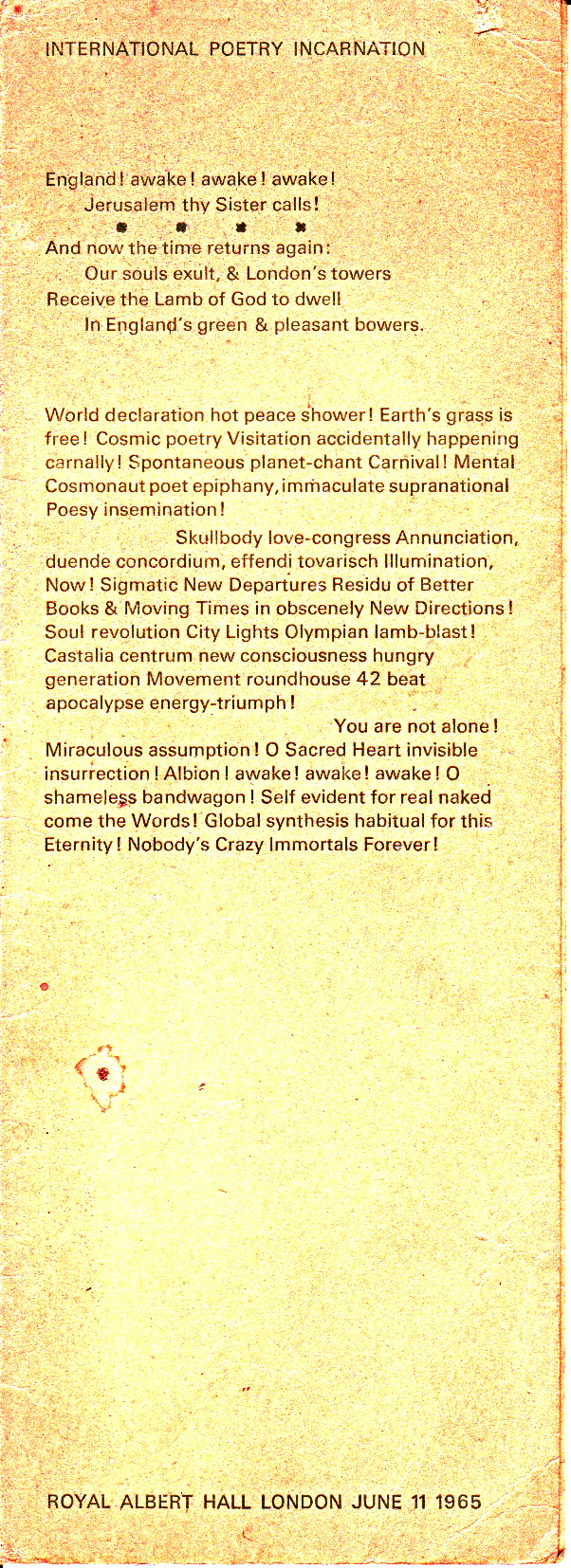
The International Poetry Incarnation was the moment when the ‘Beats’ descended on London to put Modern American Poetry on the map, as the British critic, Eric Mottram, put it — ‘on the mat’ would better describe what I saw at the time. (You can CLICK HERE to read more about the event including who was there and what they did.) And this certainly fired me up, indeed I’m not sure I ever cooled down what is more got my feet back on the ground. An odd metaphor because although it’s true, my subsequent life as a father, teacher, builder, gardener and blue-water sailor defined me more as a worker than as a dreamer. And I don’t particularly value feet-on-the-ground anyway, unless they’re naturally bare, of course —  like  ‘good-fella’ feet, I mean, and would you say they were on the ground?

What I liked about Jerome Rothenberg was his way of chanting, winging it, voicing his own verbal rituals and transliterations, and of course his Native American and Oceanic tapes which he played at the Polytechnic of Central London. That was one of the new Technical Colleges springing up all over the U.K. with the very first ‘Modern Poetry’ departments in Europe. I myself wasn’t yet involved in ‘creative writing’ and wouldn’t take it up seriously for another 25 years — I taught poetry but I didn’t write it. Indeed, years before I started writing it I moved up to Scotland with a Himalayan refugee who badly needed shelter. That was the Lama Chögyam Trungpa, of course, almost 30 by then and already astonishingly articulate, in English! But he was also in a very vulnerable position as he was paralyzed on one side and drinking heavily plus downing whatever was handed to him by his adoring disciples — they just drifted into Garwald like ghosts with their bottles and bags. And it was in this milieu that I helped Trungpa ‘invent’ his own way of ‘writing’ Modern American Poetry long before I began to write poetry myself — you can GO HERE AGAIN & SCROLL DOWN for a glimpse of how that ‘transliteration’ worked. Needless to say, my household in Scotland fell apart very rapidly, and I had to go deeper and deeper into the woods as well as way, way out to sea, literally as well as figuratively, indeed to get so lost I could only start all over again — which is the subject of the latter (chronologically earlier) parts of FIG LEAF SUTRAS: A Memoir in Poems: 1994-2024 (unpublished).……[To see better you can click on the Bo Tree above — at home in Chiang Mai.]

~…………….~…………….~…………….~

There’s an aspect to all this that I rarely talk about but need to, it’s so near the roots of my ‘Fig Leaf Trajectories.’ So forgive me if I go back a bit and tell my story all over again on another level.

I came to King’s College, Cambridge, from Yale in 1962 as a 23 year old Kellett Fellow  — my thesis topic had already been approved by C.S.Lewis and, after Lewis’ death, was supervised by the distinguished Cambridge Professor of English and WWII Singapore survivor, G.G.Hough, whose life experience had led him to many of the same interests as my own including Edmund Spenser and C.G.Jung. With the latter’s trust and encouragement, my unfinished thesis won a Research Fellowship in 1965, one of the highest honors at Cambridge at the time, and my academic future seemed assured. But I was impatient, on fire almost, and to make a long and foolish story very short, I resigned my Fellowship at Christ’s College, sold my beautiful windmill, and went off to Scotland with my young family by the one hand and my new friend Trungpa by the other. I became a Trustee of the new Samye-Ling Tibetan Centre in Eskdalemuir and at the same time renovated a huge pile of stone called ‘Garwald House’ — to put Trungpa & entourage in (we the family lived in the servants’ quarters). I also took a job teaching the teenage children of Scottish shepherds and mill-workers nothing they wanted to learn — Langholm Academy, 18 miles down the road, the closest job I could find and certainly the most difficult I ever had. (I tried for months not to use ‘the Belt,’ and I failed — from the students’ point of view, of course, they won. And that was also Hugh MacDiarmid’s school!)

But there was one more life-changing twist to this transition. Just before I left Cambridge, the formidable Shakespearean scholar and Mistress of Girton College, M.C.Bradbrook, was charged with the task of examining me and my 400pps thesis orally, which she certainly did. “Too psychological,” she implied — too “Jungian,” “too Buddhist for an English dissertation” quite specifically — indeed, during my ‘Viva’ in her rooms at Girton we talked mainly about my relationship with the Lama Trungpa. (“Why?” was her question over and over again. “How could you?”) And to make a short story even shorter, Polyphonic Narrative in Elizabethan Literature exited with the traditional “M.Litt (Cantab.)” —  a grand-sounding degree, certainly, but not the shiny new “PhD” my thesis was registered for, and that I would have very much needed had I gone home to continue the same sort of work in the States.

The disaster sent more than ripples through the graduate student community at Cambridge — everybody else felt their own necks must surely be on the block if mine was. But I was already way up in the hills of Dumfriesshire by the time I heard the news, many miles from the nearest shop by a one track road with sheep lying all over it. And I never went back to Cambridge — which I probably should have, but that’s where I was and still am, never going back anywhere. And today I’m even a bit proud of myself for not having challenged the decision — and I’m sure both the English Faculty and my advisor, Professor Hough, must have been very relieved indeed that I just moved on.

At this point I want to say that I harbor no hard feelings toward M.C.Bradbrook, indeed I think her decision was actually helpful to me as I could never have become the sort of literary scholar the degree was supposed to prepare me for. And I did moon the establishment, which was certainly how my behavior felt to Muriel Bradbrook. Cambridge at the time was a ‘scientific’ university which didn’t teach ‘Modern Poetry’ as an academic subject at all, just Chaucer, Milton, and Wordsworth along with assumptions about Classical Languages and Prosody. Of course there were active poets in Cambridge, many of them, but at Cambridge that’s what you did with your life, not what you ‘read!’ At Cambridge you gossiped about contemporary poets in your ‘rooms’ like T.R.Henn did about W.B.Yeats in his, for example (I was there — crowded, fascinating!), but you didn’t ‘study’ them! And yes, in many ways I still sympathize with that position, and am very glad I was there and not somewhere else.

The fact is that I just didn’t fit in, at least with the establishment I didn’t. But for me Cambridge was the most wonderful place to be just as I was and as it was — not fitting-in was just what I needed. Of course Cambridge has always been one of the great Thinking Places of the world, and I still get fired up just thinking about the profound scholarship combined with quotidian genius-folly of Christopher Smart in the 18th Century, for example, what is more about Samuel Taylor Coleridge in the 19th (he quit twice!) or Ludwig Wittgenstein in the 20th (say no more!). In my own time E.M.Forster ate at the high table at King’s every evening, Thom Gunn was still a phantom presence, and F.R.Leavis talked about everything you’re not supposed to.

In some ways I was over-the-top too, of course I was, but I know I was also appreciated for my energy, resourcefulness, and courage — I was often asked to head this or that, for example, local community-boards, societies. But I was also considered disrespectful by some, a little dangerous even, and I was certainly not the only one who got dished. Any day, rain or shine, you could see what appeared to be a tramp on an old bicycle with a torn gown, disheveled hair, and wild, wild eyes with his basket stuffed with books and his paper-bag lunch. He often talked informally while eating his lunch in a drafty courtyard at Downing College with anyone interested, and there were many outliers there beside me. Because that was F.R.Leavis himself, one of the greatest 20th Century English Literary Critics, still there and still on fire in words not just about D.H.Lawrence but about “Tom” (T.S. Eliot) as well. In many ways his renegade status as an Engaged Critic suited him even better than a Chair would have. He felt good in his own skin like that — more an outcast Prophet than a Professor.      ………………………… [Photo: Stefan Collini on F.R.Leavis, TLS, Sept. 2000]

Another inspiration at the time was the newly arrived polyglot American, George Steiner. He was even more threatening as he ‘read’ not just ‘English’ but all the European languages (‘read’ is what you did at Cambridge as no Lectures or Course Work were required for a graduate degree at the time). George Steiner was not invited to become a University Lecturer — but don’t worry, he lectured still but unofficially, with people sitting in the aisles and on the window sills, just to get an ear in! Although he was Senior Tutor at the new Churchill College (I ‘tutored’ his undergraduates in Shakespeare), his association with me made the C.U. Faculty of English worry even more about what they were going to do with Christopher Woodman. And I solved that for them by just doing it myself, absconding with the Tibetans!

I just want to add that it’s a mystery to me why I was so good at Literary Criticism in the first place, and why I won all those prizes. Because I wasn’t cut out to be an Academic — Polyphonic Narrative in Elizabethan Literature was beautiful scholarship but at the same time a touchy-feely pot-boiler just waiting to be satirized by Vladimir Nabokov. For I was as much into Jerome Rothenberg as Edmund Spenser, and most of all bringing up children, building the most beautiful tree-houses in the world for them and then steadfastly sailing away with everybody on board. Indeed, after ‘going down’ from Cambridge in 1969 I eventually became the person you see in the photo. It’s 1980, I think, in the Windward Islands somewhere, possibly even  Jean Rhys’ Dominica, and I’m all of 40 already — another decade to go before I would write the first (i.e. last) poem in this book just below.

All I know that’s important is laid out in FIG LEAF SUTRAS — “the radiant cruelty of what is,” as James Agee put it in Let Us Now Praise Famous Men (cited on the title page). The book moves backwards in time, starting as it does in Chiang Mai and reversing its way through three decades of basements, boats, broken hearts, temples, revelations and scribblings to where I am now, just Lung Kip. That’s what I’m called here in Chiang Mai, “the old guy who is older than your father.”

James Agee was dead at 45 — this book is about what there is to add after you’re 70.

Trust in water
words white
and buoyant like
an iron hospice bed
and do not fear
to live or hope
beyond the soft
morning light
or soft voices
of the children
in the park.

These are the very last words in FIG LEAF SUTRAS: A Memoir in Poems, 1995-2025, though chronologically they are the youngest. They first began to compose themselves very near the beginning in a basement in Carroll Gardens, Brooklyn (“basement” is a recurring image in the book). The fact that FIG LEAF SUTRAS is a young man’s book written by a much older man may be one of it’s most positive characteristics — that such poetry can mature even as fresh wine does in an aging dark cellar.

Like blessings, Christopher

…………….

.


.……..+………+………+………+………+………+………+…….


[There are no ‘Major Threads’ devoted to my 3rd book,  FIG LEAF SUTRAS, as the poems for it were collected after I stopped writing-about-writing in this Blog. In a sense it is itself about writing-about-writing from beginning to end, which is why this Preface is so autobiographical.

[If you haven’t yet seen it you should have a look at THE HARD PART FIRST which digs a bit more deeply around the Roots of the Tree in the present  thread.]

[You can also go on to the 2nd Preface, On Living with GALILEO’S SECRET, or choose another Thread from the ***MAJOR THREADS*** listed in the left hand margin.]


Gilding the Pieces: LA-CROIX-MA-FILLE.

Fan Tail 450
The old Impington Windmill at Histon, Cambs, 1967.

Histon is the small village near Cambridge where Christopher Woodman began to restore an old windmill in the 1960s. The ‘fan-tail’ which you see here drives a series of cogs and shafts that turn the whole top of the mill so the wind-blades always face the wind. This meant that when Christopher Woodman looked out of his window from the Miller’s Cottage each morning, having completed that part of the restoration, he was never quite sure where he was as the world changed all its coordinates when the wind shifted directions in the night.

.
PARTINGS & RESTORATIONS

…………………………………………………..updated May 12th, 2022
To start with, I have very few friends who read poetry and even fewer who read the poetry I write. This is partly because at two very important junctures in my life I quit poetry altogether, and as a poet I have no past.

The first time I quit was in my teens when I stopped writing because I knew my poetry was fake. Even at sixteen I was aware that I wrote poetry because I wanted to be a poet, and would cobble together anything and call it a poem for that reason. CW Yearbook 1957Indeed, I was aware that I was putting on a mask in order to hide my own struggle with myself, not to express it — I couldn’t tell anybody that but knew it myself. That’s one of the reasons I’m still so interested in W.B.Yeats who was an out-of-touch adolescent with similar obsessions all his life. On the other hand, right from the start Yeats built on an ancient mythology that had everything to say in itself however much he fudged it, and of course he was also a genius in so many other ways. I posed as Yeats did but with a great deal less skill and with no effective schtick of my own at all. I pretended to be Shelley, for example, and even nourished the fantasy that my boy’s boarding school was the school that imprisoned 19 year old Percy Bysshe’s 16 year old Harriet! But all the same I did get a superb education there and, perhaps even more importantly, the experience of waking up among the magical New Hampshire lakes and forests for five of my most sensitive years.

I also arrived with a beautiful soprano voice, and from the age of 11 sang solos in the St. Paul’s School boy’s choir, Handel to Mendelssohn. I did it for that long because my voice remained clear as a bell until I was all of 15, no less. And of course I was just getting ready to quit poetry at the same time that my voice was finally changing, and little did I realize what all that would mean for the latter part of my life!

To finish up the First Parting, then, I fell in love with the girl in the red silk dress at 17, married her at 20, and had my first child as a sophomore at Columbia in 1960, just 5 days after I turned 21. I loved my young wife to distraction too but lost her not so long after I married her, just one single fraught decade out of 8 of them — and lost her in much the same way as both the hero and the author lost Yvonne de Galais in Le Grand Meaulnes, that most important of all tropes.

At a séance in New Haven, Conn., 1962.

It was thus that women trumped poetry in my life, and in a sense still do. But I’m not in any way a threat to anybody, not even to myself, nor have I ever been ‘any of the above’ what is more promiscuous. On the contrary, I’ve been much too fond of my wives even when the marriages failed, and they were long ones, an inspired 10+ years each. That always made it especially hard to let them go and, like Alain-Fournier, to my detriment I didn’t.

Women have always been it in my poetry as well — as it was for the Troubadors, for Dante and Petrarch, for Goethe and Coleridge to John Fowles and his mentor, Alain-Fournier. On the other hand, this pedigree has had less to do with my personal relationships with the women I have loved than with what might be called my ‘magical thinking.’ Indeed, it lies at the core of my inner life as a seriously engaged Buddhist/Christian/Animist who remains both an undeveloped enfant terrible and an old hurt soul to this day. As silly as all that may sound, I wouldn’t be me without any of it!

And just to mention that I’m now in the 30th year of a marriage with a very real, dynamic, professional woman, Homprang Chaleekanha, and if you want to know more about that sort of love relationship you should read the last of my 3 books, Fig Leaf Sutras: a Memoir in Poems, 1994-2024. I just hope you will be able to get hold of it soon. Indeed, it’s out there right now, fishing with the very brightest feathers and most succulent bait it can manage.)

The Second Parting was not with writing poetry but with studying the history of it as a graduate student at King’s College, Cambridge. C.S.Lewis accepted my research proposal based on the reading of Edmund Spenser’s The Faerie Queene I had developed under Professor Harry Berger at Yale, and C.S.Lewis was my Supervisor until he passed away leaving me just with the title of my thesis, “Polyphonic Narrative in Elizabethan Literature” — which remains to this day the origin of my style, my imagery, and my modus vivendi both as a poet and as a person.

That Second Parting happened just four years after my brother Tony’s accident in 1965, and was certainly hastened by it. In the interval I had won a Research Fellowship at Christ’s College and at the same time become Chairman of the Cambridge University Buddhist Society, a delicate balancing act if there ever was one. And what I did after that shocked everybody, even myself — I resigned my Fellowship at Christ’s, sold my beloved windmill in Histon, packed up my beautiful wife and by then 3 little girls, and went off to Scotland with a Tibetan Lama. But the really devastating event in that Second Parting was the moment when my beautiful wife, aka ‘the girl in the red silk dress,’ departed with another of the Lama’s disciples, and I found myself at 29 alone with 3 small children and a whole lot of relics already — memories, images, artifacts, whatever you want to call them — all of which are covered in the gold leaf that has always sanctified my turbulent, topsy-turvy past.

Indeed, “La-Croix-Ma-Fille!” used to be called “Gold Leaf on the Waters” but has now moved on to a title that’s more like life as mine actually turned out to be. And how I hope you will be able to get hold of my book in the very near future as it’s so winsome and so longs to be read. It’s out trolling at the moment too — you can click on the title, “LA-CROIX-MA-FiILLE!” to see what it’s doing right now.

……………………………..My fingers ache with so much crossing,
………………………………………………………..Christopher

RELOCATIONS & RECASTINGS


Tea break at the Old Windmill with Sophia & Delia in the sandpit.

Christopher Woodman restored the old ‘Impington Windmill’ in the village of Histon while living in the Miller’s Cottage at the base of the mill in the 1960s — those are wooden cog-wheels that he’s sitting on which he intended to restore as well. He had already rebuilt the whole fan-tail porch in hard wood and recovered the dome-like cap as well with lap-strake cedar. Fortunately there were blacksmiths in Cambridgeshire at the time who still knew how to find and/or recast the broken iron parts of the machinery just as his writing attempts to relocate and sometimes to recast the missing parts of himself and his life. Much of that was also involved in his 400pps Cambridge thesis, “Polyphonic Narrative in Elizabethan Literature,” which was not liked at all by any.

1910

This is an old photo of the ‘Impington Windmill’ in 1910 with young women in white bonnets picking strawberries for the Chivers jam factory in the nearby village. If you look closely you can see two figures standing on the fantail of the mill. There are also two horse-drawn wagons, and the overseer is wearing a suit and fine hat. This is very much the worlds of both Tess of the d’Urbervilles (1891) and Le Grand Meaulnes (1913), remnants of both of which were still there in rural England and France when Christopher Woodman arrived just 50 years later. The miller’s cottage where he lived with his wife and children is visible just to the left of the mill, indeed his third and youngest daughter, Antonia Unity, was born in the cottage in 1967.

1

THIS IS THE END OF THE THIRD SHORT PREFACE...


 ……..+………+………+………+………+………+………+……. ……..+………+………+………+………+………+………+…….+…….+…….
[To exit this Preface you can visit  LA CROIX MA FILLE! ,  the ***FIRST MAJOR THREAD*** on this particular theme.

[Alternatively you can go on to the   ***FIRST MAJOR THREAD*** in the Index:  FOR THOSE LIKE GALILEO WHO NO LONGER READ .

[You could also choose any other title from the Index in the left-hand Margin.]


FOR THOSE LIKE GALILEO

Peniche Original

 A Péniche on the Canal de Bourgogne.
(Click to see the Other World better.)

……….
….from FOR THOSE LIKE GALILEO WHO NO LONGER READ
……………………………………………..Le Canal de Bourgogne

……………….So where are they now the poems
……………….For those who do no longer read
……………….But lose their way in words,
……………….Their overheated selves
……………….Closed down like God’s own
……………….Disowned fools in
……………….Damp, forgotten locks
……………….And other fasts and solitudes—
……………….Fisher kings, tall stilt-legged birds,
……………….The mist-wrapped walker with
……………….The busy dog and old felt hat—
……………….Mute, pre-dawn souls bewildered by
……………….The wash and roar of meanings when it’s all
……………….Gunnel-rubbing function transport
……………….Pumping huge breast-plates of
……………….Greased iron up and down
……………….A ruined cut?

……………………………from GALILEO’S SECRET: Two Decades of
……………………………….Poems under House Arrest.
…………………………………………..(unpublished fragment)

…………………………..………

To pass through the Tunnel click on the Stamp.

A personal Note:
The venerable industrial canal has provided much of the transport for heavy cargo in Europe right up to the present, yet few of us are familiar with the gates, cranks and levers, or understand the complex hydraulics of the dams and reservoirs that feed them. The 242kms Canal de Bourgogne, a truly sacred relic with its 189 shaded locks, ascends 400 meters vertically in the Burgundy region of central France and then descends to meet the Yonne and the Seine rivers and on down through Paris to Le Havre and the sea. An engineering masterpiece, the canal linked the Mediterranean with the English Channel and at the same time put the finishing touches on one of the most beautiful old-world landscapes in Europe. Much less known is the fact that it came to shelter a unique community of people who lived on boats, and whose identity was formed not by place or jurisdiction, but by how they worked apart and at the same time respected each other.

The Canal de Bourgogne is one of the places I have loved most in my long life away from home. I still rejoice in the thought of it but know it’s unlikely I shall ever visit it again as it’s no longer a place to work one’s way through, just to play around in, to pretend. For that reason I’m not really very interested in it anymore  — it was ‘working my way through it’ that so engaged me right from my first passage 50 years ago to the moment when it was closed to heavy traffic in the 1990s. “Se frayer un passage” (“to ‘force’ or ‘work’ one’s way through something, like a blacksmith ‘works’ wrought-iron) is what the French “bateliers” (‘barge people’) have always called working their huge 125ft steel barges through the complex system of wrought-iron gates, sluice valves, levers and ladders for days on end to wherever they happened to be going  — and it could be grand places too, Marseille,  Lyon, Paris — or anywhere in Holland, Belgium, Germany, indeed all the way from the Rhone to the Rhine and back again to humble St Jean de Losne on the Saône or Conflans-sur-Seine. And they did all that not only with 350 tons of sand, stone, coal or grain on board, but with the whole family — home was aboard and everybody was there all the time!

Alone and always pushing the limits, the bateliers are fiercely proud of who they are and what they do to this day, indeed as proud as the ‘Roma,’ Tinkers,’ or ‘Travelers’ in Ireland and the U.K. or the ‘Gitanes’ in France are proud, all unique people who work their way stealthily through long, hard, isolated lives on the back roads of modern life. Deracinated and forever on the move, they dedicate their lives to wrestling with the loss of so much that was once so kind and familiar, and to watching the world self-destruct on the high roads. And that’s heroic, isn’t it, even if it means you look down on everybody else? (I add that last while bowing, quietly, as a poet, out of sight myself.)
)…………………………………………C.W. (photo March 2nd, 2025)

.

……….A Batelier family photographed at home on a Sunday.

A sensitive reader who has been through a Galileo-like “house arrest,” and I think many of us have, will understand the extreme dislocation, the burden, the longing  and the loneliness he must have experienced. Even more importantly, such a person may have experienced the mysterious resolution at the end of the poem, of being as alone as that yet well and whole at last.

………………
CONTINUED IN  THE FOLLOWING DISCUSSION.

IN PURSUIT OF THE STILL UNWEIGHED: Off the Record at Eighty.

…………………
I am on the side of angels and of dirt.”
…Sir Stanley Spencer (1891-1959)

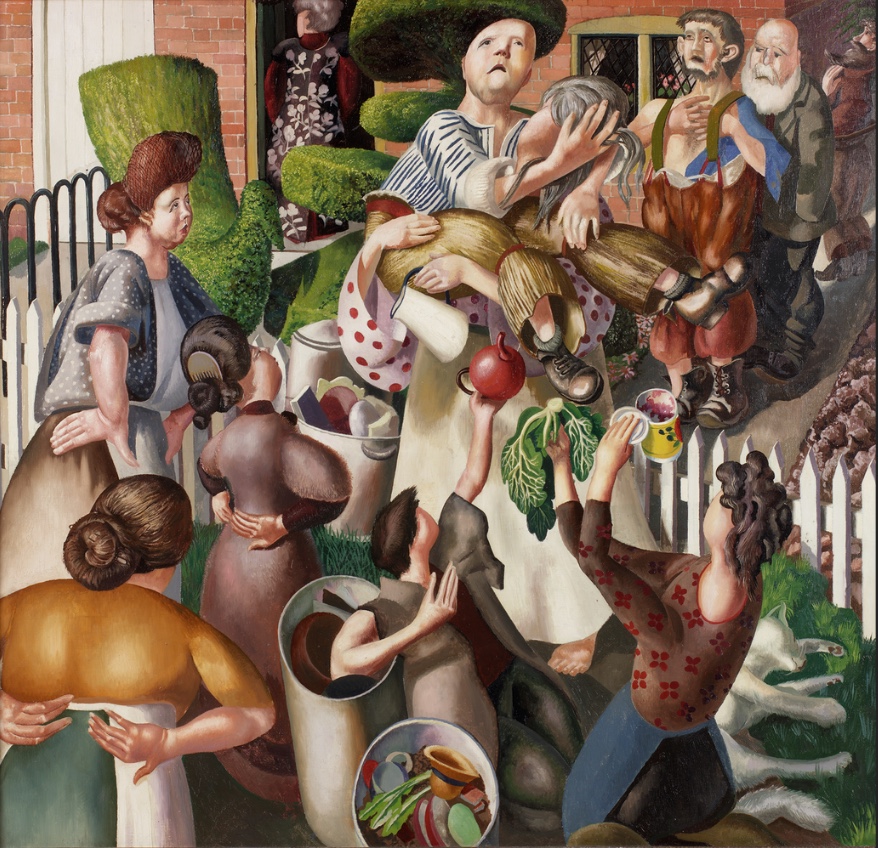
  The Lovers (The Dustman)  (1934)
Sir Stanley Spencer

A “dustman” in England is what Americans call a “garbageman,” and Stanley Spencer loved to see the “dustbins” set out every Tuesday morning in the streets of  his beloved Cookham. In  the painting he is himself a dustman with his trousers tied up tightly just below the knee — to prevent the vermin from climbing up inside them! Like a grown-up difficult child he is in the arms of his wife who is holding some left-over milk for him while he twists her thick grey hair in his fingers — which  he so loved to do! The other women are offering him bits of sacred garbage too: a broken teapot, some cabbage leaves, an empty jam tin…

The painting was submitted by the artist to the Royal Academy for the 1935 Summer Exhibition and was rejected. As a result, Stanley Spencer, already a revered painter at 45, resigned from the Academy.

[N.B. I have to show you the whole unpublished poem because the entire thread is about how  failure can also be a kind of forgiveness… (Oct. 17th, 2026 )


…………GRAVITY’S RAINBOW:
…………SUNDAY IN THE PARK WITH SIR STANLEY

………………..O rejoice in the women,
………………..And the white perfect ducks
………………..With their fashionable heads in the mud,
………………..How they tether themselves down
………………..With pegs in the ground
………………..So they won’t float up in the air,
………………..The feathery dry air that is brighter than gold
………………..But stays unredeemed on the shelf.

………………..For the ducks like the women
………………..Turn weight upside down
………………..By the water on Sunday to stay down,
………………..Not to be better, or up nearer the sun
………………..With the buskers, fine philharmonic
………………..Conductors, preachers, teachers,
………………..Invalids in chariots, toddlers and clowns —
………………..Ah those sweet little flippers that tickle the air,
………………..As pliant as play-dough or beeswax,
………………..Useless as paperweight slippers,
………………..Ballast for butterflies, barbells for kittens —
………………..Perfect as the lead in the magician’s tight furnace
………………..Or the sticky brown muck in God’s oven.

………………..“O the big wide basket of my body,”
………………..The duck woman cries,
………………..“O the piles of starched linen, the fillips,
………………..The white cotton aprons and tea-towels
………………..Folded so nicely in my trembling arms,
………………..Down on my knees by the pool!

………………..“Take this fine little turn-up,
………………..For example,” she says,
………………..“Do you see how it’s paddled and done?
………………..“The masterful curl at the end of the tail,
………………..How the bottom turns upward as if at a ball,
………………..The crinoline, the petticoats,
………………..The old-fashioned drawers that kick highest of all —
………………..And O how they flutter with each do-si-do,
………………..And how the heart goes — can’t you feel it?
………………..And aren’t it worth the applause?”

……………….. “Come on in then, come on in!”
………………..The duck-caller cries,
………………..And when she comes in on his arm
………………..To waddle like a lover on the velvety floor,
………………..Or soon to be mother,
………………..Which is very good too,
………………..How he dips by the water for a nod or a snooze
………………..Any day in the park, old poet by the pool —
………………..Takes his nap on a folding green chair and the paper,
………………..A moist royal nap amongst women,
………………..Head-over-heels in God’s pool.

…………………………Christopher Woodman
……………………………. from GALILEO’S SECRET: Two Decades of
……………………………..poems under House Arrest. [unpublished]”

NOTE: “Gravity’s Rainbow” from the very end of GALILEO’S SECRET, has in itself a considerable bibliography just waiting to be discovered by some ardent young academic a few years after Christopher Woodman’s death. “And the guy never got published,” the lucky student  may recount breathlessly to his friends over his latte at Starbucks, “so  nobody’s ever done him!”

“I can’t wait!” says Christopher.”

…………………THE DISCUSSION CONTINUES IN THE COMMENTS

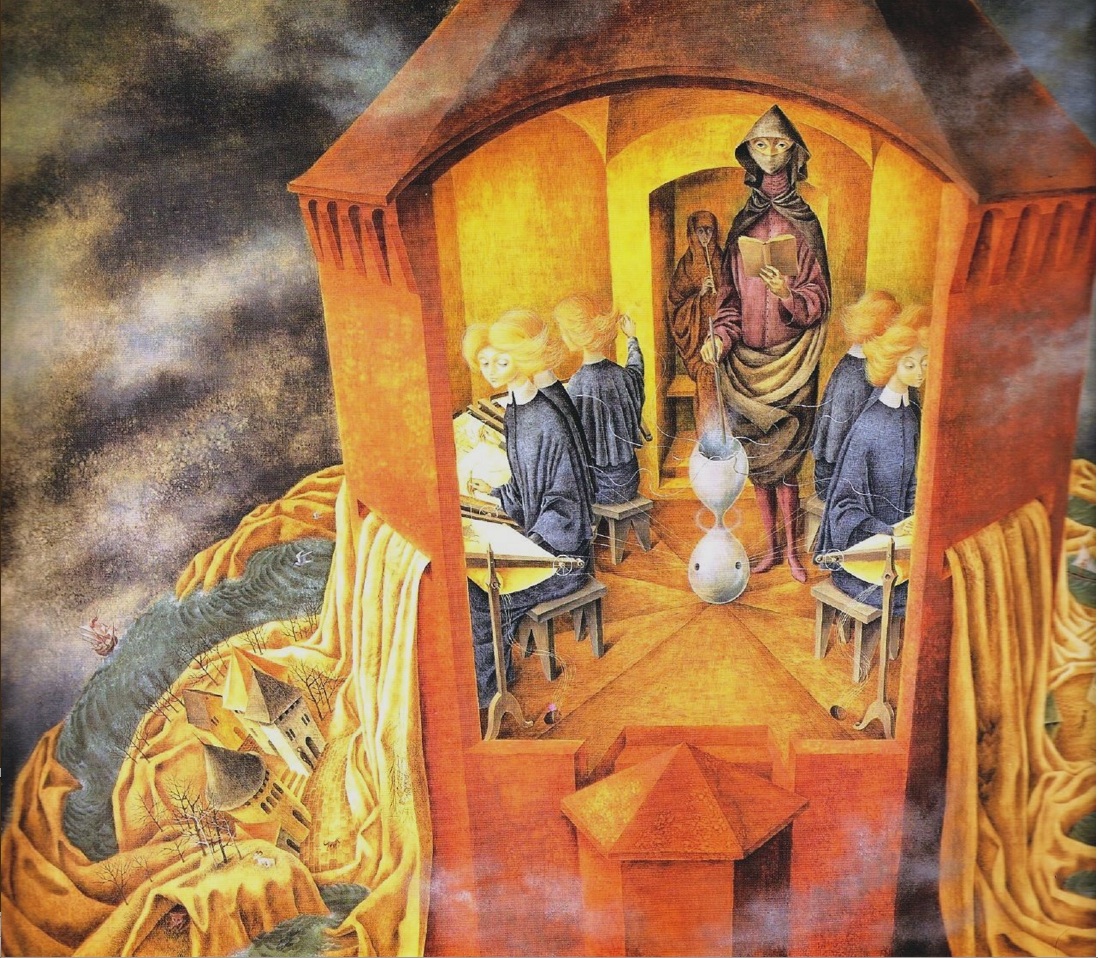
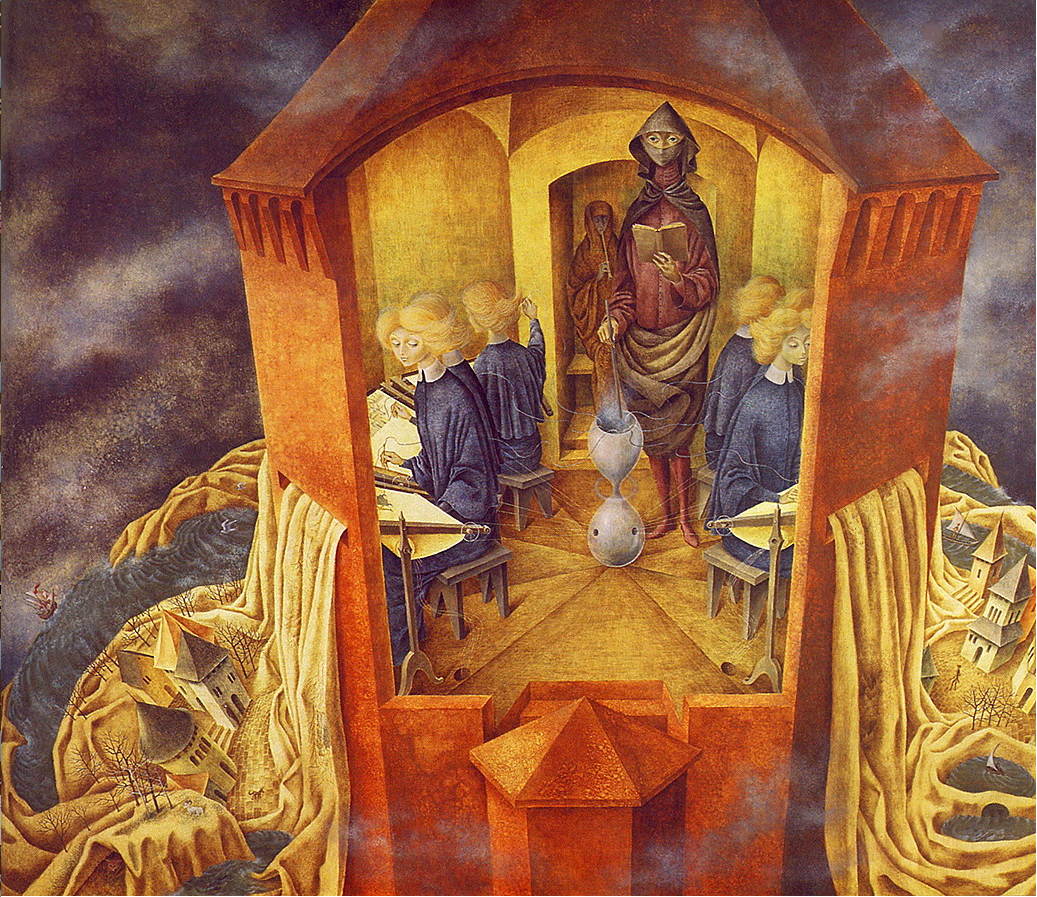
BORDANDO el MANTO TERRESTRE by Remedios Varo

Remedios Varo“Bordando el Manto Terrestre” [ Embroidering the Earth’s Mantle ] (1961) by Remedios Varo.
The Cowpattyhammer management apologizes for having closed “Make It New!” so abruptly.

One of the casualties was that we never got a chance to look at this painting by the Spanish-Mexican painter and anarchist, Remedios Varo. The title means “Embroidering the Earth’s Mantle,” and the imagery is probably the closest we got to the “secret” that was such an important part of the discussion. My own feeling is that with the exception of the sculpture of the tall Aborigine woman and her daughter that introduced the previous thread, this extraordinary painting was probably the most relevant.

You can click here to look at the painting in more detail. Once you have moved in, the definition of the graphic is quite high so you can zoom in as much as you like. Indeed, I’d be very interested to hear what you see.

In addition, if there are any matters arising from the previous thread do feel free to comment below — the management is very grateful to the increasing numbers of people who visited the site in the last weeks of the discussion, and would be very pleased to have more feedback.

Christopher Woodman

………THE COMMENTS THAT FOLLOW DEVELOP THE THREAD

MAKE IT NEW!

A Letter To Tom about “Rhyme”


Tony Woodman and me at the Gran Prix of Czechoslovakia, Brno, 1963

Dear Tom……………………………………………………[November 22nd, 2009]
My hunch is that your emphasis on “rhyme” in your previous article is going to be misunderstood. I think it will give those who don’t want to hear you at all the excuse not to read you, and may weaken your argument even for those that are willing to give what you say a try.

Let me say this first: I’m a curious critic because I’m so sophisticated yet so naive and trusting — I know so much (or at least ought to, considering the length of my education) and yet am so obviously an innocent. I deliberately didn’t say ‘ill-informed’ there, because what I do know I know quite well, and my eyes are always wide-open. It’s just that I’ve only been engaged with the history of ‘Modern Poetry’ since I started writing it in 1990, and I was already 50 by then. I’ve never sat in a Modern Poetry lecture, for example, never participated in a Writing Workshop, and only rarely attended a Poetry Reading. I’ve got Gawain and the Green Knight, all of Chaucer, The Faerie Queene, George Herbert, Christopher Smart, John Clare and Emily Dickinson on my shelves here in Chiang Mai, but very few literary-critical texts written after Wimsatt & Brooks.

The fact is I only came up against ‘Modernism’ when I realized that the 10 precious packets I had sent to a much-respected University Poetry Series between 1994 and 2006 were probably never opened, and that my 8 packets to yet another up-and-coming Press hadn’t deterred its editor from sending me a form letter purporting to be a personal critique of my work. The letter, almost identical copies of which have subsequently emerged, suggested that for a certain sum the editor would help me to improve my book and that I could then resubmit it to his/her competition. I remember that moment very well — I was at my desk with my cheque book in hand when I was first alerted to the existence of Foetry.com which had already started to investigate the letters. When I then complained about my own letter on Poets & Writers (Nov 2006), I was scolded by a well-known critic for my limited understanding of publishing poetry in America today, while the very same judges who had abused me were praised for their hard work and integrity.

That was hard for me — and still is.

But the critic who attacked me on P&W was partly right, of course — even at 66 I was uppity and ignorant, and was nowhere near ready to concede that the situation I found myself in was ‘normal’ what is more ethically acceptable or conducive to the development of good poetry in me or anyone else in America. And the next thing I knew I found myself banned on-line for discussing my disquiet, first by the P&W blog, then by the AoAP blog, and finally by the Poetry Foundation’s new and wonderful Blog Harriet — not a very promising start to my new career, and particularly not at 69.

So what can you call me, then, and how can my input be more useful?

Hardly a “noble savage,” as my style is too perfect even if my content is analphabet. Yet I am a peasant in poetry when you compare me with somebody like David Lehman, for example, what is more Stephen Burt — and indeed, one of the reasons I got put “on moderation” at Blog:Harriet so early was that I annoyed a lot of people who knew a whole lot more than I did about the poetry business, and wanted me to be more practical, respectful, and compliant. Because after all, who was I to strew the nice Harriet ground with metaphors that exploded with such devastating effect, even taking out the management? And my cow pat hammer, that was the last straw [open the ‘Comments,’ then ‘Show More Comments,” then scroll down to July 6th, 2009, “Footnote for Posterity”]. And I was fired a few days later.

What I do have (and this is all about that word “rhyme,” of course, Tom) is my Rip Van Winkle status, a contemporary poet back from the dead. Because my anomaly is that I was so highly educated in the History of Literature (Columbia, Yale, King’s College, Cambridge, summa cum laude, phi beta kappa, Dino Bigongiari Prize for Italian Studies, Woodrow Wilson at Yale, Kellett Fellow at King’s [after Lionel Trilling and Norman Podhoretz but before David Lehman], C.S.Lewis & G.G.Hough as my Supervisors for my work on Edmund Spenser, Tutor for George Steiner at Churchill, Research Fellow at Christ’s) — yet I never got formally educated in Modern Poetry, not once. So I go straight from the ’30s in which I was born and jump straight to the ’90s in which I got published by Marilyn Hacker in The Kenyon Review — sans mentor, sans prize, sans compromise! Indeed, I will be forever grateful to Marilyn Hacker — and to the likes of James Laughlin (only just legible on his old Remington), Theodore & Renee Weiss (I was one of the last QR Finalists, and I still have his notes in pencil), Joseph Parisi ( who read my long poem, Works & Days,  3 times!), and Alice Quinn (who suggested The Kenyon Review for my Connemara Trousers). They made not just my day but my life!

Yes, a “noble non-starter,” I might be called, playing on that P & W critic’s “loser.” Or a “noble non-accredited accomplisher” perhaps.   Because the irony is that in the end my publishing credits have turned out to be not bad at all, considering my age and when I started.

So back to  “rhyme,” then, Tom. I’m sure you know exactly what you mean by the word, and you do know the literary-historical details like the back of your hand. But what you don’t know first hand is the snobbery that lies behind the creation of Modernism, the revulsion with which those early 20th century poets around Pound and Hilda Dolittle rejected the late 19th century mush so loved by those who had just emerged from the crude working class.  Because Edgar Guest/Hallmark-type “rhyme” was not the side of the verse they specifically despised, but rather the feel-good sentimentality which went along with the satisfaction you got when you at last sat down to ‘dinner’ together around a ‘table’ or ‘read’ together  in the ‘parlor’ — which factory workers were still not going to do in Britain or America for some time to come. On the other hand, after 1916 “A Heap O’Livin” sold over a million copies — which opens up a huge social and educational grey area in the History of American Poetry, one which is not yet quite out of the bag like what actually happened when my ancestors put in to Plymouth.

That’s what I know about more than most of you who are reading this and interested in our struggle. Because I was brought up in the 19th century, and I was a snob and “mush” made me feel unclean too, so I know the feeling only too well. I spent my early years in Gladstone, New Jersey, after all, the so-called “Gold Coast,” and in my American childhood I never sat down with a worker, or a so-called ‘person of color,’ or a Catholic who wasn’t a descendant of Diamond Jim Brady (my mother’s family in Boston in the 20s didn’t socialize with the Kennedys, who were Irish like the servants, and my mother was terribly distressed when I named my second daughter “Delia Hilary Orlando Woodman,” (Irish plus a name which could be mistaken for someone of Italian descent???).

And to our great credit, but goodness knows why, we ran, my two brothers and I — my younger brother, Loring, westward to the Gros Ventre in Wyoming, myself eastward across the Atlantic to Cambridge and then on up to remote Eskdalemuir, and Tony just really really fast (he was the first American to have a big success in Gran Prix motorcycle racing in Europe until he broke his back in the Northwest 200 in Ireland in 1965). And how I ran, and kept bees, and fiddled around with Trungpa Rimpoche, and sailed, but mostly just fell in love with my wonderfully wrong women — and little by little I sloughed off that good taste and sense of superiority which went along with the family silver (I still have a trunkful somewhere, and enough 18th century willow pattern china to serve you all at once, though goodness knows where that is as well) — and here I am now writing to you like the fool…

No, it’s not the rhyme, Tom — it’s the snobbery of a new intellectual class that is still not too secure and needs to put a lot of distance between itself and the upper working-class poetry that makes sense when you finally arrive on the first rung of the new upwardly mobile America.

And should the ‘petit bourgeois poetry’ of the 19th and early 20th centuries be re-evaluated, then, should that forgotten corpus be restored to grace? Hardly, but the alternative “Make it New” movement at the opposite extreme must be re-assessed as ‘petit-bourgeois poetry’s’ shadow, in the Jungian sense, so that those aspects of our western poetry tradition that got debased and/or hidden by ‘Modernism’ can be brought out into the open and liberated — like feeling, like music, like value and meaning and even, when its applicable, like rhyme. Indeed, all the underpinnings of Modernism must be fearlessly re-examined, and it’s tendency to sew new clothes for the emperor ruthlessly exposed, as we’re doing — and how the courtiers do kick and howl!

That’s our theme, of course, and it’s a big one, and one for which I think I’m well-equipped even with just a small cow pat as a hammer in my hand.

Christopher
Read the rest of this entry »

WE WERE THERE TOO: But We’re Banned from Blog:Harriet now. And WHY? Did Martin Earl find us troublesome? Or what about you, Annie Finch, or you Camille Dungy? Don Share? Cathy Halley? You were all there along with Gary Fitzgerald and Michael Robbins? Who in the light of the International Poetry Incarnation of 1965 could possibly have allowed this to happen in 2009, and at The Poetry Foundation of all places???

International Poetry Incarnation,
The Original Program,
The Royal Albert Hall, June 11th, 1965,
Smoking Permitted.

Albert Hall 1aAlbert Hall 2

FISH II GRAB

Thomas, Gary, Christopher, Camille, Annie, Michael, Don, Cathy, others…

I certainly don’t see a problem, and I second Thomas’s drift in this comment. The thread is about open space, cornfield, Nebraska style space. Thomas has a point. You read what you want to read. Volume can only be stimulating, especially when the discourse is conducted at such a high level. I’m sure this is exactly what Ms. Lilly had in mind, free and open forums which grow organically. Any given post can sustain pointed commentary for only so long before drift, meta-commentary, opinion, personal ideology and the gifts of individual experience begin to take hold. I, for one, feel extremely lucky, as one of the hired perpetrators these last few months that the threads unfold the way they do. Maybe Gary has a point – some people could be scared away by the clobbering breadth of the most enthusiastic threaders. But perhaps not. I suspect a lot of people are reading just for the fun of it, for the spectacle, without necessarily feeling the need to contribute. And I’ve seen enough examples of people, late in the day, breaking in without any trepidation. Thomas has brought up a lot of good points here about the way things are supposed to work. And I would say, having observed this process over the last six months, that, given the lawlessness, there has always been a sense of decorum, even decorum threaded into the syntax of insult (a wonderful thing to see). We are all at a very lucky moment in the progress of letters. A kind of 18th century vibrancy is again the order of the day. We should all thank the circumstances that have led to this moment. We should drink a lot of coffee and get to work.

Martin
POSTED BY: MEARL ON JULY 6, 2009 AT 12:02 AM

Honestly, you all, go and read such passionate and well-informed commentary, and BLUSH! Go and read the discussion on BLOG HARRIET right here, and then look at Harriet today. What a loss!

Christopher