updated September 14th, 2025
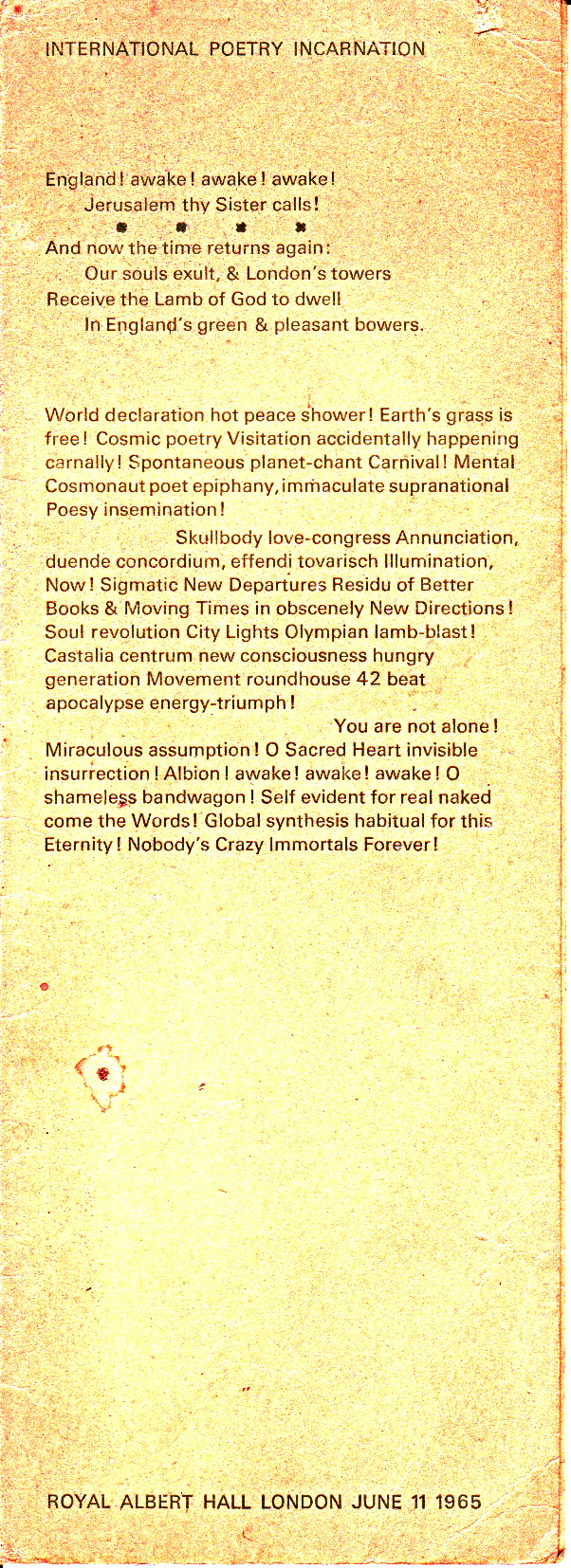
At an important moment in my life, Jerome Rothenberg and his Technicians of the Sacred: A Range of Poetries from Africa, America, Asia, Europe and Oceania appeared on the scene, helping me to understand how much poetry meant to me personally as opposed to what I was doing with it as a flamboyant 25 year old graduate student in Renaissance Studies at Cambridge. It was 1965, the year of the International Poetry Incarnation at the Royal Albert Hall in London, and everything in the world was loosening up just then. European students were getting themselves ready to come out on the streets of Paris in just 3 more years, and the Tibetans, having escaped over the Himalayas in just 1959, were busy learning English and French and, of course, how to talk to people — which they had never done before in our sense. And there was lots going on in America too, needless to say — that’s why some were here!
The International Poetry Incarnation was the moment when the ‘Beats’ descended on London to put Modern American Poetry on the map, as the British critic, Eric Mottram, put it — ‘on the mat’ would better describe what I saw at the time. (You can CLICK HERE to read more about the event including who was there and what they did.) And this certainly fired me up, indeed I’m not sure I ever cooled down what is more got my feet back on the ground. An odd metaphor because although it’s true, my subsequent life as a father, teacher, builder, gardener and blue-water sailor defined me more as a worker than as a dreamer. And I don’t particularly value feet-on-the-ground anyway, unless they’re naturally bare, of course — like ‘good-fella’ feet, I mean, and would you say they were on the ground?
What I liked about Jerome Rothenberg was his way of chanting, winging it, voicing his own verbal rituals and transliterations, and of course his Native American and Oceanic tapes which he played at the Polytechnic of Central London. That was one of the new Technical Colleges 
~…………….~…………….~…………….~
There’s an aspect to all this that I rarely talk about but need to, it’s so near the roots of my ‘Fig Leaf Trajectories.’ So forgive me if I go back a bit and tell my story all over again on another level.
I came to King’s College, Cambridge, from Yale in 1962 as a 23 year old Kellett Fellow — my thesis topic had already been approved by C.S.Lewis and, after Lewis’ death, was supervised by the distinguished Cambridge Professor of English and WWII Singapore survivor, G.G.Hough, whose life experience had led him to many of the same interests as my own including Edmund Spenser and C.G.Jung. With the latter’s trust and encouragement, my unfinished thesis won a Research Fellowship in 1965, one of the highest honors at Cambridge at the time, and my academic future seemed assured. But I was impatient, on fire almost, and to make a long and foolish story very short, I resigned my Fellowship at Christ’s College, sold my beautiful windmill, and went off to Scotland with my young family by the one hand and my new friend Trungpa by the other. I became a Trustee of the new Samye-Ling Tibetan Centre in Eskdalemuir and at the same time renovated a huge pile of stone called ‘Garwald House’ — to put Trungpa & entourage in (we the family lived in the servants’ quarters). I also took a job teaching the teenage children of Scottish shepherds and mill-workers nothing they wanted to learn — Langholm Academy, 18 miles down the road, the closest job I could find and certainly the most difficult I ever had. (I tried for months not to use ‘the Belt,’ and I failed — from the students’ point of view, of course, they won. And that was also Hugh MacDiarmid’s school!)
But there was one more life-changing twist to this transition. Just before I left Cambridge, the formidable Shakespearean scholar and Mistress of Girton College, M.C.Bradbrook, was charged with the task of examining me and my 400pps thesis orally, which she certainly did. “Too psychological,” she implied — too “Jungian,” “too Buddhist for an English dissertation” quite specifically — indeed, during my ‘Viva’ in her rooms at Girton we talked mainly about my relationship with the Lama Trungpa. (“Why?” was her question over and over again. “How could you?”) And to make a short story even shorter, Polyphonic Narrative in Elizabethan Literature exited with the traditional “M.Litt (Cantab.)” — a grand-sounding degree, certainly, but not the shiny new “PhD” my thesis was registered for, and that I would have very much needed had I gone home to continue the same sort of work in the States.
The disaster sent more than ripples through the graduate student community at Cambridge — everybody else felt their own necks must surely be on the block if mine was. But I was already way up in the hills of Dumfriesshire by the time I heard the news, many miles from the nearest shop by a one track road with sheep lying all over it. And I never went back to Cambridge — which I probably should have, but that’s where I was and still am, never going back anywhere. And today I’m even a bit proud of myself for not having challenged the decision — and I’m sure both the English Faculty and my advisor, Professor Hough, must have been very relieved indeed that I just moved on.
At this point I want to say that I harbor no hard feelings toward M.C.Bradbrook, indeed I think her decision was actually helpful to me as I could never have become the sort of literary scholar the degree was supposed to prepare me for. And I did moon the establishment, which was certainly how my behavior felt to Muriel Bradbrook. Cambridge at the time was a ‘scientific’ university which didn’t teach ‘Modern Poetry’ as an academic subject at all, just Chaucer, Milton, and Wordsworth along with assumptions about Classical Languages and Prosody. Of course there were active poets in Cambridge, many of them, but at Cambridge that’s what you did with your life, not what you ‘read!’ At Cambridge you gossiped about contemporary poets in your ‘rooms’ like T.R.Henn did about W.B.Yeats in his, for example (I was there — crowded, fascinating!), but you didn’t ‘study’ them! And yes, in many ways I still sympathize with that position, and am very glad I was there and not somewhere else.
The fact is that I just didn’t fit in, at least with the establishment I didn’t. But for me Cambridge was the most wonderful place to be just as I was and as it was — not fitting-in was just what I needed. Of course Cambridge has always been one of the great Thinking Places of the world, and I still get fired up just thinking about the profound scholarship combined with quotidian genius-folly of Christopher Smart in the 18th Century, for example, what is more about Samuel Taylor Coleridge in the 19th (he quit twice!) or Ludwig Wittgenstein in the 20th (say no more!). In my own time E.M.Forster ate at the high table at King’s every evening, Thom Gunn was still a phantom presence, and F.R.Leavis talked about everything you’re not supposed to.
In some ways I was over-the-top too, of course I was, but I know I was also appreciated for my energy, resourcefulness, and courage — I was often asked to head this or that, for example, local community-boards, societies. But I was also considered disrespectful by some, a little dangerous even, and I was certainly not the only one who got dished. Any day, rain or shine, you could see what appeared to be a tramp on an old bicycle with a torn gown, disheveled hair, and wild, wild eyes with his basket stuffed with books and his paper-bag lunch. He often talked informally while eating his lunch in a drafty courtyard at Downing College  with anyone interested, and there were many outliers there beside me. Because that was F.R.Leavis himself, one of the greatest 20th Century English Literary Critics, still there and still on fire in words not just about D.H.Lawrence but about “Tom” (T.S. Eliot) as well. In many ways his renegade status as an Engaged Critic suited him even better than a Chair would have. He felt good in his own skin like that — more an outcast Prophet than a Professor. ………………………… [Photo: Stefan Collini on F.R.Leavis, TLS, Sept. 2000]
Another inspiration at the time was the newly arrived polyglot American, George Steiner. He was even more threatening as he ‘read’ not just ‘English’ but all the European languages (‘read’ is what you did at Cambridge as no Lectures or Course Work were required for a graduate degree at the time). George Steiner was not invited to become a University Lecturer — but don’t worry, he lectured still but unofficially, with people sitting in the aisles and on the window sills, just to get an ear in! Although he was Senior Tutor at the new Churchill College (I ‘tutored’ his undergraduates in Shakespeare), his association with me made the C.U. Faculty of English worry even more about what they were going to do with Christopher Woodman. And I solved that for them by just doing it myself, absconding with the Tibetans!
I just want to add that it’s a mystery to me why I was so good at Literary Criticism in the first place, and why I won all those prizes. Because I wasn’t cut out to be an Academic — Polyphonic Narrative in Elizabethan Literature was beautiful scholarship but at the same time a touchy-feely pot-boiler just waiting to be satirized by Vladimir Nabokov. For I was as much into Jerome Rothenberg as Edmund Spenser, and most of all bringing up children, building the most beautiful tree-houses in the world for them and then steadfastly sailing away with everybody on board. Indeed, after ‘going down’ from Cambridge in 1969 I eventually became the person you see in the photo. It’s 1980, I think, in the Windward Islands somewhere, possibly even Jean Rhys’ Dominica, and I’m all of 40 already — another decade to go before I would write the first (i.e. last) poem in this book just below.
All I know that’s important is laid out in FIG LEAF SUTRAS — “the radiant cruelty of what is,” as James Agee put it in Let Us Now Praise Famous Men (cited on the title page). The book moves backwards in time, starting as it does in Chiang Mai and reversing its way through three decades of basements, boats, broken hearts, temples, revelations and scribblings to where I am now, just Lung Kip. That’s what I’m called here in Chiang Mai, “the old guy who is older than your father.”
James Agee was dead at 45 — this book is about what there is to add after you’re 70.
Trust in water
words white
and buoyant like
an iron hospice bed
and do not fear
to live or hope
beyond the soft
morning light
or soft voices
of the children
in the park.
These are the very last words in FIG LEAF SUTRAS: A Memoir in Poems, 1995-2025, though chronologically they are the youngest. They first began to compose themselves very near the beginning in a basement in Carroll Gardens, Brooklyn (“basement” is a recurring image in the book). The fact that FIG LEAF SUTRAS is a young man’s book written by a much older man may be one of it’s most positive characteristics — that such poetry can mature even as fresh wine does in an aging dark cellar.
Like blessings, Christopher
…………….
 .
.……..+………+………+………+………+………+………+…….
[There are no ‘Major Threads’ devoted to my 3rd book, FIG LEAF SUTRAS, as the poems for it were collected after I stopped writing-about-writing in this Blog. In a sense it is itself about writing-about-writing from beginning to end, which is why this Preface is so autobiographical.
[If you haven’t yet seen it you should have a look at THE HARD PART FIRST which digs a bit more deeply around the Roots of the Tree in the present thread.]
[You can also go on to the 2nd Preface, On Living with GALILEO’S SECRET, or choose another Thread from the ***MAJOR THREADS*** listed in the left hand margin.]
 (AP Photo/Noah Berger – Las Vegas, Sept.9th, 2020)